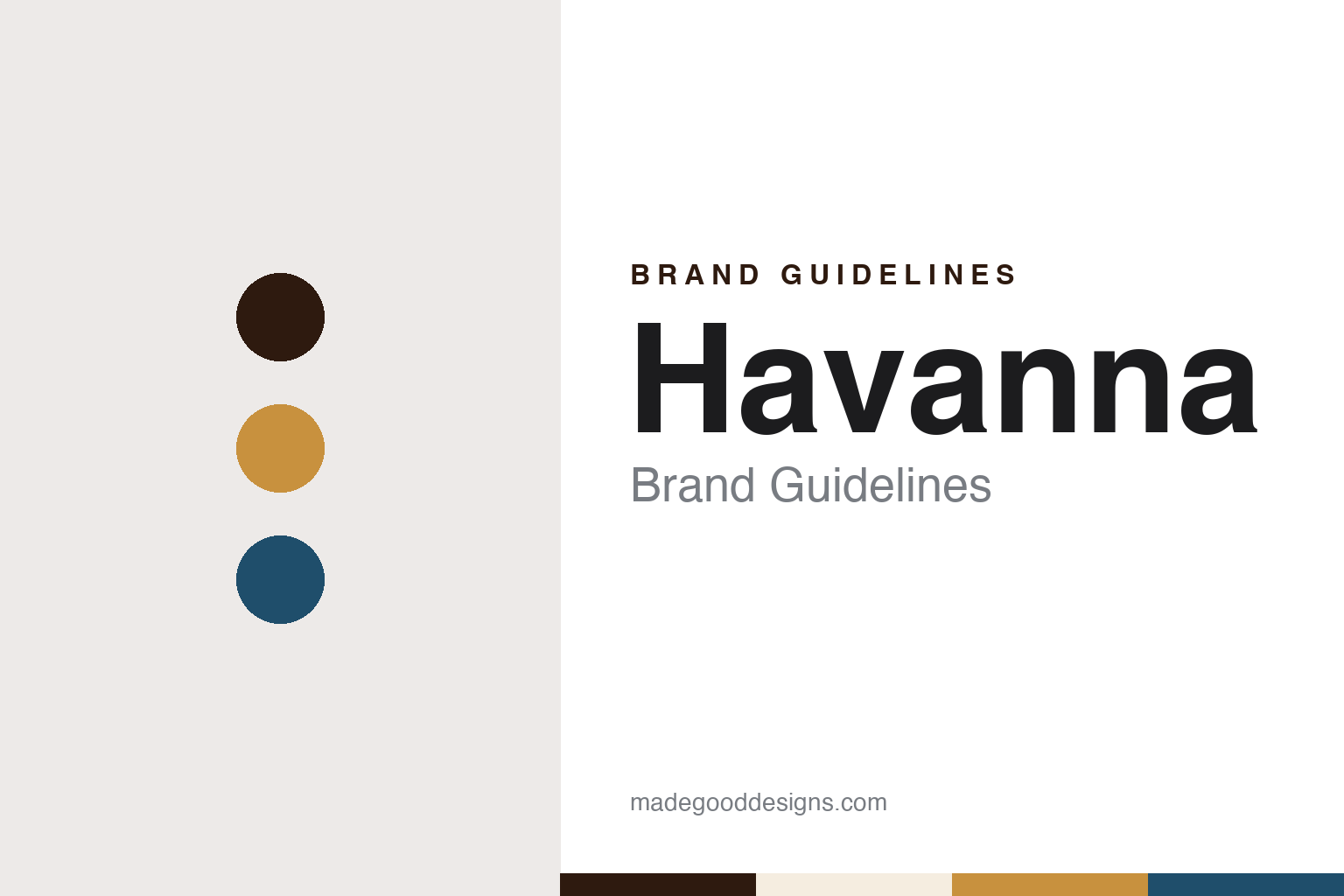
Havanna Brand Guidelines
The Mar del Plata alfajor that became a café chain.
Aa
Two constants: a bitter cocoa, dulce de leche and Atlantic blue palette and a classic display serif register. Abstract homage — not a Havanna product or mark; no box, logo or alfajor is reproduced.
A confitería by the casino
Three partners, a refurbished café and a seaside souvenir.
Havanna was born in Mar del Plata, the Atlantic resort city in Buenos Aires province. Spanish Wikipedia names its founders as Benjamín Sisterna, Demetrio Elíades and Luis Sbaraglini, and says the partners had earlier made alfajores under the name Santa Mónica. Elíades owned the Confitería Havanna, a café in the centre of the city, and it was that name, rather than the earlier one, that went onto the new alfajores.
English Wikipedia, citing the Mar del Plata newspaper La Capital in 2020, says “Alfajores Havanna” was registered in 1947 and operated in the former café, which was completely refurbished and turned into a factory; the first products were sold in January 1948. Spanish Wikipedia accordingly gives 1947 in its text and 1948 in its summary box. The company’s own history puts the opening of its factory and shop on 6 January 1948, at the corner of Buenos Aires and Rivadavia streets, opposite the city’s Central Casino. The company says production was visible to customers, that it started with two workers, a master confectioner and a helper, and that the founders themselves helped to sell and pack.
The name is a homage to the Cuban capital, but the double “n” has never been fully explained: La Nación wrote in 2000 that the reason for the spelling was still unclear, English Wikipedia notes. Spanish Wikipedia says the form matches the German spelling of Havana.
Spanish Wikipedia says Havanna’s chocolate alfajores became an iconic souvenir that tourists took home from the coast, and the company says it spent its first decades growing along the Atlantic seaboard, reaching 50 outlets there by 1994.
Colour
Exxel, DyG and a stock-market listing.
For half a century Havanna was run by its founding partners and their circle. That changed in 1998, when the business was sold to the Exxel Group, the Argentine private-equity firm, Spanish Wikipedia says, citing La Nación, which reported the deal in December 1997. At the time of the sale, according to that report, Havanna made 5.5 million dozen alfajores a year in two factories and had 130 points of sale.
Exxel’s ownership coincided with Argentina’s 2001 economic crisis, and Spanish Wikipedia says the company built up heavy debts. In 2003 Exxel sold Havanna to a group of private investors known as the Grupo de Desarrollo y Gestión (DyG), English Wikipedia says, citing El Cronista in 2006; Spanish Wikipedia, citing Clarín and El Cronista in 2003, names its members as Guillermo Stanley, Carlos Giovanelli, Christian Colombo and Damián Pozzoli.
Under DyG the brand became as much a café as a confectioner. The company dates its “Cafetería Havanna” concept to the period from 1995, aimed at Argentina’s main tourist centres, and says that from 2003 the format spread to Paraguay, Chile, Bolivia, Brazil, Peru, Costa Rica, Venezuela and Spain, with more than 60 Havanna cafés abroad. Spanish Wikipedia says the cafés serve gourmet coffee alongside the alfajores, and by late 2016 Havanna had about 200 franchised stores in Argentina alone, La Capital reported. In the same period the menu widened: the company lists frappés and lattes in 2008 and 2009, a Mini line in 2012 and a 70% cacao alfajor, next to the Havannets, cookies and dulce de leche.
On 9 June 2016 the company began trading on the Bolsa de Comercio de Buenos Aires for the first time, under the ticker HAVA, Spanish Wikipedia says, citing the magazine Fortuna. The listed company is Havanna Holding S.A., English Wikipedia says.
Typography
Design and documentation.
The seven brands in this group all make food or drink, and they come from four South American countries — Argentina, Chile, Peru and Colombia: Arcor, Bagley, Havanna, Carozzi, Costa, Inca Kola and Colombina. South American food and drink brands in general sit at many different points in the trade, from family firms that still carry a founder’s surname to names that now belong to much larger food groups, and a single brand can be sold everywhere from a corner shop to a supermarket shelf.
A food or drink brand’s identity is usually carried less by a single product than by a pack, a name and the treat or staple it promises, because the company behind the name may have changed hands, moved its factory or grown far beyond the town where it started. That makes the questions behind each name worth asking plainly: who started it, who owns it now, and where its products are actually made and packed.
Each guide separates what independent sources record from what the company says about itself — its founding story, its owners over time, where its products are made and how its packaging has changed — and marks plainly what rests only on the company’s own word.
Aa
A classic display serif for a seaside confitería brand. (Specimen set in Playfair Display, a serif STAND-IN; NOT the Havanna logo.)
Havanna
Still made near Mar del Plata, with chocolate from Bariloche.
Havanna has kept its production close to where it began. Spanish Wikipedia, citing the photo archive of La Capital, describes the company’s classic Mar del Plata factory as dating from 1958. In December 2016 the company opened a new plant in the Parque Industrial de Batán, just outside Mar del Plata; La Capital reported that the site covered 55,000 square metres and was expected to raise production by about half, English Wikipedia says.
Its chocolate has a second home in Patagonia. The company says that in 2003 it acquired its own chocolate factory in San Carlos de Bariloche, the lakeside town in Río Negro province that is Argentina’s best-known chocolate destination. Havanna’s products are exported well beyond the cafés: Spanish Wikipedia lists Bolivia, Brazil, Chile, Costa Rica, Ecuador, the United States, Mexico, Paraguay, Peru, Venezuela, Spain, France and Switzerland among its markets.
The company says a 2017 rebrand modernised its packaging and logos. The palette in this guide is our own interpretation, drawn from cocoa, dulce de leche and the Atlantic coast where the brand began.
The company’s own timeline traces its growth in stages: first along the Atlantic coast, where it says it had 50 outlets by 1994; then, from 1995, cafés in Argentina’s main tourist centres; and from 2003 cafés in neighbouring countries and Spain. Over the same years its ownership moved from the founding partners to the Exxel Group in 1998, to the DyG investors in 2003, and in 2016 onto the Buenos Aires stock exchange.
For a design guide, Havanna shows how a seaside souvenir, a café and an unusual spelling can carry one brand from a single confitería to a listed company. Compare Arcor, the Argentine confectionery group, and Cacau Show, the Brazilian chocolate chain built on its own shops. For this guide we use bitter cocoa, a dulce de leche gold and an Atlantic blue with a serif, an unofficial interpretation; no product or logo is reproduced.
Explore & save
Keep Havanna’s identity on hand — save it to a board in the Made Good inspiration library.
Havanna identity set
Pin the Havanna bitter cocoa, dulce de leche and Atlantic blue palette and the classic display serif register to your own board.