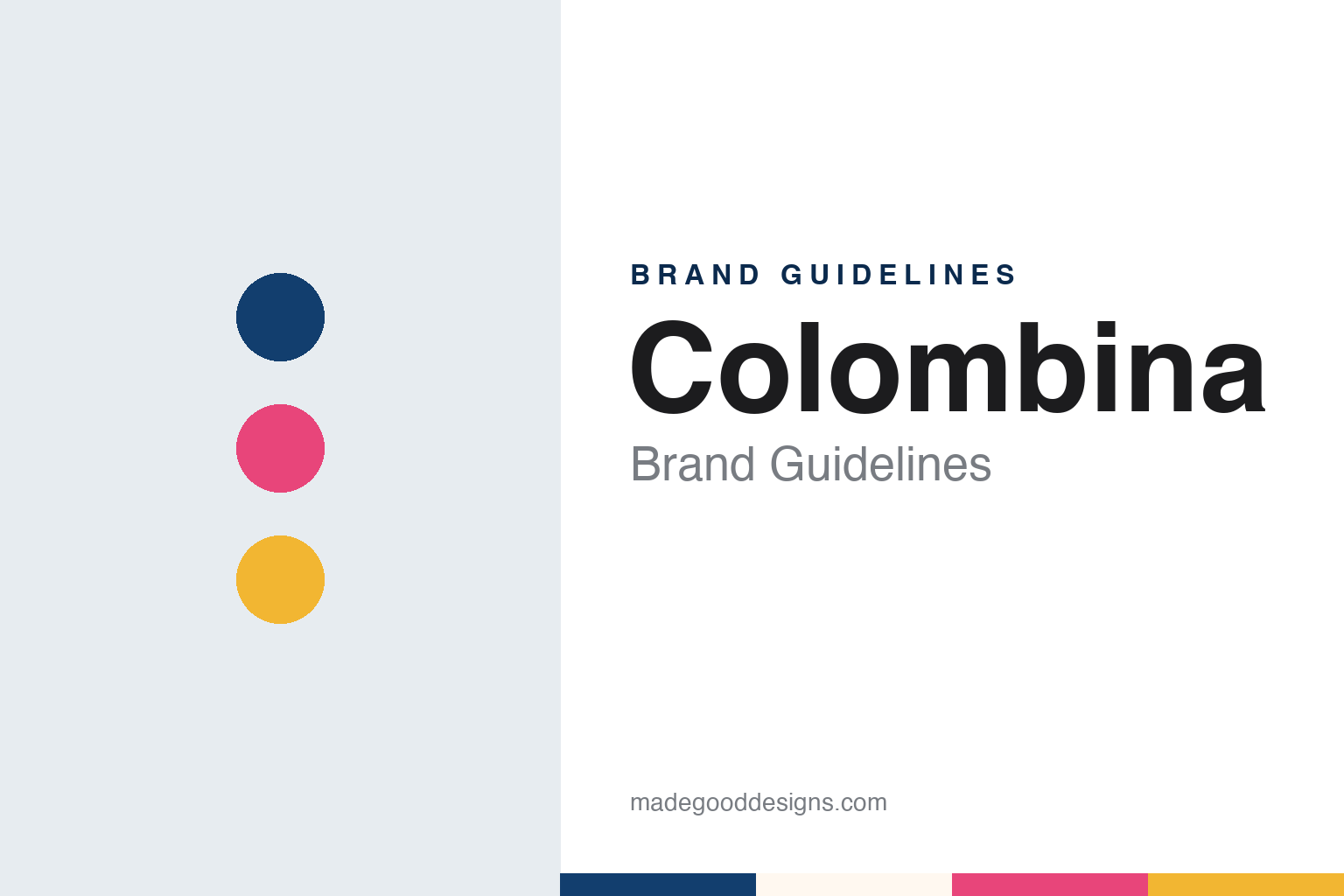
Colombina Brand Guidelines
The Valle del Cauca sweet maker behind Bon Bon Bum.
Aa
Two constants: a Valle blue, lollipop pink and cane gold palette and a rounded confectioner’s sans register. Abstract homage — not a Colombina product or mark; no pack, logo or sweet is reproduced.
Sugar into sweets
A cane mill, a new company and a name.
Colombina began with sugar. The company says its founder, Hernando Caicedo, a businessman from Colombia’s Valle del Cauca, started milling sugar cane for panela in 1918 and built that small holding up into a sugar mill, the Ingenio Riopaila. In 1927, it says, he saw a chance to add value to the sugar he produced and set up a new company to turn it into sweets: Colombina S.A. Spanish Wikipedia also gives 1927 as the founding year and names Caicedo as founder, and Forbes Colombia reported in 2022 that his grandson, the company’s president, dates the firm to the same year.
Spanish Wikipedia says the company was founded in Cali, which is still its head office. A 2019 brand feature in Cali’s newspaper El País says Caicedo opened his first confectionery works in the city’s old San Nicolás district and at La Paila, in the municipality of Zarzal, and that the company still keeps both sites. The company’s own timeline places the building of its La Paila plant in the 1960s, when exports began to grow.
Two stories are told about the name. The same El País feature says the people of old Cali used to call sweets of this kind “colombinas,” and that the word became the brand. A commercial feature in El Tiempo, cited by Spanish Wikipedia, instead traces it to an Italian opera whose heroine swung on a crescent moon while two characters sang to her, and says that figure inspired Caicedo. The company says that by 1935 its sweets in tropical-fruit flavours had become popularly known as “Colombinas.”
The founder’s son, Jaime Hernando Caicedo, took over the running of the company in 1946, according to its timeline. In the 1960s, the company says, it adopted European techniques to make fillings and jams from the region’s own fruit in place of artificial flavourings, and began exporting to the United States.
Colour
A gum-filled lollipop and a wider pantry.
The product that defines Colombina abroad is Bon Bon Bum, a lollipop with a chewing-gum centre. In October 2020 the news magazine Semana reported that the company was celebrating the lollipop’s 50th anniversary, dating it to 1970, and that it sold more than two billion units a year in some 90 countries. The company describes it as the first gum-filled lollipop on the market and says it tripled Colombina’s sales within a year of its launch; those are the company’s own claims. The business daily La República reported that the La Paila plant produces eight million Bon Bon Bum a day, according to a headline cited by Spanish Wikipedia, and Forbes Colombia reported in 2022 that the lollipop had won a listing with Walmart in the United States.
The same decade, the company says, brought the coffee sweet Coffee Delight and Nucita, a two-colour chocolate spread. Later product lines took Colombina well beyond confectionery. Its timeline records an alliance in the 1980s with Seatech International to distribute Van Camp’s tuna and sardines in Colombia, and the purchase of Splendid, which took it into biscuits, together with a biscuit and cake factory in the Cauca department. In the 1990s it took full ownership of La Constancia, its sauces and conserves brand.
From 2001 the company has distributed Café Buendía through an alliance with Colombia’s National Federation of Coffee Growers, it says. It entered ice cream by buying Inalac, maker of Helados LIS, in 2004 and Helados Robin Hood in 2006; launched the Crakeñas crackers in 2007; and bought C.I. Comexa, maker of the Amazon sauces and hot sauces, in 2013. In 2015 it introduced Colombina 100%, a range it describes as free of artificial colours and flavourings. The brand line on its website is “El sabor es infinito” — “flavour is infinite.”
Typography
Design and documentation.
The seven brands in this group all make food or drink, and they come from four South American countries — Argentina, Chile, Peru and Colombia: Arcor, Bagley, Havanna, Carozzi, Costa, Inca Kola and Colombina. South American food and drink brands in general sit at many different points in the trade, from family firms that still carry a founder’s surname to names that now belong to much larger food groups, and a single brand can be sold everywhere from a corner shop to a supermarket shelf.
A food or drink brand’s identity is usually carried less by a single product than by a pack, a name and the treat or staple it promises, because the company behind the name may have changed hands, moved its factory or grown far beyond the town where it started. That makes the questions behind each name worth asking plainly: who started it, who owns it now, and where its products are actually made and packed.
Each guide separates what independent sources record from what the company says about itself — its founding story, its owners over time, where its products are made and how its packaging has changed — and marks plainly what rests only on the company’s own word.
Aa
A rounded confectioner’s sans for a lollipop maker. (Specimen set in Fredoka, a sans STAND-IN; NOT the Colombina logo.)
Colombina
A family company with plants on two continents.
Colombina has stayed under the Caicedo family’s leadership across three generations. César A. Caicedo Jaramillo, the founder’s grandson, became executive president in 2002, the company says; Forbes Colombia described him in 2022 as having led the business for two decades from Cali. Colombina S.A. is listed on the Colombian stock exchange, Spanish Wikipedia says.
Most of its food is made in Colombia. The company lists seven production plants. The largest is the confectionery plant at La Paila–Zarzal in the Valle del Cauca, which it calls the biggest in Colombia and where it makes sweets, marshmallows, gums, chewing gum, chocolate and snacks; Forbes Colombia also described it in 2022 as the country’s largest confectionery plant. Biscuits, wafers and cakes come from Santander de Quilichao in Cauca; sauces, conserves and milk desserts from Tuluá; and ice cream from plants in Itagüí and Bogotá. Outside Colombia it has made sweets, biscuits and cakes at Escuintla, Guatemala, since 2001, and in 2016 it bought the assets of the Spanish confectioner Fiesta, whose factory at Alcalá de Henares supplies Europe, Africa and the Middle East, the company says.
Its reach abroad has grown through its own subsidiaries. Forbes Colombia reported direct operations in 14 markets in 2022, including an office in Miami for the United States; the company says it added Bolivia and the United Arab Emirates in 2025, bringing it to 16 countries with operations of its own.
For a design guide, Colombina shows how a sugar mill’s sideline grew into a food company whose best-known product is still a lollipop. Compare Arcor, the Argentine confectioner, and Cacao Hunters, a Colombian chocolate maker. For this guide we use a Valle blue, a lollipop pink and a cane gold with a rounded sans, an unofficial interpretation; no product or logo is reproduced.
Explore & save
Keep Colombina’s identity on hand — save it to a board in the Made Good inspiration library.
Colombina identity set
Pin the Colombina Valle blue, lollipop pink and cane gold palette and the rounded confectioner’s sans register to your own board.