Skinos Brand Guidelines
The Athens mastiha spirit in a white bottle with a round window.
Aa
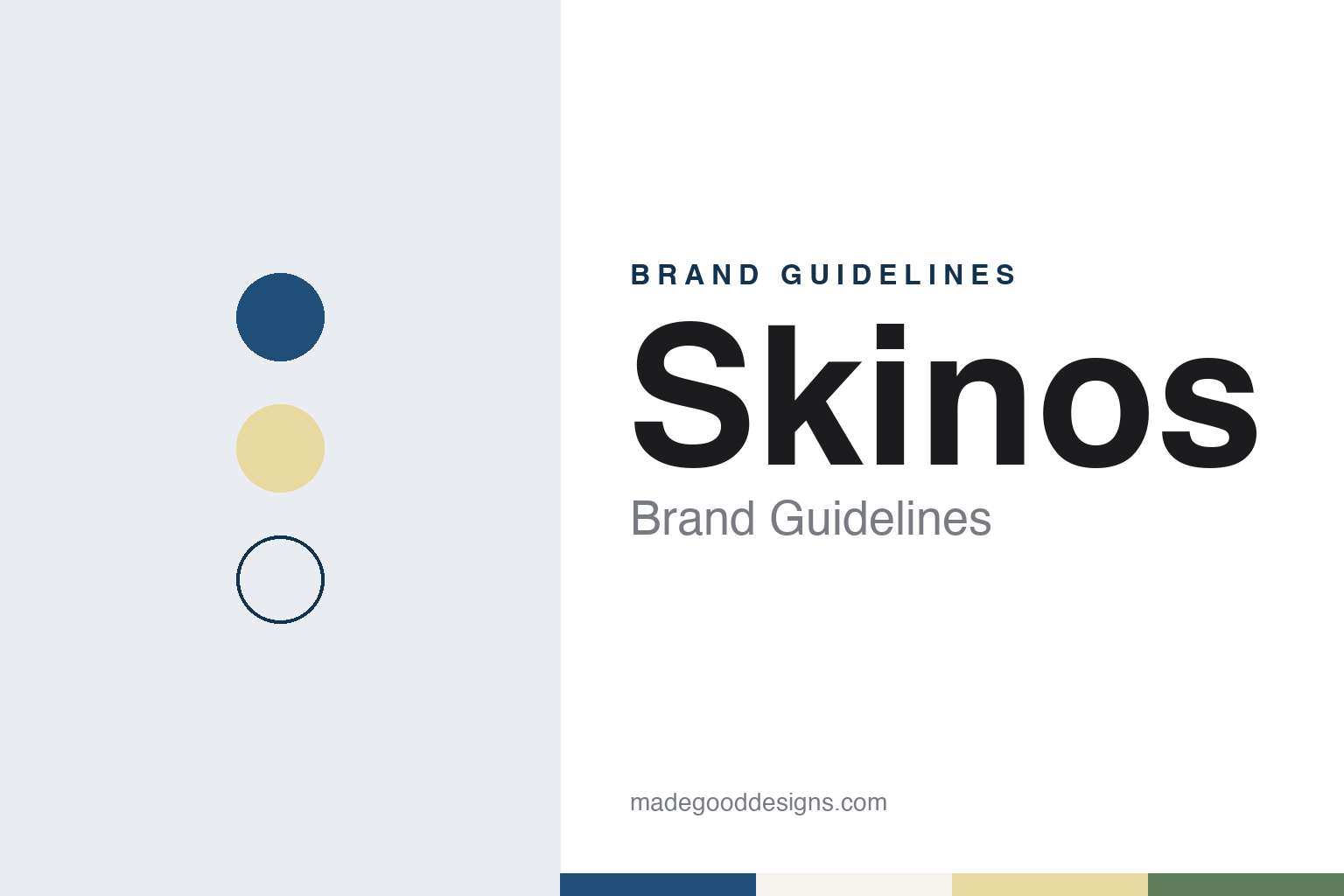
Two constants: an Aegean blue, resin tear and whitewash palette and a geometric sans register. Abstract homage — not a Skinos product or mark; no label, logo or bottle is reproduced.
A resin from one island
The mastic tree of Chios, its old Greek name and a spirit built on both.
Skinos is a Greek spirit built on a single ingredient: mastiha, the resin of the mastic tree, Pistacia lentiscus. The brand’s own site describes mastiha as a resin produced in “tears” only on the island of Chios in the northern Aegean, and the name of the spirit comes from the tree itself. DS Concepts, the company behind the brand, says that on Chios the mastiha tree is known by the name skinos.
The resin has a long and well-documented place on the island. English Wikipedia says Chios mastic is protected by a European Union protected designation of origin, that the Chios Gum Mastic Growers Association was founded in 1938, and that as of 2024 there were twenty-four mastichochoria, or mastic villages, on Chios. In 2014 UNESCO added the “know-how of cultivating mastic on the island of Chios” to its Representative List of the Intangible Cultural Heritage of Humanity, describing a family occupation in which an incision is made in the bark and branches from July onwards.
The brand itself is much younger. The drinks magazine Punch reported in June 2015 that Skinos was founded in 2001 by Demetre Steinhauer, managing partner of the Greek company Concepts Ltd, and called the brand Athens-based. According to Punch, the spirit was first meant mainly for export, but it found an unexpected following in Greece’s own cocktail bars. The brand’s website, myskinos.com, appears in the Internet Archive from April 2008, and news posted there in 2011 describes Steinhauer as the founder of Skinos.
Colour
A distillate of resin, a white bottle and a summer story.
Skinos explains its method on its own site. The company says the resin is harvested on Chios in June and July through a series of “prickings,” and that the hardened tears, which take ten to twenty days to set, are taken to a cool warehouse where village women sort and clean them by hand. Mastiha is then mixed with alcohol and heated in bronze alembics, the company says, and the resulting extract is blended with sugar, alcohol and mineral water to make a clear, lightly sweet spirit. Skinos lists it at 30% alcohol by volume, with Chios mastiha extract among its contents. English Wikipedia lists Skinos, under Athens, among the mastiha liqueurs made in Greece beyond Chios.
The bottle carries most of the identity. The company describes a “very distinct” white glass bottle with raised white lines and a round window through which the spirit catches the light, and says it is filled in Italian glass with a cork closure. Limited editions have redrawn that bottle almost every summer. Skinos says its 2014 “Greek Islands” edition, of 6,000 bottles, was designed by the contemporary designer Stathis Brouzos; its 2015 edition borrowed the geometric façades of the historic village of Pyrgi on Chios; and later editions were dedicated to Mykonos (2016), the sea (“Thalassa,” 2017), the Greek coastline seen from above (2018), “Summer Colours” (2019) and Poseidon’s “Divine Summer” (2021).
The words around the bottle stay on one theme. The current site, designed by the agency Interweave, builds the brand around the “Greek Summer Spirit,” with lines such as “Greek Up Your World” and an “Island of Truth” campaign of white surfaces, Aegean blue and summer light. Cocktails carry much of that message: the brand’s recipes include the Skinos Lemonada, the Skinos Mandarin, a Mediterranean Negroni and a Santorini Mule. In 2011 the brand ran its first Mediterranean Cocktails Challenge for bartenders, with a final at a bar in Athens on 7 June that year, the brand’s site reported at the time, and the winner was sent to the Tales of the Cocktail festival in New Orleans.
Typography
Design and documentation.
The seven brands in this group are all Greek wine houses and spirits: Boutari, Kourtakis, Tsantali, Kir-Yianni, Plomari, Tsilili and Skinos. Wine and spirits brands in general sit at many different points in the trade, from family houses that still carry a founder’s name to labels that now belong to much larger drinks groups, and a single brand can be sold everywhere from a corner shop to a restaurant list.
A wine or spirits brand’s identity is usually carried less by a single bottle than by a label, a name and the place it promises, because the company behind the name may have changed hands, moved its production or grown far beyond the place where it started. That makes the questions behind each name worth asking plainly: who started it, who owns it now, and where its wine or spirit is actually made and bottled.
Each guide separates what independent sources record from what the company says about itself — its founding story, its owners over time, where its wine or spirit is made and how its labels have changed — and marks plainly what rests only on the company’s own word.
Aa
A clean geometric sans for a white bottle and an Aegean summer. (Specimen set in Jost, a sans STAND-IN; NOT the Skinos logo.)
Skinos
From a Greek trading company to DS Concepts, and out to export markets.
Skinos belongs today to DS Concepts Ltd, which describes itself with the line “Spirited in Greece” and names Skinos on its brand pages. The company says it was created to build brands that would carry “the unique Greek way of living” to the world, and that what began as a small project grew larger than its founders expected. It also runs a “Lab” that invites beverage ideas rooted in Greece or the Mediterranean, offering to help them from concept to launch. A Canadian retail listing for Skinos, carrying the producer’s own text, describes the parent business, Concepts S.A., as a trade and marketing company established in 2001. The brand’s current site gives a contact address in Cyprus.
Exports came early. The brand’s own news page reported in 2011 that Skinos had been introduced in the United States in October 2010, and the trade title Massachusetts Beverage Business listed the Greek mastiha liqueur that same month. The same 2011 page said that DEM Global Brands had become its exclusive importer in Turkey after a launch in travel-retail shops, and the current site lists markets across Europe, North America, the Middle East and Asia, from the United Kingdom and Germany to Israel, Japan and Hong Kong.
Two search traps are worth knowing. The domain skinos.com has no link to the spirit — archived versions show it parked and later used by an unrelated skincare site — and the brand lives at myskinos.com. Skinos is also one mastiha spirit among many: the Chios Gum Mastic Growers Association sells its own liqueurs through The Growers’ Spirit, and brands such as KLEOS and Roots use the same resin.
For a design guide, Skinos shows how a young spirit can take an ancient island ingredient and sell it through a single object — a white bottle with a window — and a mood of Greek summer rather than a founding date. Compare Ouzo 12, the ouzo named after its twelfth barrel, and Metaxa, the Piraeus spirit with an amphora bottle. For this guide we use Aegean blue, resin tear and whitewash with a geometric sans, an unofficial interpretation; no product or logo is reproduced.
Explore & save
Keep Skinos’s identity on hand — save it to a board in the Made Good inspiration library.
Skinos identity set
Pin the Skinos Aegean blue, resin tear and whitewash palette and the geometric sans register to your own board.