Fontanafredda Brand Guidelines
The royal estate in Serralunga d’Alba, founded 1878.
Aa
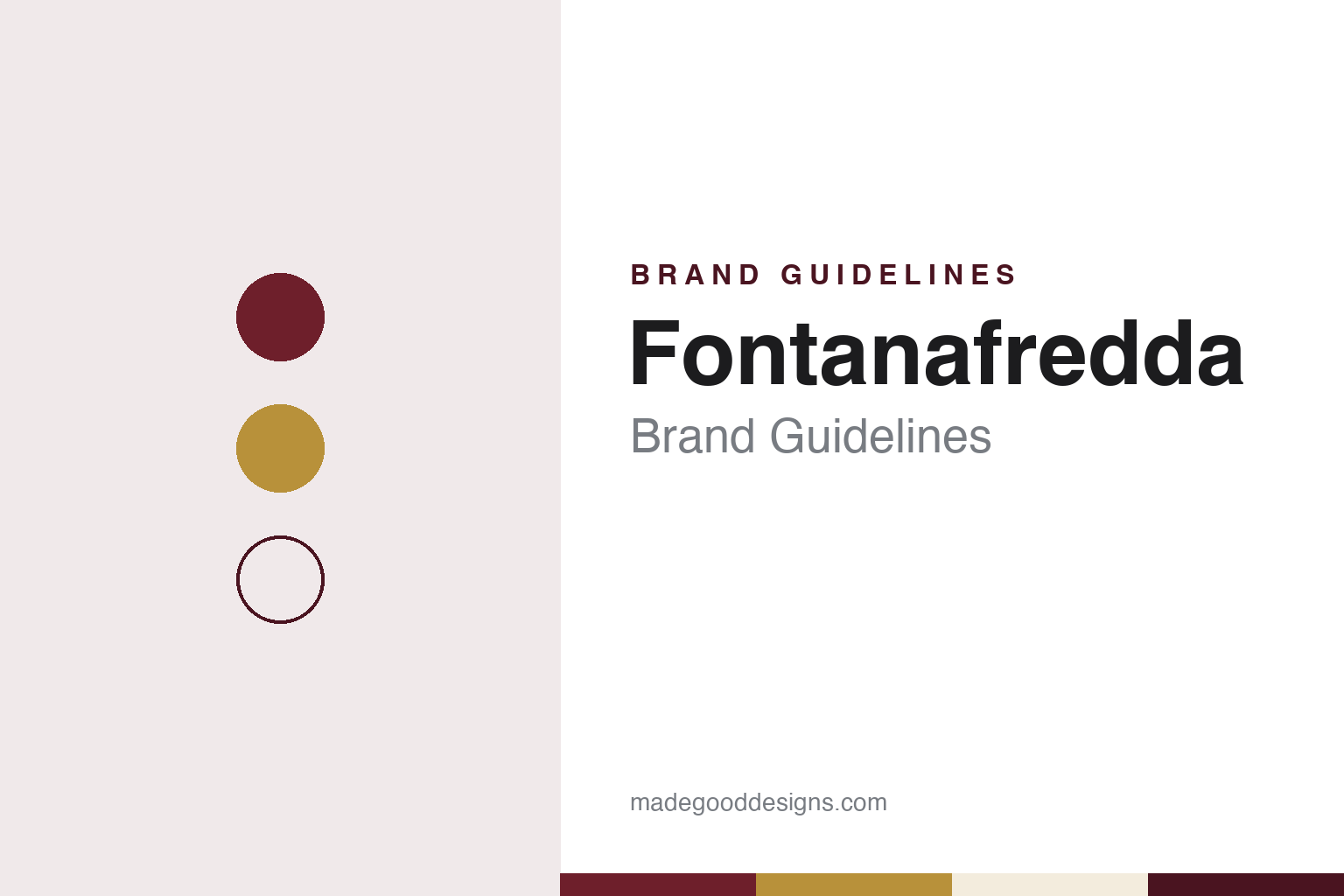
Two constants: a Barolo red, Langhe gold and cellar cream palette and a classical serif register. Abstract homage — not a Fontanafredda product or mark; no label, logo or bottle is reproduced.
A royal estate
A king’s purchase, and a count’s winery.
Fontanafredda is a wine estate at Serralunga d’Alba, in the Langhe hills of Piedmont, and its story begins in a royal household. The company says King Vittorio Emanuele II bought the property in 1858 for Rosa Vercellana, known as “la Bella Rosina,” and that it was later registered in the names of their children. English Wikipedia records that the king made Rosa Countess of Mirafiori and Fontanafredda by royal decree in 1858, married her in a religious ceremony in 1869 and in a civil, morganatic ceremony in Rome in 1877. Wine Spectator described the king’s original purchase, in 2008, as a country and hunting retreat.
Wine came quickly. The company dates its first vineyard in Barolo to 1866, says the words “Tenimenti di Barolo e Fontanafredda” appeared on its first bottles, and dates the first wines made in the estate cellars to 1870. It credits the founding of the winegrowing business in 1878 to the couple’s son, Emanuele Alberto Guerrieri, Count of Mirafiori, who it says cultivated more than 300 hectares with paid staff and built a village of farmhouses, cellars, stables and a church around the winery. The company also says the first concrete wine vats in Europe were installed in its cellars in 1887, and that by 1918 the estate employed 200 people, with more than 40 families living on it.
The name needs a little care online. Fontanafredda is also a town of about 12,000 people in the province of Pordenone, in Friuli-Venezia Giulia, at the other end of northern Italy, with its own football club. The winery is in Piedmont, and its own site is fontanafredda.it.
Colour
A bank, and then a return to Piedmont.
The count’s line did not keep the estate. The company says phylloxera and the Great Depression forced the sale of the land and cellars to Monte dei Paschi di Siena, the Tuscan bank, in 1931, the year Wine Spectator and WineNews also give, and that the “Casa E. di Mirafiori” label was sold separately to the Gancia family of Canelli. Under the bank the estate kept building its range: the company dates its first Contessa Rosa sparkling wine to 1959, its first certified single-vineyard Barolo, Vigna La Rosa, to 1964, and its first Barolo carrying the name of its commune, Barolo Serralunga, to 1988.
By 2007 the bank was ready to sell. WineNews reported in March 2007 that Monte dei Paschi, which owned all of Fontanafredda, planned to sell it, describing an estate of more than 110 hectares, 80 of them vineyards in the Langhe, making about 6.5 million bottles a year, from Asti Spumante to Barolo, with about half exported. The same report noted talk of interest from Oscar Farinetti, then head of the Eataly food stores.
That talk proved right. Wine Spectator reported on 25 July 2008 that a deal concluded on 30 June had given Farinetti and his partner Luca Baffigo Filangieri 32 per cent each, a combined majority, with the remaining 36 per cent going to the Monte dei Paschi di Siena Foundation. The magazine noted that Farinetti had bought the historic Giacomo Borgogno estate in Barolo six months earlier, and that the general manager, Giovanni Minetti, was staying on, and put the winery’s output at about 540,000 cases a year. The company describes 2008 as the year Fontanafredda became Piedmontese again, after 77 years.
Typography
Design and documentation.
The seven brands in this group are all Italian wine houses from Piedmont, Sicily and Campania: Fontanafredda, Marchesi di Barolo, Planeta, Donnafugata, Feudi di San Gregorio, Mastroberardino and Cusumano. Wine houses in general sit at many different points in the trade, from families that still carry a founder’s name to estates that now belong to investors or larger groups, and a single name can be sold everywhere from a local wine shop to a restaurant list abroad.
A wine house’s identity is usually carried less by a single bottle than by a label, a name and the place it promises, because the company behind the name may have changed hands, bought vineyards far from where it started or added new labels of its own. That makes the questions behind each name worth asking plainly: who started it, who owns it now, and where its grapes are grown and its wine is made and bottled.
Each guide separates what independent sources record from what the company says about itself — its founding story, its owners over time, where its wine is made and how its labels have changed — and marks plainly what rests only on the company’s own word.
Aa
A classical serif for a wine house with royal roots. (Specimen set in Cormorant Garamond, a serif STAND-IN; NOT the Fontanafredda logo.)
Fontanafredda today
Organic vineyards and a storytelling village.
Under its new owners the estate has turned towards its land. The company says the conversion of its vineyards to organic farming began in 2015 and that its first certified organic harvest came in 2018. Il Sole 24 Ore reported in April 2026 that about 120 hectares were being converted, describing the Farinetti family as managing the historic estates and Oscar Farinetti’s son Andrea Farinetti as the family member most closely involved. The same report said the estate now makes about one million bottles of Barolo a year, against 150,000 in 2007, and quoted Andrea Farinetti on a return to single-vineyard Nebbiolo.
The old royal village has become a destination in its own right. The company says its “Storytelling Village,” the Villaggio Narrante, was inaugurated in 2017 and now runs hospitality alongside the cellars, and that in 2024 more than 170 fruit plants were planted among the Serralunga d’Alba vineyards to encourage biodiversity. Wine Spectator in 2008 placed the estate’s vineyards in the communes of Serralunga d’Alba, Barolo and Diano d’Alba. The company trades today as Fontanafredda srl, with its base still in Serralunga d’Alba, where the count’s village of cellars, farmhouses and church stands.
For a design guide, Fontanafredda shows how a royal history — a king, a countess and their son — can stand behind a Piedmont wine name for more than a century and a half, through a bank’s long ownership and back into Piedmontese hands. Compare Marchesi di Barolo, the Abbona family’s winery in the old cellars of the Falletti marquesses, and Antinori, the Florentine wine family. For this guide we use Barolo red, Langhe gold and cellar cream with a serif, an unofficial interpretation; no product or logo is reproduced.
Explore & save
Keep Fontanafredda’s identity on hand — save it to a board in the Made Good inspiration library.
Fontanafredda identity set
Pin the Fontanafredda Barolo red, Langhe gold and cellar cream palette and the classical serif register to your own board.