Marchesi di Barolo Brand Guidelines
The Falletti cellars, run by the Abbona family since 1929.
Aa
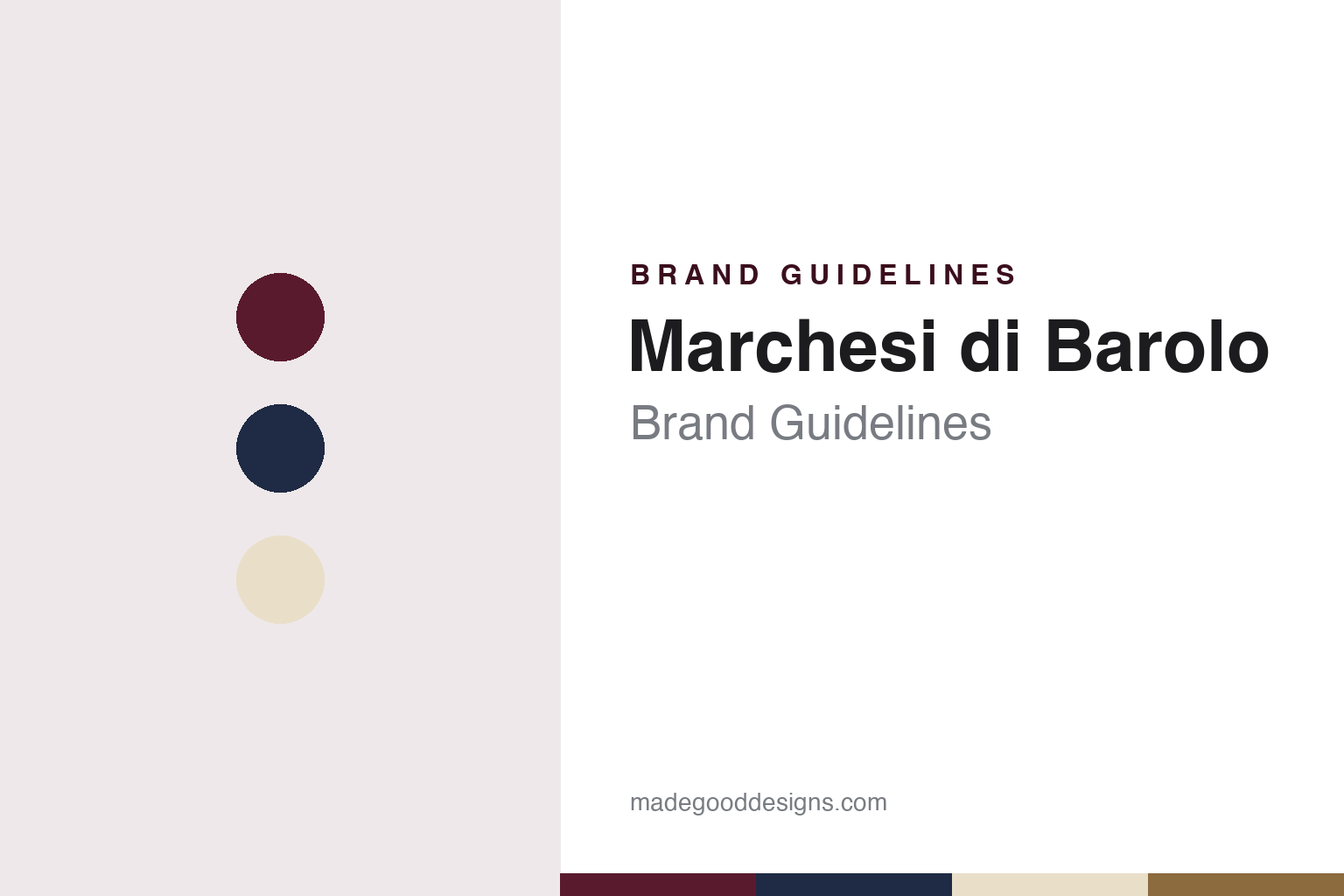
Two constants: a Nebbiolo garnet, marquis navy and parchment palette and an old-style serif register. Abstract homage — not a Marchesi di Barolo product or mark; no label, logo or bottle is reproduced.
The Falletti cellars
A marquis, a marchesa and the cellars of Barolo.
Marchesi di Barolo is a winery in the village of Barolo, in the Langhe hills of Piedmont, and its name points back to the noble family that owned the village’s castle and cellars in the nineteenth century. The marquis Carlo Tancredi Falletti di Barolo married the French noblewoman Juliette Colbert on 18 August 1806, English Wikipedia and the company both say; she took the Italian name Giulia when the couple settled at Palazzo Barolo in Turin in 1814. The company describes her as a great-niece of Louis XIV’s finance minister.
The company credits Giulia with seeing the potential of the Nebbiolo grape on the family’s Barolo estates, and says Barolo wine was first made in its historic cellars. It cites a visit by Giorgio Gallesio on 19 September 1834, when the cellar held 30 casks. English Wikipedia recounts that the couple’s wine was offered to guests and to reigning monarchs rather than sold, and that Giulia sent 325 barrels to King Carlo Alberto by ox-drawn cart after he asked about it.
The couple had no children. Carlo Tancredi died in 1838 and Giulia in Turin in 1864, English Wikipedia records. She founded the charity Opera Pia Barolo and left it her entire fortune, the same article says; the company says her bequest included the Barolo cellars, and Frederick Wildman, the winery’s importer in the United States, describes the charity as created to help the neediest people around Turin. Giulia’s charitable work led to a cause for her beatification, and Pope Francis declared her Venerable in 2015, English Wikipedia notes.
Colour
The Abbona family since 1929.
The winery’s present owners come from a family of local winemakers, the Abbonas. The company says that in 1929 Pietro Abbona, with his brother Ernesto and his sisters Marina and Celestina, took over the old cellars of the marquesses, and that the family moved into the Cascina del Pillone the same year. Frederick Wildman gives the same year and says Pietro later acquired the marquesses’ vineyard holdings as well; a travel page published by IBT Viaggi also states that the winery has belonged to the Abbona family since 1929, and that Pietro bought the “Opera Pia Barolo” estate with its ageing cellars.
The company says that in 1933 King Vittorio Emanuele III allowed Pietro Abbona to display the royal coat of arms as a supplier to the royal household, and that Pietro’s label showed the castles of Barolo and Serralunga. Some of his casks, it says, are still in the cellars. In 1973, at the invitation of the wine writer Gino Veronelli, the cellars began making single-vineyard wines from Cannubi, Coste di Rose and Sarmassa, the company says, and the same three crus head its Barolo range today.
The winery has stayed in the family. Frederick Wildman says the estate has been directed since 2006 by Pietro’s great-grandson Ernesto Abbona with his wife Anna, the fifth generation. Robert Parker Wine Advocate profiled Anna Abbona in March 2018, describing her and Ernesto as leading the estate, their daughter Valentina as promoting the brand around the world after studying international markets, and their son Davide as having recently joined. The company today names all four as running the winery and speaks of six generations of winemaking.
Typography
Design and documentation.
The seven brands in this group are all Italian wine houses from Piedmont, Sicily and Campania: Fontanafredda, Marchesi di Barolo, Planeta, Donnafugata, Feudi di San Gregorio, Mastroberardino and Cusumano. Wine houses in general sit at many different points in the trade, from families that still carry a founder’s name to estates that now belong to investors or larger groups, and a single name can be sold everywhere from a local wine shop to a restaurant list abroad.
A wine house’s identity is usually carried less by a single bottle than by a label, a name and the place it promises, because the company behind the name may have changed hands, bought vineyards far from where it started or added new labels of its own. That makes the questions behind each name worth asking plainly: who started it, who owns it now, and where its grapes are grown and its wine is made and bottled.
Each guide separates what independent sources record from what the company says about itself — its founding story, its owners over time, where its wine is made and how its labels have changed — and marks plainly what rests only on the company’s own word.
Aa
An old-style serif for a winery named after a noble house. (Specimen set in Libre Caslon Text, a serif STAND-IN; NOT the Marchesi di Barolo logo.)
Marchesi di Barolo today
Old casks, and new farms beyond Barolo.
The historic cellars remain the heart of the business. Frederick Wildman describes them as standing in the village of Barolo, overlooking the castle of the Marchesi Falletti. The company says that in 2002 five old oak casks that had belonged to Giulia, which it calls the “Botti della Marchesa,” were restored and returned to use for Barolo, and that it keeps a collection of Barolo riserva going back to vintages of the late nineteenth century. It opened a restaurant, La Foresteria, on the historic premises in 1996.
The family has also spread beyond the village. The company lists vineyards in Barolo, the wider Langhe, the Roero and the Monferrato Nicese, and wines including Barolo, Barbaresco, Barbera, Dolcetto, Arneis and Moscato, grouped into lines it calls Barolo del Comune, I Cru di Barolo and Bric Amel. It says it took over Cascina Bruciata in Barbaresco in 2016, an estate DoctorWine describes as small and bought from Carlo Balbo, and Cascina Colombera in Perno in 2022.
The name needs a little care. “Marchesa di Barolo” is also the title by which Giulia herself is known, and English Wikipedia’s article under that name is about her life and charities rather than the winery; Barolo is also the name of the village and of the wine itself, made by many producers. The winery’s own site is marchesibarolo.com.
For a design guide, Marchesi di Barolo shows how a winery can carry the name of a noble house, and the authority of its cellars, through nearly a century of ownership by a single family of growers. Compare Fontanafredda, the royal estate at Serralunga d’Alba, and Masi, the Boscaini family’s Amarone house in Valpolicella. For this guide we use Nebbiolo garnet, marquis navy and parchment with a serif, an unofficial interpretation; no product or logo is reproduced.
Explore & save
Keep Marchesi di Barolo’s identity on hand — save it to a board in the Made Good inspiration library.
Marchesi di Barolo identity set
Pin the Marchesi di Barolo Nebbiolo garnet, marquis navy and parchment palette and the old-style serif register to your own board.