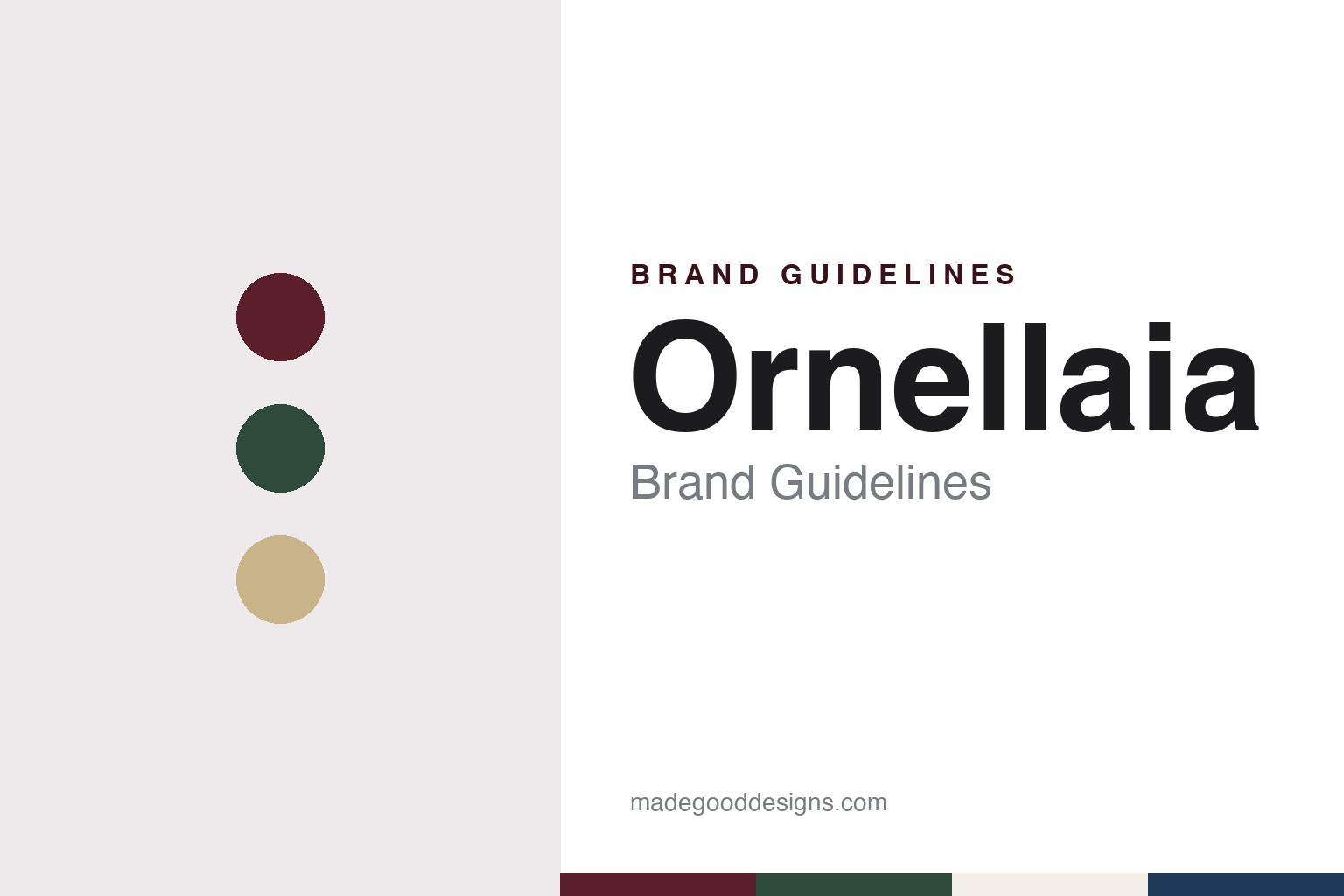
Ornellaia Brand Guidelines
The Bolgheri estate founded in 1981, Frescobaldi-owned since 2005.
Aa
Two constants: a claret, cypress green and Tyrrhenian blue palette and a classical serif register. Abstract homage — not an Ornellaia product or mark; no label, logo or bottle is reproduced.
A coastal estate, 1981
Vines between Bolgheri and the sea.
Ornellaia is both a wine estate and the name of its flagship red. It sits at Bolgheri, on the Tuscan coast: English Wikipedia places it in the Bolgheri DOC, in the northern Maremma between Livorno and the island of Elba, looking out over the Tyrrhenian Sea. The estate dates itself to 1981. It was founded by Marchese Lodovico Antinori, of the Florentine Antinori wine family, working with the winemaker Tibor Gál, Wikipedia says. The vineyards were planted in 1981, the first vintage followed in 1985 and a winery was built in 1987. Ornellaia’s own history names 1985 as the year the wine was launched.
The company describes the estate as stretching between Bolgheri and the coast, on ground once covered by the sea, which left sand, marl and marine fossils, with clay and limestone pebbles higher up; it calls the soils marine, alluvial and volcanic in origin. The vineyard is divided into dozens of small parcels, most of them facing southwest. Wikipedia says the vines lie in two areas separated by Bolgheri’s famous avenue of cypresses, and that the Bellaria vineyards, north of the village, were added later.
The company says Cabernet Sauvignon and Merlot are the main varieties, followed by Cabernet Franc and Petit Verdot, while its white wines draw on Sauvignon Blanc, Petit Manseng, Viognier, Verdicchio and Vermentino. Wikipedia calls the flagship one of Italy’s leading Bordeaux-style red wines and says the French oenologist Michel Rolland has been a consultant since the estate’s beginnings; Axel Heinz was its winemaker until 2023.
Colour
From the Antinori founder to Mondavi and the Frescobaldis.
English Wikipedia, citing reports in Harpers and on JancisRobinson.com in 2002, says the Californian winery Robert Mondavi took a minority stake in November 1999 and had taken over the estate by 2002, in a partnership with the Frescobaldi family, the Florentine wine dynasty. After Constellation Brands acquired the Mondavi holdings, the Frescobaldis bought the remaining shares from Constellation in April 2005 and became sole owners, as Decanter and Wine Spectator both reported that month. Jonathan Nossiter’s documentary Mondovino recorded the Antinori, Frescobaldi and Mondavi families’ differing accounts of the changes, Wikipedia notes.
The estate today says it is owned by the Frescobaldi family. It names Marchese Ferdinando Frescobaldi as President of Ornellaia, leading the estate alongside Marchese Lamberto Frescobaldi, with Marco Balsimelli as Technical Director. In 2012 the company was renamed from Tenuta dell’Ornellaia to Ornellaia e Masseto, Wikipedia says.
The Ornellaia range is built around the flagship Ornellaia, labelled Bolgheri DOC Superiore. Le Serre Nuove dell’Ornellaia, made since 1997, is the estate’s second wine, which the company describes as Italy’s first ever “second vin.” Le Volte dell’Ornellaia, first released in 1991, is a Toscana IGT red, and the list also includes white wines, among them Ornellaia Bianco, as well as grappa and olive oil.
Masseto is the Merlot from a single vineyard on the estate. WineNews reported in January 2019 that the vineyard’s first wine, from 1986, was labelled simply “Merlot,” and that the Masseto name first appeared with the 1987 vintage. Masseto was long made in Ornellaia’s cellar, but it now has a fully underground winery of its own, designed by the studio Zito+Mori beneath the rebuilt Masseto house; the 2018 harvest was the first made there, and the winery was presented on 12 April 2019, WineNews said.
Typography
Design and documentation.
The seven brands in this group are all Italian wine houses and labels: Gaja, Sassicaia, Ornellaia, Tignanello, Allegrini, Zenato and Pio Cesare. Wine houses and labels in general sit at many different points in the trade, from family houses that still carry a founder’s name to labels that belong to a larger wine group or estate, and a single name can be sold everywhere from a wine shop to a restaurant list.
A wine brand’s identity is usually carried less by a single bottle than by a label, a name and the place it promises, because the company behind the name may have changed hands, bought new vineyards or grown far beyond the place where it started. That makes the questions behind each name worth asking plainly: who started it, who owns it now, and where its wine is actually made and bottled.
Each guide separates what independent sources record from what the company says about itself — its founding story, its owners over time, where its wine is made and how its labels have changed — and marks plainly what rests only on the company’s own word.
Aa
A classical serif for an estate name set in capitals. (Specimen set in Cormorant Garamond, a serif STAND-IN; NOT the Ornellaia logo.)
Vendemmia d’Artista
One word, one artist, one vintage.
Ornellaia’s best-known design idea is Vendemmia d’Artista, the “artist’s harvest.” The company says the project began with the 2006 vintage and that each year since, a contemporary artist has been commissioned to create a site-specific work for the estate and a set of limited-edition labels. The starting point is a single word, chosen by the Estate Director to capture the character of the new vintage: the 2006 vintage was L’Esuberanza (exuberance), interpreted by Luigi Ontani, and the 2023 vintage La Vitalità, interpreted by Marina Abramović. Other artists on the company’s list include Rebecca Horn, Zhang Huan, Michelangelo Pistoletto, William Kentridge and Shirin Neshat.
The artwork reaches bottles in two ways. The company says each edition includes 111 numbered large-format bottles signed by the artist — 100 double magnums, ten imperials and one salmanazar — and that since 2012 every case of Ornellaia has carried one bottle with the artist’s label. Since 2009 the proceeds of the project’s charity auctions have gone to art foundations and museums, and since 2019 they have supported accessibility programmes at the Solomon R. Guggenheim Foundation, the company says. In 2017 the estate also opened an Archivio Storico, a historical archive of past vintages.
For a design guide, Ornellaia shows how a young estate can borrow the language of the art world, keeping its own name and label steady while letting a new artist reinterpret each vintage. Compare Sassicaia, the Bolgheri red of Tenuta San Guido, and Laudemio Frescobaldi, the olive oil of the family that owns Ornellaia. For this guide we use claret, cypress green and Tyrrhenian blue with a serif, an unofficial interpretation; no product or logo is reproduced.
Explore & save
Keep Ornellaia’s identity on hand — save it to a board in the Made Good inspiration library.
Ornellaia identity set
Pin the Ornellaia claret, cypress green and Tyrrhenian blue palette and the classical serif register to your own board.