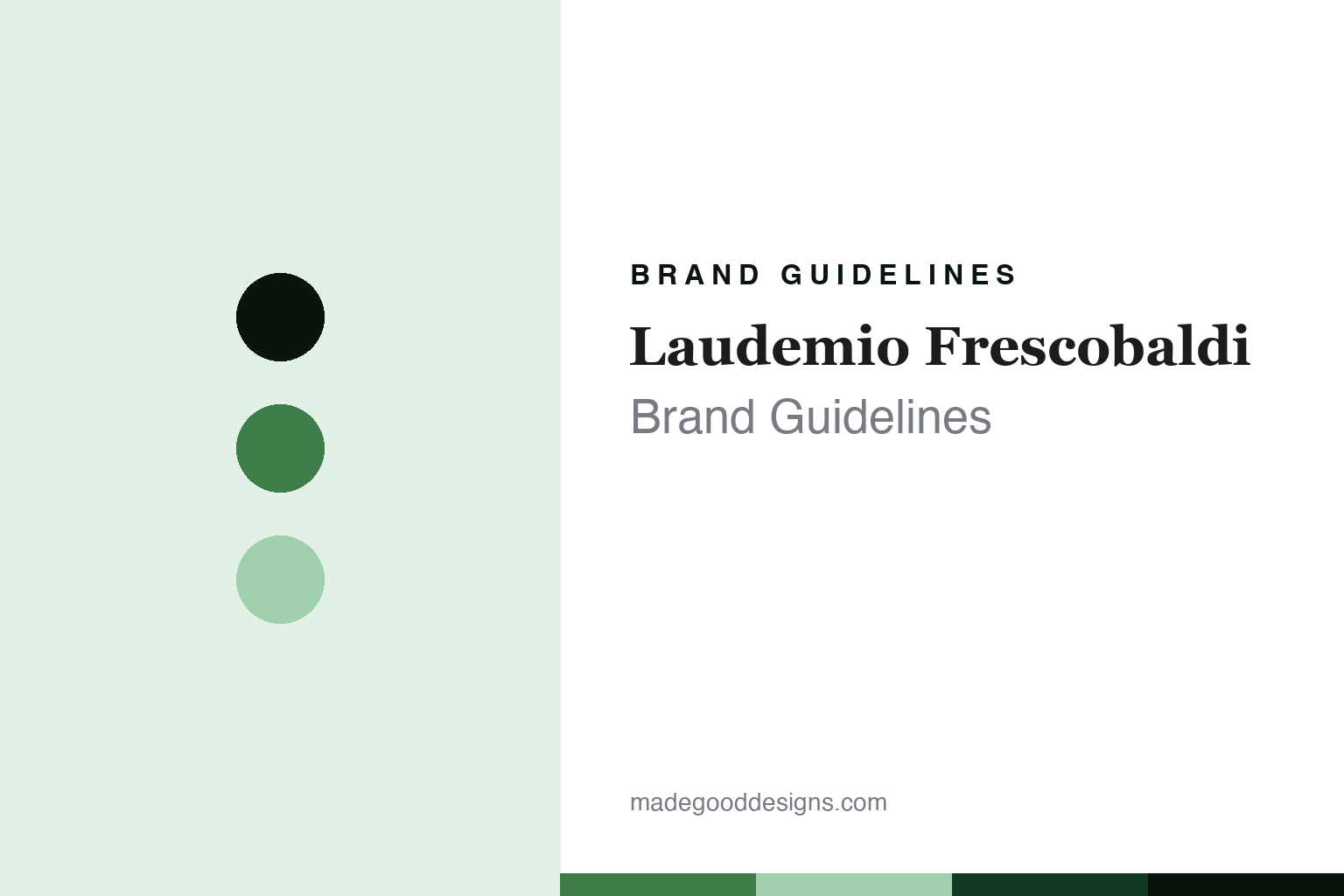
Laudemio Frescobaldi Brand Guidelines
The Frescobaldi oil under Tuscany’s shared mark.
Aa
Two constants: a Tuscan-emerald palette and a heritage-serif register. Abstract homage — not a Frescobaldi or Laudemio asset or mark.
The Frescobaldi oil under Tuscany’s shared mark
Laudemio Frescobaldi is the Frescobaldi family’s Tuscan oil under the shared Laudemio consortium mark.
Laudemio Frescobaldi brings the round a shared mark — the Frescobaldi family’s Tuscan olive oil, made under Laudemio, a collective quality mark held by a consortium of Tuscan estates, not a Frescobaldi-only brand. Laudemio Frescobaldi makes premium Tuscan extra-virgin olive oil, and its answer to a round about the second pressing is a distinction worth getting right: a famous family name and oil, bottled under a shared Tuscan standard that many estates use. A brand, and a mark.
Its identity is the Frescobaldi oil under Tuscany’s shared mark. Laudemio Frescobaldi’s family name, the shared Laudemio mark and its Tuscan estate are the story here. A brand, shared. The Frescobaldi oil under Tuscany’s shared mark.
(Honest notes, so the story stays precise, and this one matters. Laudemio is a collective, consortium trademark, held by Laudemio Srl Consortile, a group of around twenty-one Tuscan estates that each bottle their own Laudemio to a strict shared protocol, so Laudemio and even the tall square bottle belong to the consortium, not to Frescobaldi alone, and we frame Laudemio Frescobaldi as the Frescobaldi family’s entry under that shared mark. Frescobaldi, at laudemiofrescobaldi.com, is one of those member estates, owned by the Frescobaldi family, the Marchesi Frescobaldi house. On heritage, the family traces winemaking and oil to 1300, which we attribute to the family, while the Laudemio oil line dates to a first harvest in 1989, and the consortium to the mid-nineteen-eighties, so we say the late eighties without a hard year. On where it is made, a star theme of this round, the oil is estate-grown and pressed within hours at Frescobaldi’s mill at Castello Nipozzano, in Tuscany, so we name Nipozzano. We do not name the cultivars, which we could not verify, nor a bottle designer, since the bottle is the consortium’s shared design. The word Laudemio was the medieval term for the best of the harvest, reserved for the landlord. Its name and crest are IP we describe but do not reproduce; there is no official brand hex; these tones are an unofficial interpretation.)
Colour
Laudemio Frescobaldi lives in a Tuscan emerald. Click a swatch to copy the hex.
Laudemio Frescobaldi’s identity is Tuscan, shared and refined — a Tuscan emerald, an ink, a mint, a deep green, and a paper. The palette leans Tuscan emerald and mint: a vivid, green register that nods to a bright, just-pressed Tuscan oil and a heritage estate rather than a loud palette. It signals a premium Tuscan oil under a shared mark. The honest caveat: with no published brand hex, these values are an original, unofficial interpretation, not first-party colours.
The lesson is a Tuscan emerald signals a heritage, shared identity. Laudemio Frescobaldi’s world is a considered, made object. For designers, it is a reminder that a Tuscan emerald and a soft mint can carry a pantry brand — the tone of a bright Tuscan oil. Because these tones can fail as small text, keep type dark and let the colour live in the accents, palette and band. The takeaways: honour a shared mark; date the product not the dynasty; press for real; and treat any single hex as unofficial.
Typography
The register is a heritage serif — Tuscan, refined, considered.
Laudemio Frescobaldi’s identity carries a Tuscan, refined, considered spirit — a heritage oil, not a fashion. A heritage serif captures the mood: refined, historic and confident, the register of a Tuscan house. Set in a Tuscan-emerald palette, the heritage serif feels Tuscan and refined — exactly the personality Laudemio Frescobaldi carries. It is a shared standard rather than a logo, mirroring an olive and an oil. (The Laudemio square bottle is the consortium’s shared design, which we describe but do not reproduce, and the exact typeface is not ours to use.) Because it is not ours to use, the honest description is “a heritage-serif oil,” shown here in a stand-in. The type behaves like the brand: Tuscan, refined and considered.
Aa
A heritage-serif oil — Tuscan and refined. (Specimen set in Playfair Display, a heritage-serif STAND-IN; NOT the Frescobaldi logo.)
The second pressing
Laudemio Frescobaldi stands for the Frescobaldi oil under Tuscany’s shared mark.
Laudemio Frescobaldi brings the round a shared mark. A Tuscan-emerald palette, a heritage serif and a collective standard make one thing — the Frescobaldi oil under Tuscany’s shared mark — the whole identity: Tuscan, shared and refined. The family name is the label, and the Laudemio consortium is the distinction. The point is a famous Tuscan family’s oil, bottled under a shared quality mark that many estates use.
Put to work, the identity is a distinction told straight, as design. A maker in this spirit would honour a shared mark, date the product not the dynasty, and press for real. A reader in this spirit would keep the facts right: Laudemio is a collective consortium trademark, held by around twenty-one Tuscan estates, with a shared protocol and a shared square bottle; Frescobaldi is one member, owned by the Frescobaldi family; the family traces its history to 1300, while the Laudemio oil dates to a first harvest in 1989 and the consortium to the mid-eighties; and the oil is estate-grown and pressed at Castello Nipozzano. Laudemio Frescobaldi joins Capezzana on the round’s Tuscany side, and its shared-mark status is the round’s who-owns-the-name standout. The honest editorial moves are to frame Laudemio as the consortium mark throughout, to date the oil to 1989 and the family to 1300 separately, to name only Nipozzano, and to not attribute the shared bottle to Frescobaldi. The lesson Laudemio Frescobaldi teaches is that a shared mark can be a whole identity, and getting the ownership of a name right keeps it credible.
For designers and brand-builders, Laudemio Frescobaldi continues the second pressing: honour a shared mark — and date the product not the dynasty. The lessons: respect a collective mark and say who owns it; separate a family’s deep heritage from a product’s launch; do not claim a shared design as your own; name only the estate you can verify; and never reproduce a crest. It is also a reminder to stay precise: Laudemio Frescobaldi is the Frescobaldi family’s Tuscan oil under the shared Laudemio consortium mark — with the palette here an unofficial interpretation. Read that way, Laudemio Frescobaldi is less a bottle than a standard: a Tuscan oil under a shared mark. The lesson for a brand is that a shared mark and honest framing reinforce each other, and calling Laudemio a consortium mark keeps the story earned. Laudemio Frescobaldi made the-Frescobaldi-oil-under-Tuscany’s-shared-mark the identity — proof that a shared mark can define a brand.
Explore & save
Keep Laudemio Frescobaldi’s identity on hand — save it to a board in the Made Good inspiration library.
Laudemio Frescobaldi identity set
Pin the Tuscan-emerald palette and the heritage-serif register to your own board.