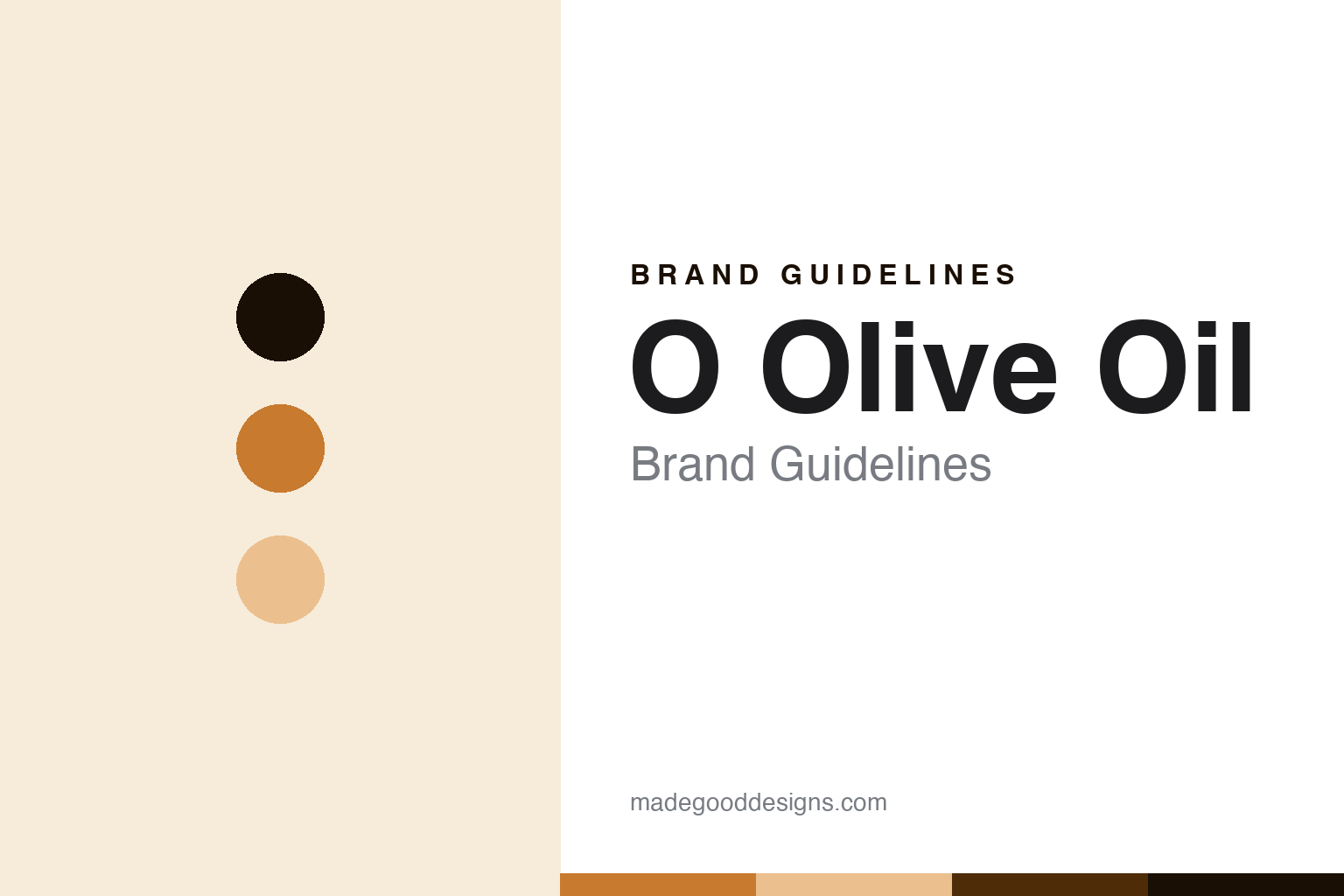
O Olive Oil Brand Guidelines
The California pioneer of citrus-pressed oil.
Aa
Two constants: a citrus-amber palette and a citrus-sans register. Abstract homage — not an O Olive Oil product or mark.
The California pioneer of citrus-pressed oil
O Olive Oil is the California brand that co-presses whole citrus with olives, since 1995.
O Olive Oil closes the second pressing with a technique — the California brand, founded in 1995, that co-presses whole citrus with the olives, crushing them together to make a citrus oil, alongside its California olive oil and wine vinegars. O makes California olive oil and vinegar, and its answer to a round about the second pressing is a method, right in the name: an oil made by pressing whole fruit and olives as one. A brand, citrus.
Its identity is the California pioneer of citrus-pressed oil. O’s citrus co-pressing, its 1995 origin and its California base are the story here. A brand, citrus. The California pioneer of citrus-pressed oil.
(Honest notes, so the story stays precise. O Olive Oil, at ooliveoil.com, the brand styled simply O, makes California extra-virgin olive oil, a citrus co-pressed range and wine vinegars. Its signature method, in the brand’s own words, dates to 1995, when its founder crushed fresh citrus together with Arbequina olives, so the citrus is milled with the olives, not infused afterward, and a blood orange oil is confirmed. It was founded in 1995, and we could not verify the founder’s name, so we leave it unnamed rather than guess. On where it is made, a star theme of this round, it is based in Petaluma, California, not Napa, with vinegars made at a California fermentation facility, and its olives described only as California-grown, so we say California-grown and pressed in California, without naming a specific grove or press town. On ownership, the structure is not disclosed, so we do not assert it is independent or founder-owned. On its status, it is among the early California producers to co-press citrus with olives, which we say rather than claim it was the first, since the technique is a general one used elsewhere too. Its sustainability and organic claims are its own. Its O mark and label are IP we describe but do not reproduce; there is no official brand hex; these tones are an unofficial interpretation.)
Colour
O Olive Oil lives in a citrus amber. Click a swatch to copy the hex.
O’s identity is citrus, Californian and modern — a citrus amber, an ink, a wheat, a deep amber, and a paper. The palette leans citrus amber and wheat: a warm, citrus-tinged register that nods to a blood-orange oil and a modern California brand rather than a loud palette. It signals a citrus-pressed oil. The honest caveat: with no published brand hex, these values are an original, unofficial interpretation, not first-party colours.
The lesson is a citrus amber signals a citrus, modern identity. O’s world is a modern, made object. For designers, it is a reminder that a citrus amber and a soft wheat can carry a pantry brand — the tone of a citrus-pressed oil. Because these tones can fail as small text, keep type dark and let the colour live in the accents, palette and band. The takeaways: name the method; be honest about a first; disclose only what you can; and treat any single hex as unofficial.
Typography
The register is a citrus sans — modern, clean, plain.
O’s identity carries a modern, clean, plain spirit — a citrus-pressed oil, not a fashion. A citrus sans captures the mood: clean, modern and confident, the register of a method-led brand. Set in a citrus-amber palette, the citrus sans feels modern and clean — exactly the personality O carries. It is a method rather than a logo, mirroring an olive and a citrus. (O’s real O mark is a thing we describe but do not reproduce, and the exact typeface is not ours to use.) Because it is not ours to use, the honest description is “a citrus-sans oil,” shown here in a stand-in. The type behaves like the brand: modern, clean and plain.
Aa
A citrus-sans oil — modern and clean. (Specimen set in Space Grotesk, a citrus-sans STAND-IN; NOT the O Olive Oil logo.)
The second pressing
O Olive Oil stands for the California pioneer of citrus-pressed oil.
O Olive Oil closes the second pressing with a technique. A citrus-amber palette, a citrus sans and a co-pressed method make one thing — the California pioneer of citrus-pressed oil — the whole identity: citrus, Californian and modern. The citrus co-pressing is the substance, and the single-letter name is the design. The point is a California brand that presses whole citrus with the olives, right in its name.
Put to work, the identity is a method told straight, as design. A maker in this spirit would name the method, be honest about a first, and disclose only what it can. A reader in this spirit would keep the facts right: O Olive Oil, at ooliveoil.com, makes California olive oil, citrus co-pressed oils and wine vinegars; its method dates to 1995, when its founder crushed fresh citrus with Arbequina olives; it is based in Petaluma, California, not Napa, with olives described only as California-grown; its ownership is not disclosed; and it is among the early California citrus-pressers, not necessarily the first. O closes the round’s California side with McEvoy and Séka Hills, and its citrus co-pressing echoes a technique used by heritage estates too. The honest editorial moves are to date it to 1995, to leave the founder unnamed, to say California without a grove town, and to say among the early not the first. The lesson O teaches is that a method can be a whole identity, and being honest about a first keeps it credible.
For designers and brand-builders, O closes the second pressing: name the method — and be honest about a first. The lessons: put the method in the identity, even the name; say among the early rather than the first when a technique is shared; disclose only what you can document; leave a founder unnamed rather than guess; and never reproduce a mark. It is also a reminder to stay precise: O Olive Oil is the California brand that co-presses whole citrus with olives, since 1995 — with the palette here an unofficial interpretation. Read that way, O is less a bottle than a method: a citrus-pressed California oil, closing the round on technique. The lesson for a brand is that a method and honest limits reinforce each other, and saying among the early keeps the story earned. O Olive Oil made the-California-pioneer-of-citrus-pressed-oil the identity — proof that a method can close a round.
Explore & save
Keep O Olive Oil’s identity on hand — save it to a board in the Made Good inspiration library.
O Olive Oil identity set
Pin the citrus-amber palette and the citrus-sans register to your own board.