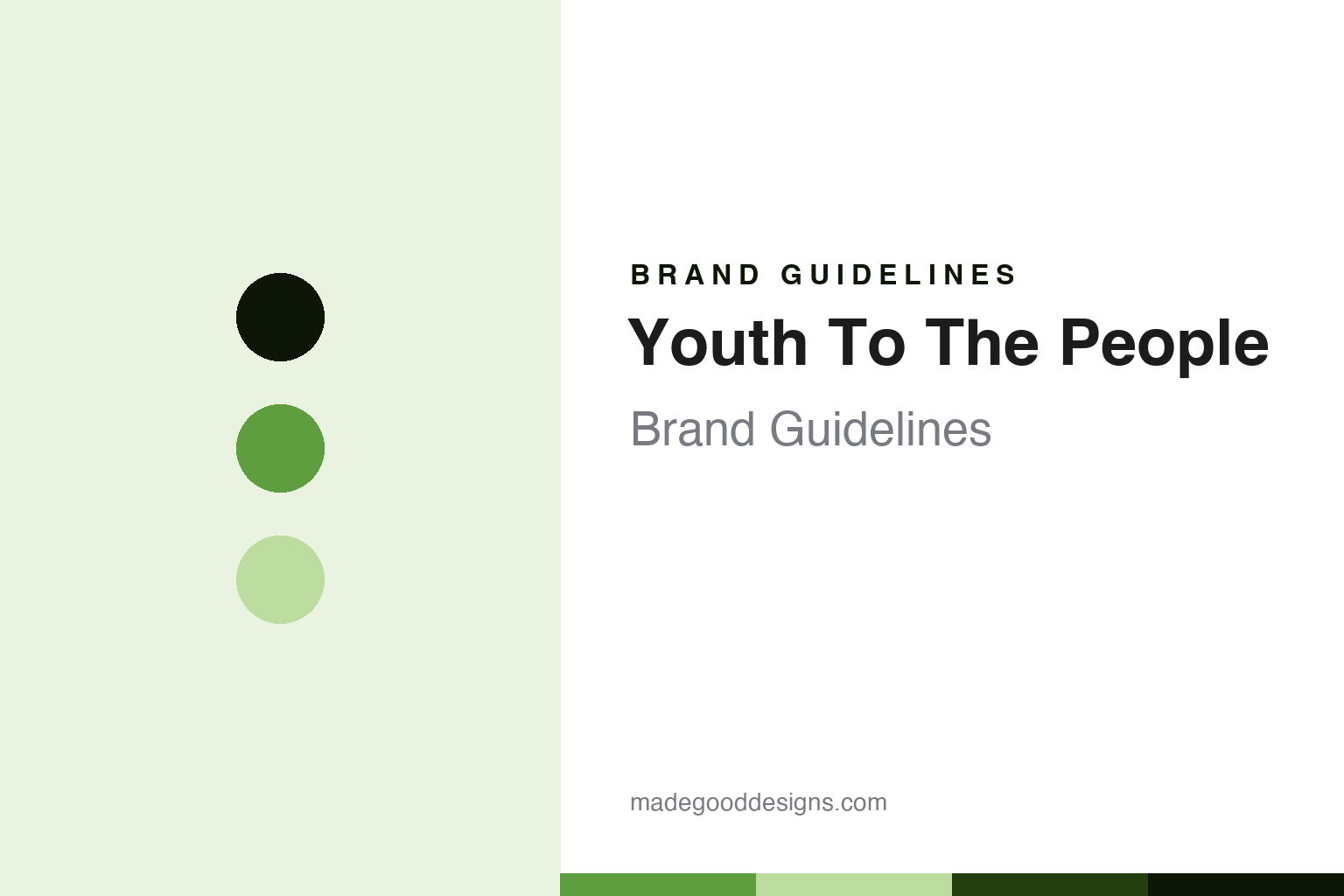
Youth To The People Brand Guidelines
The superfood skincare L’Oréal bought.
Aa
Two constants: a kale-green palette and a superfood-sans register. Abstract homage — not a Youth To The People product or mark.
The superfood skincare L’Oréal bought
Youth To The People is the LA superfood skincare brand of two cousins — now owned by L’Oréal.
Youth To The People closes the clean shelf with an acquisition — the Los Angeles skincare brand, founded by two cousins, that built a superfood identity in recyclable glass, and that L’Oréal bought. Youth To The People makes superfood skincare, and its answer to a round about the clean shelf is a founder story that ended inside a conglomerate: a green, superfood line, from a third-generation skincare family, now part of L’Oréal. A brand, superfood.
Its identity is the superfood skincare L’Oréal bought. Youth To The People’s superfood formulas, its cousins-founders and its L’Oréal ownership are the story here. A brand, superfood. The superfood skincare L’Oréal bought.
(Honest notes, so the story stays precise, and the claims stay the brand’s own. Youth To The People, at youthtothepeople.com, makes superfood skincare, including a Superfood Cleanser, a Superfood Air-Whip Moisturizer, a Skin Drip serum and a sunscreen, marketed as vegan and clean and packaged in recyclable glass, and we report its superfood, clean, vegan and efficacy language as the brand’s own marketing. It was founded in 2015 in Los Angeles by two cousins, Joe Cloyes, its chief executive, and Greg Gonzalez, and it is a third-generation skincare family, inspired by their grandmother Eva, who ran a plant-extract skincare line decades earlier, so we name Eva and not any unrelated celebrity. On ownership, a star theme of this round, it is owned by L’Oréal, which acquired it in December 2021 and placed it in the L’Oréal Luxe division, so it is not independent. On where it is made, a theme of this round, the location is not documented, so we say a Los Angeles brand, not made in the United States. Its name and packaging are IP we describe but do not reproduce; there is no official brand hex; these tones are an unofficial interpretation.)
Colour
Youth To The People lives in a kale green. Click a swatch to copy the hex.
Youth To The People’s identity is superfood, green and acquired — a kale green, an ink, a leaf, a deep green, and a paper. The palette leans kale green and leaf: a fresh, vegetal register that nods to a superfood formula and a recyclable-glass jar rather than a loud palette. It signals superfood skincare. The honest caveat: with no published brand hex, these values are an original, unofficial interpretation, not first-party colours.
The lesson is a kale green signals a superfood, green identity. Youth To The People’s world is a fresh, made object. For designers, it is a reminder that a kale green and a soft leaf can carry a skincare brand — the tone of a superfood. Because these tones can fail as small text, keep type dark and let the colour live in the accents, palette and band. The takeaways: name a concept; use glass; be honest about ownership; and treat any single hex as unofficial.
Typography
The register is a superfood sans — green, fresh, plain.
Youth To The People’s identity carries a green, fresh, plain spirit — superfood skincare, not a fashion. A superfood sans captures the mood: clean, fresh and confident, the register of a green brand. Set in a kale-green palette, the superfood sans feels green and fresh — exactly the personality Youth To The People carries. It is a concept rather than a logo, mirroring a superfood and a serum. (Youth To The People’s real packaging is a thing we describe but do not reproduce, and the exact typeface is not ours to use.) Because it is not ours to use, the honest description is “a superfood-sans skincare,” shown here in a stand-in. The type behaves like the brand: green, fresh and plain.
Aa
A superfood-sans skincare — green and fresh. (Specimen set in Libre Franklin, a superfood-sans STAND-IN; NOT the Youth To The People logo.)
The clean shelf
Youth To The People stands for the superfood skincare L’Oréal bought.
Youth To The People closes the clean shelf with an acquisition. A kale-green palette, a superfood sans and a green formula make one thing — the superfood skincare L’Oréal bought — the whole identity: superfood, green and acquired. The superfood concept is the pitch, and the L’Oréal ownership is the meaning. The point is a cousins’ green brand, from a skincare family, now inside a conglomerate.
Put to work, the identity is an acquisition told straight, as design. A maker in this spirit would name a concept, use glass, and be honest about ownership. A reader in this spirit would keep the facts right: Youth To The People makes superfood skincare, a Superfood Cleanser and an Air-Whip Moisturizer, in recyclable glass; it was founded in 2015 in Los Angeles by cousins Joe Cloyes and Greg Gonzalez, a third-generation skincare family inspired by their grandmother Eva; it is owned by L’Oréal, which acquired it in December 2021; and its making location is undocumented. Youth To The People closes the round’s who-owns thread with Tata Harper, the two clean-beauty brands bought by conglomerates, and its superfood concept is the round’s clearest naming idea. The honest editorial moves are to date it to 2015, to name Eva not an unrelated celebrity, to state the L’Oréal acquisition, and to say an LA brand not made-in-USA. The lesson Youth To The People teaches is that a superfood concept can be a whole identity, and stating the ownership keeps it credible.
For designers and brand-builders, Youth To The People closes the clean shelf: name a concept — and be honest about ownership. The lessons: build a brand on a clear concept, like superfood; use recyclable glass as a signature; state a conglomerate acquisition plainly; report clean and vegan claims as your own; and never reproduce packaging. It is also a reminder to stay precise: Youth To The People is the LA superfood skincare brand of two cousins, now owned by L’Oréal — with the palette here an unofficial interpretation. Read that way, Youth To The People is less a jar than a concept: superfood skincare, closing the round inside a conglomerate. The lesson for a brand is that a concept and honest ownership reinforce each other, and stating the L’Oréal acquisition keeps the story earned. Youth To The People made the-superfood-skincare-L’Oréal-bought the identity — proof that a concept can close a round.
Explore & save
Keep Youth To The People’s identity on hand — save it to a board in the Made Good inspiration library.
Youth To The People identity set
Pin the kale-green palette and the superfood-sans register to your own board.