Faiveley Brand Guidelines
A Nuits-Saint-Georges family domaine, seven generations since 1825.
Aa
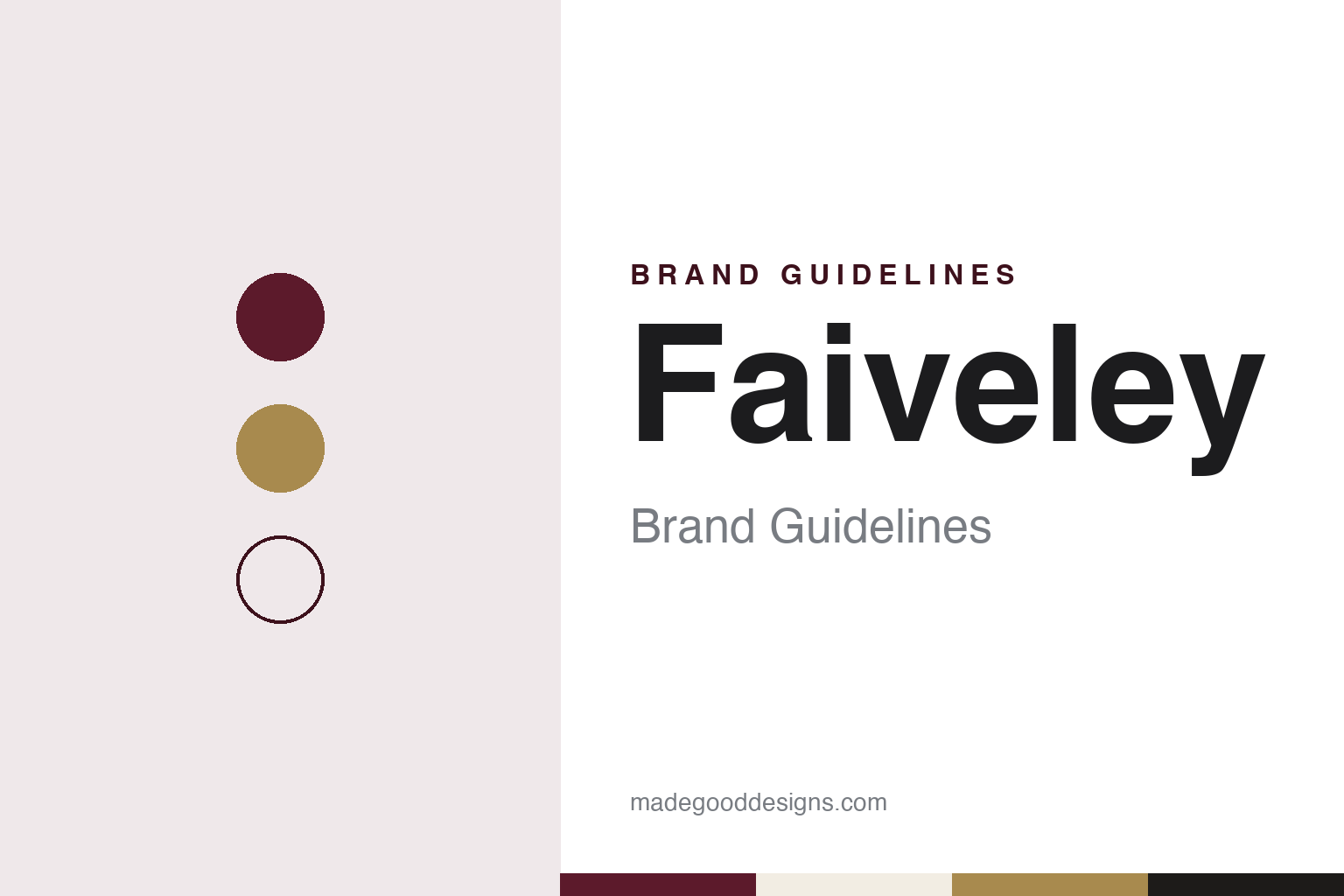
Two constants: a garnet, brass and limestone cream palette and a classical book serif register. Abstract homage — not a Faiveley product or mark; no label, logo or bottle is reproduced.
A Nuits-Saint-Georges family
Seven generations in one Burgundy town since 1825.
Faiveley began in 1825 in Nuits-Saint-Georges, a town in the Côte de Nuits. English Wikipedia, citing Clive Coates’s The Wines of Burgundy (2008), says the house was founded by Pierre Faiveley, a native of the town. The family still owns it. On its own website the domaine describes itself as a Burgundian family established in Nuits-Saint-Georges for seven generations, living and working there since 1825.
The vineyards were built up one generation at a time. English Wikipedia says the business passed in 1860 to Pierre’s nephew Joseph, who bought Corton Clos des Cortons, a grand cru monopole, meaning a vineyard with a single owner; the wine is sold today as Corton Clos des Cortons Faiveley. Joseph’s son François took over in 1889 and, between then and 1919, added parcels in the Nuits-Saint-Georges premier cru Les Saint-Georges and in the grand cru Clos de Vougeot. A later François Faiveley, great-grandson of the first, ran the company from 1976 to 2004 and extended the family’s holdings in the Côte de Nuits and in Montagny and Mercurey, English Wikipedia says.
The family has never worked only in wine. The domaine says its members also worked as a cobbler, a doctor, a doctor of law and an engineer alongside their vineyards, and it says the family was the first to use a hand sorting table for grapes and bought large areas of vines in the Côte Chalonnaise when few people believed in them. French Wikipedia notes that the house keeps a second base, with a winery and offices, at Mercurey in the Côte Chalonnaise.
Faiveley also played a part in Burgundy’s best-known wine fraternity. French Wikipedia says the Confrérie des Chevaliers du Tastevin was founded on 16 November 1934 at the Caveau Nuiton in Nuits-Saint-Georges by Georges Faiveley and Camille Rodier. The domaine tells the story as one of a slump: wine was piling up unsold in cellars after 1929, and the two friends decided to invite people to share it around a table. English Wikipedia says the fraternity’s founders bought the château of the Clos de Vougeot in 1944 and made it their headquarters.
Colour
Erwan and Eve Faiveley, Chablis and California.
The seventh generation took charge in the 2000s. English Wikipedia, citing The Wine Advocate in 2020, says Erwan Faiveley became president in 2005 and that his sister Eve joined in 2014. The domaine says Erwan came back to Burgundy at 25, after studies in Dijon and Paris, when his father offered a new way of running the business, and that Eve, after years in Barcelona, the United States and luxury cosmetics marketing in Paris, became the first woman to join the domaine. Wine Spectator reported in 2009 that Erwan had made important changes in both viticulture and winemaking within five years, English Wikipedia says.
The family kept buying land. In July 2014 Decanter reported that Faiveley had acquired Domaine Billaud-Simon, one of the best-known names in Chablis, with around 20 hectares of vines, Faiveley said, in grands crus including Les Clos, Les Preuses, Vaudésir and Les Blanchots. Decanter called it the family’s second big purchase in twelve months, after it agreed late in 2013 to buy Domaine Dupont-Tisserandot in Gevrey-Chambertin. “It’s becoming more and more difficult to find vines in the greatest appellations in Burgundy,” Erwan Faiveley told the magazine, which described him as the seventh generation of the family to run the firm.
The domaine has also looked across the Atlantic. English Wikipedia, citing the San Francisco Chronicle in January 2021, says the Faiveleys bought a minority stake that year in Williams Selyem, the Sonoma County Pinot Noir winery, from John Dyson. In June 2024 The Press Democrat reported that the family had acquired a majority stake in the winery, in the Russian River Valley; John and Kathe Dyson stay on as minority owners, and John Dyson remains chief executive, reporting to Erwan Faiveley, for at least three years. The domaine says the family had decided to explore the Pinot Noirs of California.
In Burgundy the holdings run from the Côte de Nuits to the Côte Chalonnaise. English Wikipedia lists grands crus including Chambertin-Clos de Bèze, Mazis-Chambertin, Latricières-Chambertin, Musigny, Clos de Vougeot, Échezeaux, Corton-Charlemagne and Bâtard-Montrachet, and monopoles such as the Gevrey-Chambertin premier cru Clos des Issarts, the Beaune premier cru Clos de l’Ecu and the Mercurey premier cru Clos des Myglands. The domaine gives its own area as 120 hectares; French Wikipedia adds that Faiveley’s négociant side mainly covers generic Bourgogne red and white.
Typography
Design and documentation.
The seven names in this group are all Burgundy houses and domaines: Louis Jadot, Joseph Drouhin, Bouchard Père & Fils, Louis Latour, Faiveley, Albert Bichot and Domaine de la Romanée-Conti. Burgundy wine names in general sit at many different points in the trade, from family houses that still carry a founder’s name to estates that now belong to much larger groups, and a single name can be sold everywhere from a wine shop to a restaurant list.
A Burgundy house’s identity is usually carried less by a single bottle than by a label, a name and the place it promises, because the company behind the name may have changed hands, bought or leased new vineyards or grown far beyond the place where it started. That makes the questions behind each name worth asking plainly: who started it, who owns it now, and where its wine is actually grown, made and bottled.
Each guide separates what independent sources record from what the house or domaine says about itself — its founding story, its owners over time, where its wine is made and how its labels have changed — and marks plainly what rests only on the company’s own word.
Aa
A classical book serif for a Nuits-Saint-Georges domaine founded in 1825. (Specimen set in Cormorant Garamond, a serif STAND-IN; NOT the Faiveley logo.)
Faiveley
A family name, a sculpture and a name shared with a rail company.
Faiveley puts its family history at the centre of how it presents itself. The domaine says that on 12 April 2022 a bronze of Auguste Rodin’s The Kiss was installed in the patio of its winery, and it links the choice to Maurice Fenaille, a patron of Rodin and the uncle of the family’s great-grandmother Marthe. It named a Chambertin-Clos de Bèze cuvée, “Les Ouvrées Rodin,” in the sculptor’s honour. In 2017, the domaine says, Erwan and Eve Faiveley began restoring the nineteenth-century stone house at the Clos des Issarts, with its glazed coloured roof tiles, under the state heritage architect Christian Laporte; it now serves as a residence for the Dijon artist Laëtitia de Bazelaire.
The family name also belongs to a very different business. Faiveley Transport, a maker of railway equipment, was founded in 1919 by Louis Faiveley in Saint-Ouen, near Paris, English Wikipedia says; it introduced its first pantograph, the arm that draws power from overhead wires, in 1923 and a single-arm pantograph in 1955. English Wikipedia says the American group Wabtec bought a majority of the company from the Faiveley family in 2016. The wine domaine counts the pantograph among its family’s innovations, but the two are separate businesses today: the domaine in Nuits-Saint-Georges remains in Faiveley family hands, while Faiveley Transport is majority-owned by Wabtec.
For a design guide, Faiveley shows how a single town, a family name and a long run of vineyard purchases can carry a wine house through seven generations, with the founders’ home in Nuits-Saint-Georges at the centre of the story. Compare Albert Bichot, another Burgundy family house that also owns land in Chablis and Nuits-Saint-Georges, and Louis Latour, another Burgundy wine house. For this guide we use garnet, brass and limestone cream with a classical serif, an unofficial interpretation; no product or logo is reproduced.
Explore & save
Keep Faiveley’s identity on hand — save it to a board in the Made Good inspiration library.
Faiveley identity set
Pin the Faiveley garnet, brass and limestone cream palette and the classical book serif register to your own board.