Domaine de la Romanée-Conti Brand Guidelines
The Vosne-Romanée estate shared by two families since 1942.
Aa
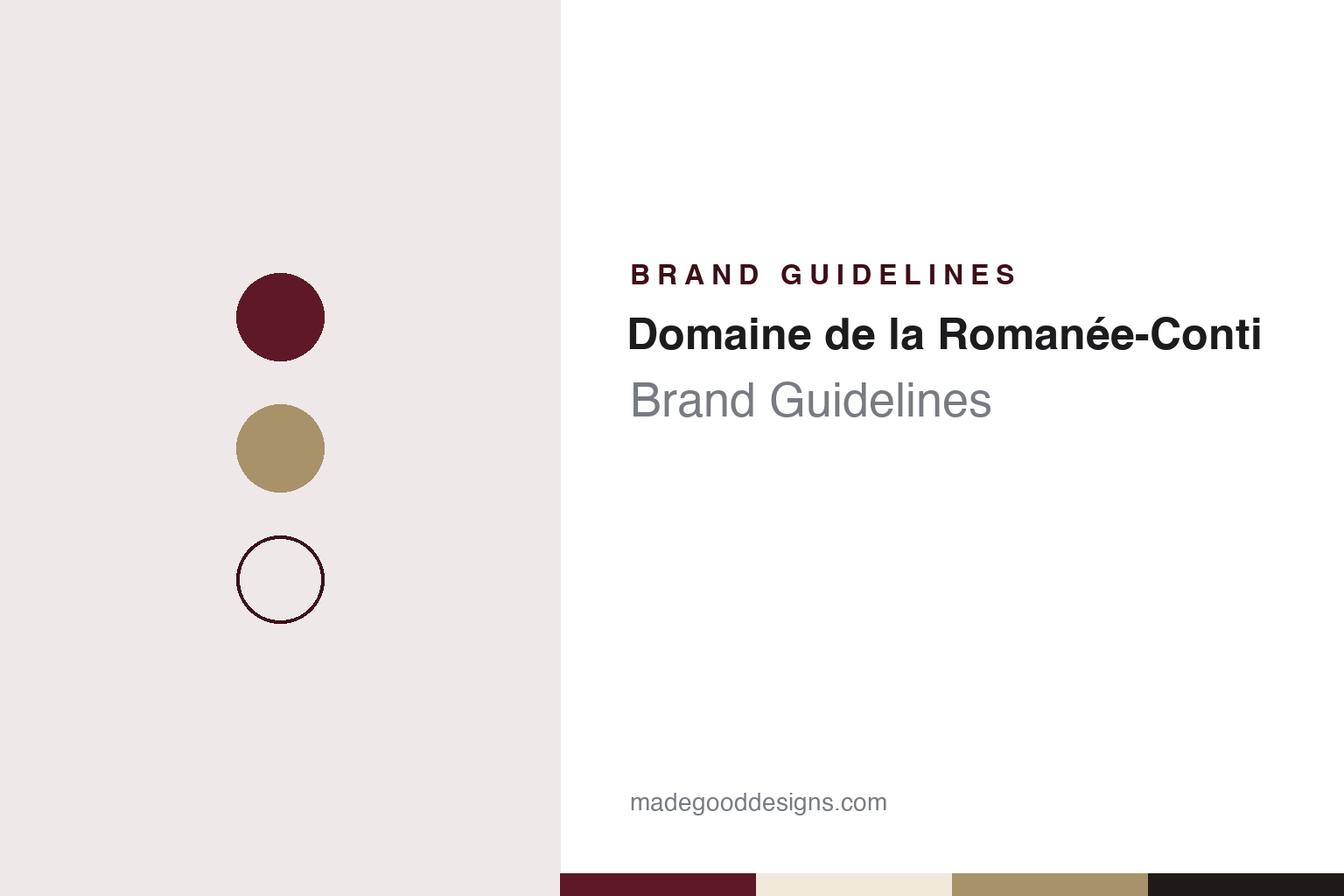
Two constants: a Vosne red, limestone and parchment palette and an old-style book serif register. Abstract homage — not a Domaine de la Romanée-Conti product or mark; no label, logo or bottle is reproduced.
A monks’ vineyard and a prince’s name
From the priory of Saint-Vivant to the Prince de Conti and a Santenay merchant.
Domaine de la Romanée-Conti is a wine estate in Vosne-Romanée, in the Côte de Nuits in Burgundy, and it takes its name from its most famous vineyard, Romanée-Conti. The domaine says the vineyard’s story begins with the priory of Saint-Vivant, founded by Manassès, lord of Vergy, and later attached to the Abbey of Cluny. The plot the monks worked was then known as the Cros des Cloux. English and French Wikipedia both date the priory’s acquisition of the vineyard to 1232.
The domaine says the name “Romanée” first appears in writing for the Cros des Cloux in the reign of Louis XIV. In 1760, English Wikipedia says, Louis François de Bourbon, Prince of Conti, won the vineyard after a contest with Madame de Pompadour, and it became known as Romanée-Conti. The domaine says the purchase was made by Jean-François Joly de Fleury acting for the prince, and that the prince also bought two neighbouring plots, today’s La Goillotte, for a winery and housing for his staff. After the Revolution the vineyard was confiscated and sold at auction, and English Wikipedia says the financier Julien Ouvrard bought it in 1819.
The estate in its present form starts with Jacques-Marie Duvault-Blochet. The domaine describes him as a grower and wine merchant based in Santenay and a general councillor of the Côte-d’Or, and says he bought Romanée-Conti in 1869. English Wikipedia credits him with building the estate “that we know today,” with holdings in Échezeaux, Grands Échezeaux and Richebourg. After his death the property passed to his daughters, and the domaine says it later came to two of his great-grandchildren, Jacques Chambon and his sister Marie-Dominique Madeleine Chambon, the wife of Edmond Gaudin de Villaine. French Wikipedia says Edmond became the estate’s administrator in 1911; the domaine says he hired Louis Clin to manage it.
Colour
Nine grands crus, two monopoles and the vineyard worked by horse.
The domaine lists nine grands crus: Échézeaux, Grands Échézeaux, Richebourg, Romanée-Saint-Vivant, Romanée-Conti, La Tâche, Corton, Corton-Charlemagne and Montrachet. Two of them it owns outright as monopoles. Romanée-Conti covers about 1.8 hectares, English Wikipedia says. The domaine says it acquired La Tâche in the years of the economic crisis that followed 1929, and English Wikipedia says that in 1936, after legal disputes, its holdings in Les Gaudichots and La Tâche were combined into a single La Tâche grand cru.
The other vineyards came piece by piece. The domaine says it bought vines in Montrachet during Charles de Gaulle’s presidency. In Romanée-Saint-Vivant, English Wikipedia says, the Marey-Monge family leased 5.28 hectares to the estate in 1966 and sold them to it in 1988. Since 11 November 2008 the domaine has leased Corton grand cru vines from the estate of Prince Florent de Merode, in Clos du Roi, Les Bressandes and Les Renardes, with a first harvest in 2009, French Wikipedia says, citing the 2022 book Romanée-Conti by Richard Olney, Frank Ribière and Vérane Frédiani. The domaine says it later also took on Corton-Charlemagne vines under a métayage, a sharecropping arrangement. French Wikipedia puts the whole estate at about 25.5 hectares, mostly in Vosne-Romanée.
The wine is grown and made in Burgundy, around the village itself. English Wikipedia says the vineyards are farmed organically, with some parcels in La Tâche and Grands Échezeaux worked biodynamically, and that horses were brought back to work Romanée-Conti and Montrachet so that tractors would not compact the soil. At harvest, it says, the grapes are picked into small baskets and sorted on tables. French Wikipedia says that in 1911 Edmond Gaudin de Villaine bought the old wine-making building of the Saint-Vivant monks in Vosne-Romanée, and the domaine says its administrative offices moved into that building later. On 4 July 2015 the Climats of the Burgundy vineyard were added to UNESCO’s World Heritage List, and the domaine says the association behind the bid was chaired by Aubert de Villaine.
Typography
Design and documentation.
The seven names in this group are all Burgundy houses and domaines: Louis Jadot, Joseph Drouhin, Bouchard Père & Fils, Louis Latour, Faiveley, Albert Bichot and Domaine de la Romanée-Conti. Burgundy wine names in general sit at many different points in the trade, from family houses that still carry a founder’s name to estates that now belong to much larger groups, and a single name can be sold everywhere from a wine shop to a restaurant list.
A Burgundy house’s identity is usually carried less by a single bottle than by a label, a name and the place it promises, because the company behind the name may have changed hands, bought or leased new vineyards or grown far beyond the place where it started. That makes the questions behind each name worth asking plainly: who started it, who owns it now, and where its wine is actually grown, made and bottled.
Each guide separates what independent sources record from what the house or domaine says about itself — its founding story, its owners over time, where its wine is made and how its labels have changed — and marks plainly what rests only on the company’s own word.
Aa
An old-style book serif for a Burgundy estate shared by two families. (Specimen set in EB Garamond, a serif STAND-IN; NOT the Domaine de la Romanée-Conti logo.)
Domaine de la Romanée-Conti
Two families, one société civile and a line of co-directors.
The company behind the estate, the Société Civile du Domaine de la Romanée-Conti, was formed on 31 July 1942, French Wikipedia says. That year Henri Leroy, a grower and wine merchant from Auxey-Duresses, bought Jacques Chambon’s shares; Wine Spectator reported in 2019 that Leroy bought 50 percent of the shares in 1942. The domaine says the de Villaine family still holds the other half, passed from Edmond to Henri and then to Aubert de Villaine, and that Henri Leroy’s shares passed to his daughters, Pauline Roch and Lalou Bize-Leroy. Each family names one member of the supervisory board, the domaine says.
The estate has long been run by one co-director from each side. The domaine says Henri de Villaine was manager from 1950 to 1974. From 1974 the co-directors were Aubert de Villaine and Lalou Bize-Leroy; Wine Spectator gives her term as 1974 to 1992 and notes that she heads Domaine Leroy. Charles Roch and then his brother Henry-Frédéric Roch followed on the Leroy side, and Wine Spectator says Henry-Frédéric Roch served alongside Aubert de Villaine for 26 years, until November 2018. On 23 January 2019, the domaine says, the general assembly confirmed Perrine Fenal, Lalou Bize-Leroy’s daughter, as co-director; Wine Spectator reported that she had been the domaine’s exclusive importer and distributor in Switzerland from 1992 to 2004.
On the de Villaine side, the domaine says the general assembly confirmed Bertrand de Villaine on 3 December 2021, and that he has worked at the estate since 2008, first in the vineyards, then in the cellar and then in its management. The World of Fine Wine described him in 2025 as co-gérant since 2022, alongside Perrine Fenal. English Wikipedia says Aubert de Villaine moved to an advisory role in 2022; with his wife Pamela he also runs a domaine of his own in Bouzeron. In January 2010 the estate received an extortion threat against its vines, a case Maximillian Potter later told in his 2014 book Shadows in the Vineyard, NPR reported. The domaine’s own website carries a warning about counterfeit bottles.
For a design guide, Domaine de la Romanée-Conti shows how a name taken from an eighteenth-century prince and a vineyard first worked by monks can carry an estate whose ownership has stayed with two families since 1942. Compare Joseph Drouhin and Louis Jadot, two other Burgundy names. For this guide we use Vosne red, limestone and parchment with a serif, an unofficial interpretation; no product or logo is reproduced.
Explore & save
Keep Domaine de la Romanée-Conti’s identity on hand — save it to a board in the Made Good inspiration library.
Domaine de la Romanée-Conti identity set
Pin the Domaine de la Romanée-Conti Vosne red, limestone and parchment palette and the old-style book serif register to your own board.