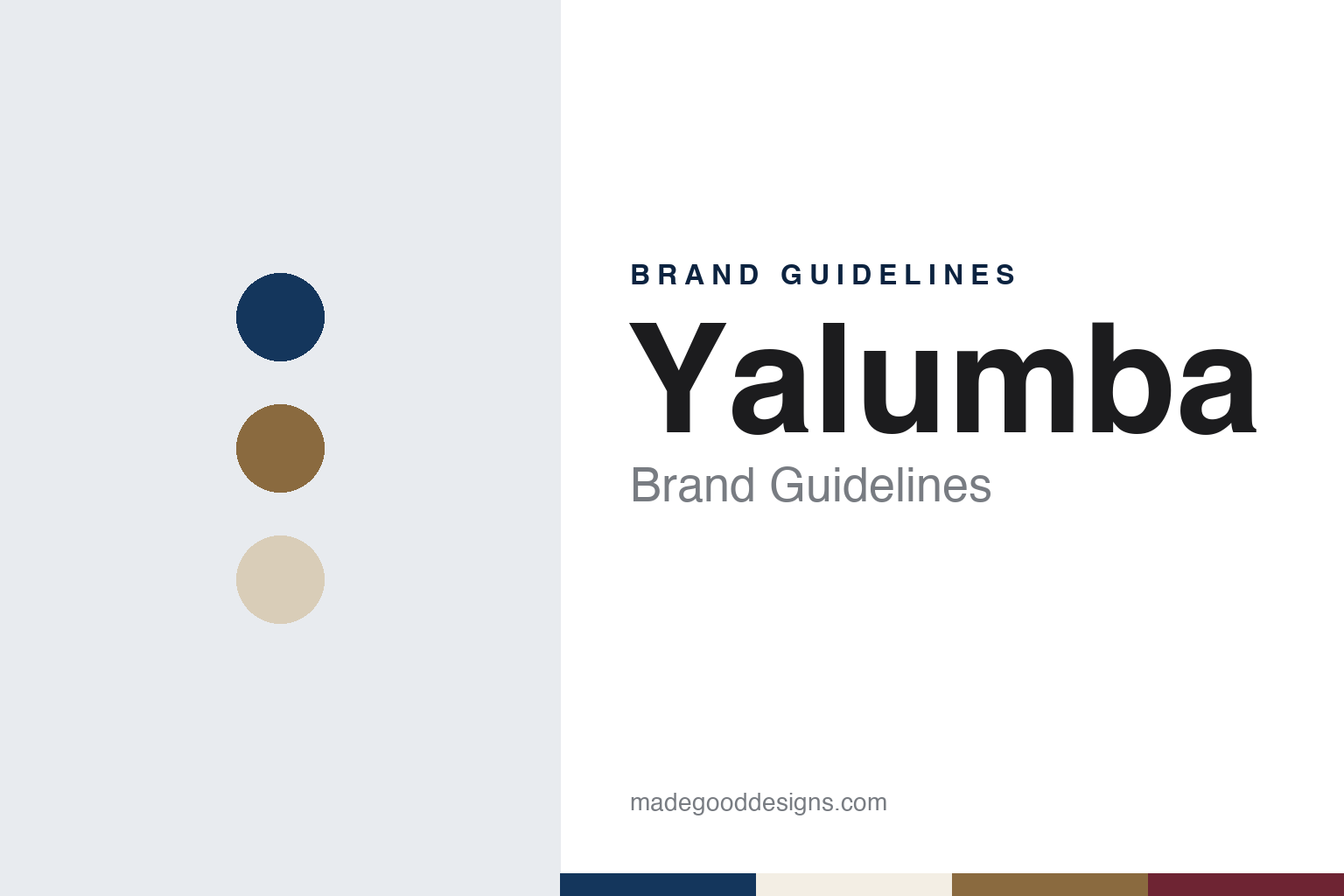
Yalumba Brand Guidelines
The Hill-Smith family winery at Angaston, founded in 1849.
Aa
Two constants: a clocktower navy, barrel oak and marble cream palette and a transitional serif register. Abstract homage — not a Yalumba product or mark; no label, logo or bottle is reproduced.
A brewer from Dorset
Thirty acres at Angaston, planted by night.
Yalumba was founded at Angaston, in South Australia’s Barossa, in 1849 by Samuel Smith, a brewer from Wareham in Dorset. The Australian Dictionary of Biography, in an entry by Jaki Ilbery published in 1976, says Smith migrated to South Australia in 1847 aboard the China with his wife Frances and their five children, lived for a time at Klemzig near Adelaide, and then moved to Angaston to work as a gardener for the landowner George Fife Angas.
In 1849, the dictionary says, Smith bought thirty acres to establish a vineyard and orchard of his own, planting at night while working for Angas during the day. He called the property Yalumba. The dictionary gives the word’s meaning as “all the country around”; the company says it is believed to come from the language of the Peramangk people, whom it acknowledges as the traditional owners of the land.
The vineyard grew in stages. The dictionary records that in 1852 Smith and his son went to the Victorian goldfields and came back after four months with enough to buy more land, a plough and horses, and to save for cellars; that he made his first wine that year; and that by 1862 he had nine acres of shiraz. In 1863 he made sixty hogsheads of wine. Yalumba wines won a bronze medal at the Intercolonial Exhibition in Melbourne in 1866–67 and a silver medal at the Paris Universal Exhibition of 1878.
The business passed down the family. According to the dictionary, Smith’s son Sidney, by then a partner, took over the management of the estate when his father retired in 1888, and supervised the building of the two-storey winery and its clock tower of blue marble; by 1900 there were 120 acres under vine. Sidney later handed the business to two of his sons, Percival, who ran the winemaking, and Walter, who built up exports to England and India. By 1975, the dictionary notes, Yalumba was in the hands of the fifth generation.
Colour
Fortified wine, then The Signature.
For more than a century Yalumba was a fortified-wine house. English Wikipedia, citing a 1981 report in The Age, says it was known for fortified wines until the 1960s. The shift to table wine is marked by the company’s flagship red: Yalumba says The Signature, a blend of cabernet sauvignon and shiraz, has been made since 1961, and each vintage, the company says, honours a person connected with the winery. The company calls that blend “the Great Australian Red.”
The fortified past was eventually sold. Forbes Australia reported in April 2026 that Yalumba sold its fortified trademarks and stock, including names such as Galway Pipe and Clocktower Port, to Mildara Blass, and used the proceeds to buy a vineyard in Coonawarra. The same report says Oxford Landing was launched in 1990 as an entry-level brand that sold strongly in the United Kingdom.
The top of the range now carries family and place names. The company lists The Caley, a cabernet and shiraz named after Fred Caley Smith, a third-generation member of the family who, the company says, travelled abroad in 1893 to study horticulture; The Octavius, a Barossa shiraz the company says comes from old vines dating back to 1854; The Tri-Centenary grenache, from bush vines it dates to 1889; The Menzies from Coonawarra; and The Virgilius, a viognier. The company says Robert Hill-Smith pioneered viognier in Australia. It names its estate regions as the Barossa Valley, Eden Valley and Coonawarra; the winery itself stands at Angaston.
Two operations set the winery apart. The company says it runs the only on-site winery cooperage in the Southern Hemisphere, where coopers have worked since around 1890 and moved into the present cooperage building in the 1990s, shaping imported oak into barrels with a long, slow toast. The Yalumba Nursery, established in 1975, grows and supplies grafted vines to growers around Australia, the company says.
Typography
Design and documentation.
The seven brands in this group are all wine names: Henschke, Yalumba, Torbreck, d’Arenberg, Felton Road, Egon Müller and Robert Weil, wine estates from Australia, New Zealand and Germany. Wine brands in general sit at many different points in the trade, from family houses that still carry a founder’s name to labels that now belong to much larger groups, and a single name can be sold everywhere from a corner shop to a restaurant list.
A wine brand’s identity is usually carried less by a single bottle than by a label, a name and the place it promises, because the company behind the name may have changed hands, moved its production or grown far beyond the place where it started. That makes the questions behind each name worth asking plainly: who started it, who owns it now, and where its wine is actually made and bottled.
Each guide separates what independent sources record from what the company says about itself — its founding story, its owners over time, where its wine is made and how its labels have changed — and marks plainly what rests only on the company’s own word.
Aa
A transitional serif for a heritage wine house with a clock tower. (Specimen set in Playfair Display, a serif STAND-IN; NOT the Yalumba logo.)
Yalumba
The Hill-Smith family and a buy-out.
The family name changed but the ownership did not. The company lists the line of proprietors from Samuel and Sidney Smith through Walter Smith and Wyndham Hill-Smith to Robert Hill-Smith, whom it calls the fifth-generation proprietor, and it describes the Hill-Smith family as having owned and operated the winery since its founding. Yalumba calls itself Australia’s oldest family-owned winery, a description English Wikipedia’s biography of Samuel Smith also gives.
The modern structure dates from a family buy-out. Forbes Australia reported in April 2026 that Robert Hill-Smith became managing director in 1985, when his branch of the family held about 35 per cent of the shares and the rest was spread across twelve other relatives, and that he and his brother Sam Hill-Smith bought out the other family shareholders in a process that ran from October 1988 to June 1989. Harpers reported in February 2015 that Robert Hill-Smith was stepping down after 30 years as chief executive to chair the board, with Nick Waterman, who had joined Yalumba in 2002, taking over as chief executive that March. On the winery’s 165th anniversary, Harpers reported, he said Yalumba would remain independent.
The sixth generation is now in the business. The company names Jessica Hill-Smith, who manages public relations and communications, and Lucy Hill-Smith, a fine-wine ambassador based in the United Kingdom. Its winemaking is led by head winemaker Sam Wigan, who the company says joined in 2001 and took the role in 2023, with Louisa Rose, at Yalumba since 1992, as head of sustainability. Yalumba is a member of Australia’s First Families of Wine, the group of family producers formed in 2009, whose founding the company credits to Robert Hill-Smith. Winetitles ranked Yalumba twelfth among Australian wine companies by production in 2022, English Wikipedia notes. The official site is yalumba.com.
For a design guide, Yalumba shows how a founding date, a clock tower and a line of named flagship wines can carry a family house across six generations. Compare Penfolds, the South Australian winery behind Grange, and Henschke, the family winery at Keyneton in the neighbouring Eden Valley. For this guide we use clocktower navy, barrel oak and marble cream with a transitional serif, an unofficial interpretation; no product or logo is reproduced.
Explore & save
Keep Yalumba’s identity on hand — save it to a board in the Made Good inspiration library.
Yalumba identity set
Pin the Yalumba clocktower navy, barrel oak and marble cream palette and the transitional serif register to your own board.