Egon Müller Brand Guidelines
The Saar Riesling estate on the Scharzhofberg since 1797.
Aa
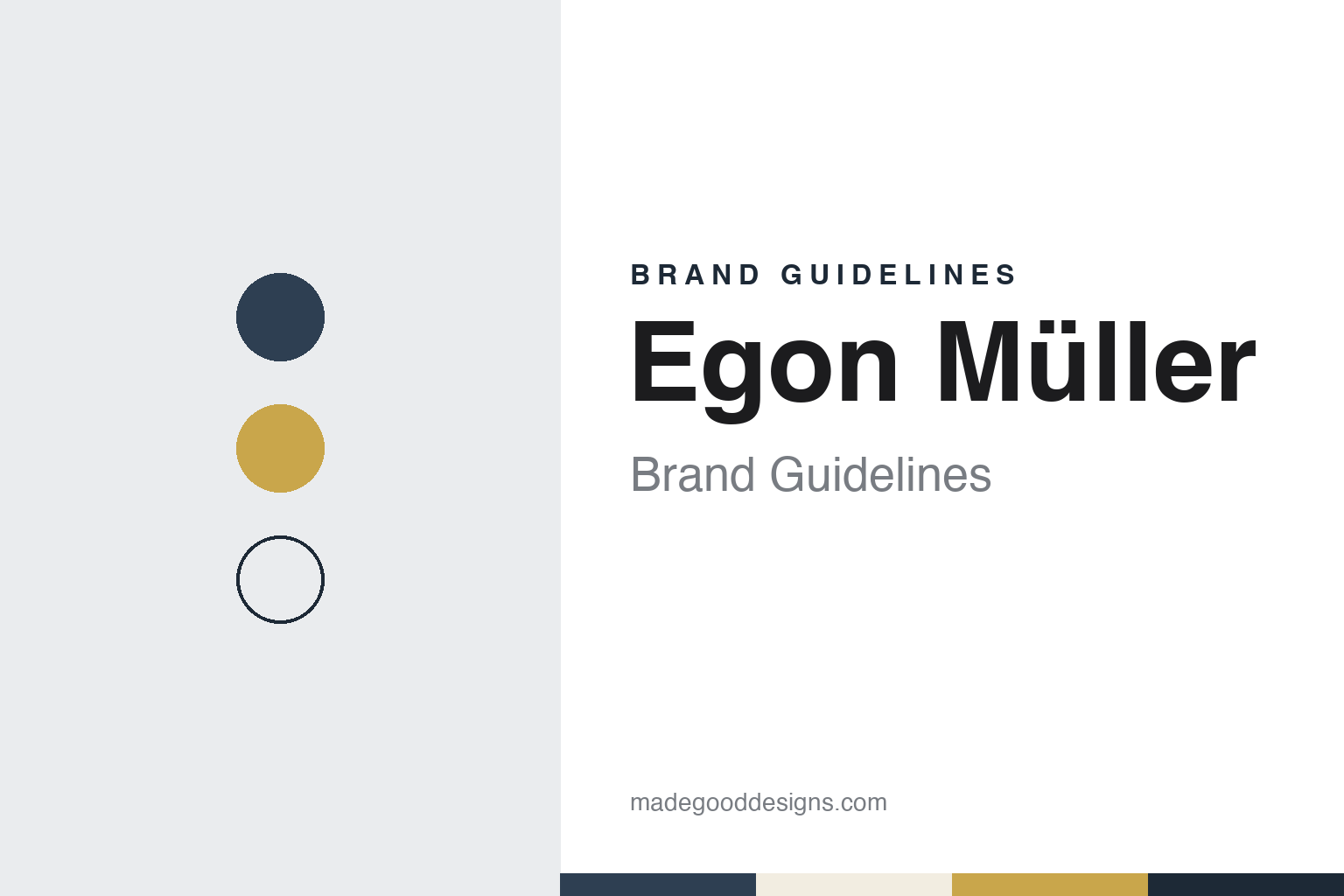
Two constants: a slate blue, Riesling gold and parchment palette and a classical serif register. Abstract homage — not an Egon Müller product or mark; no label, logo or bottle is reproduced.
Church land and a priest’s auction
From an abbey estate to one family, in Wiltingen on the Saar.
Weingut Egon Müller-Scharzhof sits at the foot of the Scharzhofberg, a slate hill outside Wiltingen on the Saar, in Germany’s Mosel wine region. For centuries the land belonged to the church. German Wikipedia, citing a 2013 house newsletter of Trier’s Bischöfliche Weingüter, says the Trier Benedictine abbey of St. Maria ad Martyres received land here in 1030, that a press house on the Scharzhof is first recorded in 1239, and that the abbey built the baroque Old Scharzhof in 1719.
The French revolutionary authorities took over the church’s property. The estate says that Jean-Jacques Koch acquired the Scharzhof from the French Republic in 1797, after French troops occupied Wiltingen and Kanzem in 1794, and it uses “Since 1797, one family” as its motto. German Wikipedia’s article on the vineyard dates the auction of the Scharzhof to 1801 and says the buyer, Johann Jakob Koch, was a Benedictine monk and the parish priest of Wiltingen, bidding on behalf of the former abbot; Koch, it says, later married his housekeeper and kept the estate for himself. The Old Scharzhof was eventually sold to Trier Cathedral, whose Bischöfliche Weingüter still farm it, while the New Scharzhof stayed with Koch’s family and passed by inheritance to the Müllers, German Wikipedia says.
The Müller name arrived through marriage. The estate says that in 1829 Koch’s property was divided among his seven children under the inheritance laws of the time, and that his daughter Elisabeth married Felix Müller, a soldier of the Napoleonic wars who had moved to the Saar from Föhrenbach in the Black Forest. In 1887 their second son, Egon Müller I, married Therese Tuckermann of Cologne, whose father bought a share of the estate from Egon’s sister. The couple set out to make the Scharzhofberg known abroad, the estate says, pouring their Rieslings at world exhibitions, including the Paris Exposition Universelle of 1900.
Colour
Four men named Egon, and a vineyard rebuilt after the war.
For four generations the estate has been led by an Egon Müller, German Wikipedia says. In 1932 it was divided between the sons of Egon Müller I, Egon and Felix, and Felix went his own way, the estate says. Egon Müller II ran the winery for only a few years: from 1941 his wife Elisabeth managed it through the war with the help of their daughters, at a time when labour and fertiliser were scarce and the vineyards visibly declined.
The estate dates its recovery to 15 August 1945, when Egon Müller III came home from captivity in England and went straight out to the Scharzhofberg. His first harvest, the estate says, gave only 1,200 litres of Riesling from 7.4 hectares. German Wikipedia says he took over from his mother that year and attended a two-semester course for estate managers at the state viticulture institute in Trier in 1947 and 1948, and that he steered the house towards top-quality wines. In 1954 he added the neighbouring Le Gallais estate, 2.5 hectares in the Wiltingen sites Kupp and braune Kupp that had first belonged to the Metz family, founders of the steel group Arbed, German Wikipedia says; the estate says he bought half from Madame Rochon de Pons and leased the other half.
Egon Müller IV, who studied at Geisenheim according to English Wikipedia, ran the estate jointly with his father from 1985 and has led it since 1991, the estate says. His ancestor Jean-Jacques Koch was his great-great-great-grandfather, VinePair noted in 2019, making him the sixth generation of the family to run the Scharzhof. He has also worked beyond Germany: in Slovakia he makes Riesling under the Château Belá label with Miroslav Petrech, and in Australia’s Adelaide Hills he makes a dry Riesling called Kanta with Michael Andrewarta of East End Cellars, VinePair reported.
Typography
Design and documentation.
The seven brands in this group are all wine names: Henschke, Yalumba, Torbreck, d’Arenberg, Felton Road, Egon Müller and Robert Weil, wine estates from Australia, New Zealand and Germany. Wine brands in general sit at many different points in the trade, from family houses that still carry a founder’s name to labels that now belong to much larger groups, and a single name can be sold everywhere from a corner shop to a restaurant list.
A wine brand’s identity is usually carried less by a single bottle than by a label, a name and the place it promises, because the company behind the name may have changed hands, moved its production or grown far beyond the place where it started. That makes the questions behind each name worth asking plainly: who started it, who owns it now, and where its wine is actually made and bottled.
Each guide separates what independent sources record from what the company says about itself — its founding story, its owners over time, where its wine is made and how its labels have changed — and marks plainly what rests only on the company’s own word.
Aa
A classical serif for a Saar estate the family dates to 1797. (Specimen set in Cormorant Garamond, a serif STAND-IN; NOT the Egon Müller logo.)
Egon Müller
One grape, old casks and a famous slope.
The estate makes only Riesling, VinePair says, in styles from Kabinett to Trockenbeerenauslese as the vintage allows. Its grapes come from the Scharzhofberg and from the braune Kupp, whose name, the estate says, comes from the iron in its slate. German Wikipedia describes the Scharzhofberg as a steep, south-facing slope of about 28 hectares planted only with Riesling, of which Egon Müller-Scharzhof holds 8.4 hectares, the largest share; other owners include the Bischöfliche Weingüter, Reichsgraf von Kesselstatt and van Volxem. Under German wine law, German Wikipedia notes, the Scharzhofberg is not registered as an individual vineyard site, so “Scharzhofberger” on a label is legally a fanciful name; the VDP growers’ association classifies it as a Grosse Lage.
The estate calls its approach traditionally minimalist. It says some of its vines are still on their own roots and date back to the nineteenth century, that yields never exceed 60 hectolitres per hectare and are usually about half that, that the soil is ploughed up to six times a year and that it uses no chemical fertilisers, herbicides or insecticides. Grapes are picked by hand. Under cellar master Heiner Bollig, the estate says, the must settles for a day before going into traditional Fuder casks or steel tanks, where fermentation is usually spontaneous and often stops by itself before the wine is dry, and the wines are bottled early.
Egon Müller-Scharzhof is a member of the VDP and the only German member of Primum Familiae Vini, a group of twelve family wine houses, VinePair said in 2019; fellow members include Antinori and Vega Sicilia, according to the association page on the estate’s site, which says Egon Müller held its rotating presidency for 2016–2017. German Wikipedia says he also chairs the Grosser Ring, the Mosel-Saar-Ruwer group of the VDP, whose yearly auction in Trier offers a small share of each harvest.
For a design guide, Egon Müller shows how a family name, a single hill and a single grape can carry an estate for more than two centuries. Compare Dr. Loosen, another Mosel Riesling family estate, and Robert Weil, the Rheingau Riesling house. For this guide we use slate blue, Riesling gold and parchment with a classical serif, an unofficial interpretation; no product or logo is reproduced.
Explore & save
Keep Egon Müller’s identity on hand — save it to a board in the Made Good inspiration library.
Egon Müller identity set
Pin the Egon Müller slate blue, Riesling gold and parchment palette and the classical serif register to your own board.