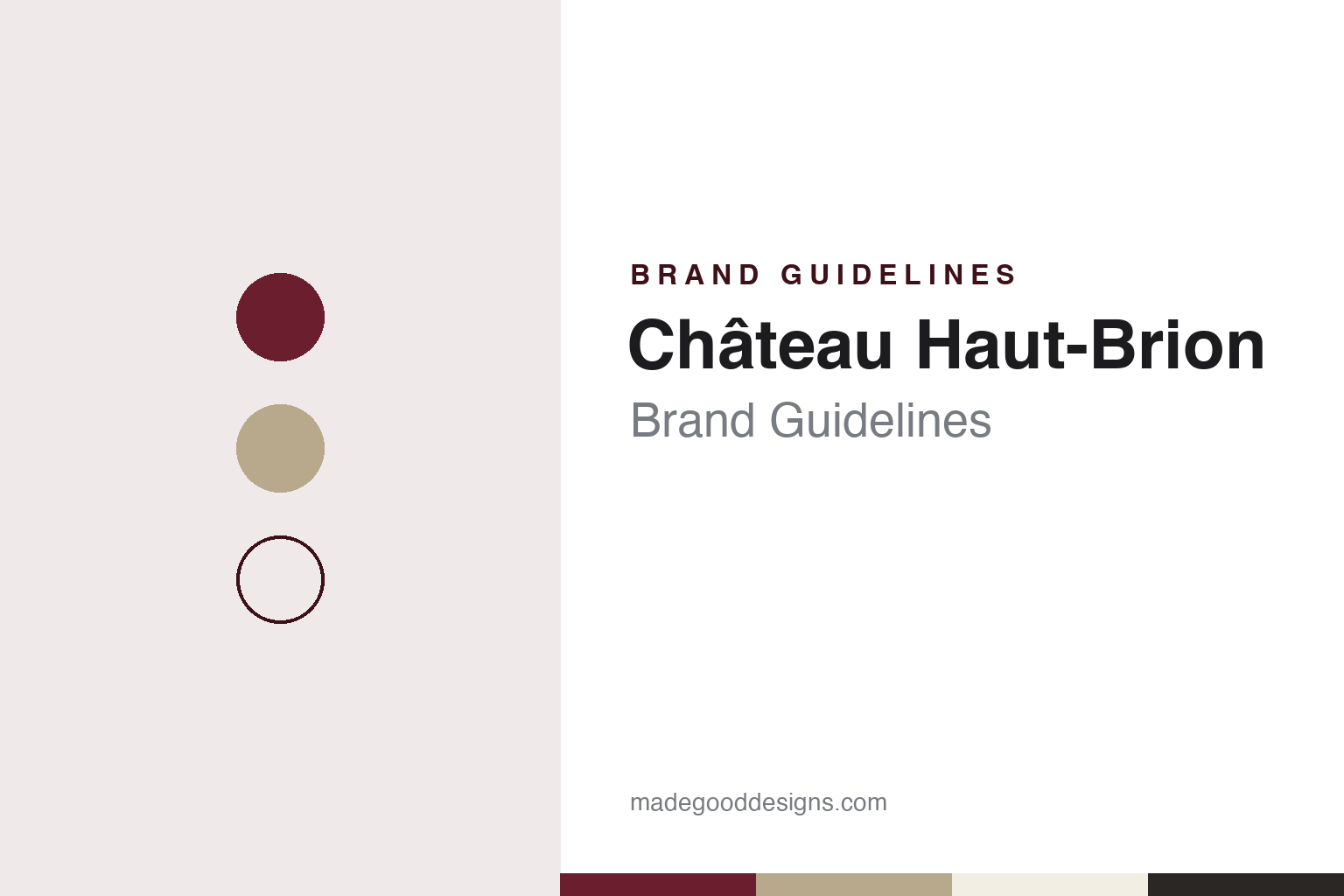
Château Haut-Brion Brand Guidelines
The Pessac first growth, in the Dillon family since 1935.
Aa
Two constants: a Pessac claret, gravel and parchment palette and a classical book serif register. Abstract homage — not a Château Haut-Brion product or mark; no label, logo or bottle is reproduced.
The Pontac estate
A gravel hill on the edge of Bordeaux and a family that named its wine after it.
Château Haut-Brion stands in Pessac, on the south-western edge of the city of Bordeaux, and is the only one of the five first growths that lies outside the Médoc. French Wikipedia places the estate in the communes of Pessac, where the company has its head office, and Talence, in the Pessac-Léognan appellation, which was created in 1987.
The estate as it exists today was assembled by the Pontac family. English and French Wikipedia both date its beginning to April 1525, when Jean de Pontac, a clerk of the Parlement de Bordeaux, married Jeanne de Bellon, whose dowry included land at Haut-Brion; in 1533 he bought the manorial rights from a Basque merchant, Jean Duhalde, and in 1549 he began building the château. The estate itself traces the name further back: it says two manuscripts in the departmental archives of the Gironde, dated 1521 and 1526, already attach the word “cru” to “Aubrion” or “Haulbrion” to describe the wine made there.
The wine’s reputation was made in England. Arnaud III de Pontac, who owned the estate from 1649 and became first president of the Parlement de Bordeaux, is credited by French Wikipedia with techniques such as topping up and racking that let the wine age. English Wikipedia records “Hobriono” in the cellar book of King Charles II in 1660, now held by the British National Archives, and Samuel Pepys wrote in his diary on 10 April 1663 of drinking “Ho Bryen” at the Royal Oak Tavern. In 1666 Arnaud’s son François-Auguste opened an eating-house in London, Pontack’s Head. The historian Charles Ludington, quoted by English Wikipedia, describes Pontac as having improved and named a wine from a small, defined area of land to raise its value for English buyers.
Visitors kept writing it down. The philosopher John Locke described the vineyard’s white sand and gravel in 1677, and Thomas Jefferson, then the American minister to France, visited on 25 May 1787 and the next day wrote to his brother-in-law Francis Eppes about sending wine “of the vineyard of Obrion,” one of the four he ranked as the best in Bordeaux.
Colour
Pontac, Fumel, Talleyrand, Larrieu — and then Dillon.
After the Pontacs the estate passed by marriage to the Fumel family, and after the Revolution their heirs sold it, on 28 February 1801, to Talleyrand, then Napoleon’s foreign minister, who sold it again in 1804, French Wikipedia records. On 12 March 1836 the Parisian banker Joseph-Eugène Larrieu bought it at auction, and his family held it until the early 1920s. It was under the Larrieus, in 1855, that the Bordeaux brokers drew up the classification for the Paris Exposition Universelle in which Haut-Brion was named a first growth alongside Lafite, Latour and Margaux — the only one of them from the Graves. Haut-Brion was also listed when the Graves got its own classification, drawn up in 1953 and revised in 1959.
The modern era began on 13 May 1935, when the American banker Clarence Dillon, president of the New York bank Dillon, Read & Co., bought the estate, French Wikipedia and the estate both record. His nephew Seymour Weller ran the company that held it — the Société Vinicole de la Gironde, later Domaine Clarence Dillon — for four decades, keeping on Georges Delmas, the estate manager since 1921. The Delmas family stayed for three generations: Georges’s son Jean-Bernard Delmas took over in 1961, oversaw the move to stainless-steel fermentation vats in the 1960s and began clonal-selection research with INRA in 1972, and his son Jean-Philippe Delmas succeeded him in 2003, English Wikipedia says.
The family line runs through Clarence Dillon’s granddaughter Joan Dillon, who succeeded Weller in 1975 and, the estate says, renovated the château’s interiors, created its park and opened a new vat house in 1991. In 1983 the company bought its long-time neighbour and rival, Château La Mission Haut-Brion. Her son, Prince Robert of Luxembourg, joined the management full time in 1997 and became its head in 2008; Decanter described him in March 2023 as chairman and chief executive of Domaine Clarence Dillon, and the estate calls him the fourth generation of the family.
The vineyard and cellars are on the estate itself in Pessac, around the château and across the main road, and English Wikipedia notes that Haut-Brion has its own cooperage.
Typography
Design and documentation.
The seven brands in this group are all Bordeaux châteaux: Château Haut-Brion, Château Cheval Blanc, Château Ausone, Château Palmer, Château Lynch-Bages, Château Pichon Baron and Château Cos d’Estournel. Bordeaux estates in general sit at many different points in the trade, from properties still held by the families whose names they carry to estates that now belong to insurers, industrial groups or private investors, and a single estate’s wine can travel from its own cellar to merchants and restaurant lists around the world.
A Bordeaux château’s identity is usually carried less by a single bottle than by a label, a name and the place it promises, because the estate behind the name may have changed hands, been enlarged or been rebuilt many times since it began. That makes the questions behind each name worth asking plainly: who founded it, who owns it now, and where its wine is actually made and bottled.
Each guide separates what independent sources record from what the estate says about itself — its founding story, its owners over time, where its wine is made and how its labels and buildings have changed — and marks plainly what rests only on the estate’s own word.
Aa
A classical book serif for a name first written down in the 1500s. (Specimen set in Cormorant Garamond, a serif STAND-IN; NOT the Château Haut-Brion logo or label lettering.)
Château Haut-Brion
A decanter bottle, a family of wines and a library.
The most visible design decision of the Dillon era is the bottle. English Wikipedia says Haut-Brion began using its distinctive shape, modelled on old decanters, with the 1958 vintage, released in 1960. French Wikipedia notes that the silhouette of the château built by Jean de Pontac appears on the labels. The estate’s current website, in its source files, loads typefaces including Chevalier, an extended Egyptian slab and Elemental Sans — a web choice, not a label specification.
The names of the other wines have been tidied around the founder. With the 2007 vintage, marking 75 years of Dillon ownership, the red second wine long sold as Château Bahans Haut-Brion became Le Clarence de Haut-Brion, and the white second wine formerly called Les Plantiers du Haut-Brion became La Clarté de Haut-Brion. The group has also grown beyond Pessac: Decanter reported in May 2015 that Domaine Clarence Dillon had completed its purchase of Château L’Arrosée in Saint-Émilion and merged it into Château Quintus, the former Tertre Daugay. Its Clarendelle range, which Decanter said in 2023 had been revitalised in 2019 with a new logo and identity, was then announced as the exclusive red and white wine partner of the Oscars from 2023.
The company has leaned into history as part of the brand. In October 2018 Domaine Clarence Dillon became the twelfth member of the Primum Familiae Vini, a group of family-owned wine producers, Decanter reported. The estate says Prince Robert built a new library at the château for rare books on wine and gastronomy, and that the restored Pavillon Catelan opened to visitors in 2021.
For a design guide, Château Haut-Brion shows how a wine can carry the name of a single hill for five centuries, while its owners shape the bottle, the second-wine names and even a library into one coherent story. Compare Château Margaux and Château Mouton Rothschild, two of its fellow first growths. For this guide we use Pessac claret, gravel and parchment with a serif, an unofficial interpretation; no product or logo is reproduced.
Explore & save
Keep Château Haut-Brion’s identity on hand — save it to a board in the Made Good inspiration library.
Château Haut-Brion identity set
Pin the Château Haut-Brion Pessac claret, gravel and parchment palette and the classical book serif register to your own board.