Château Margaux Brand Guidelines
The Médoc first growth with a neoclassical house on its label.
Aa
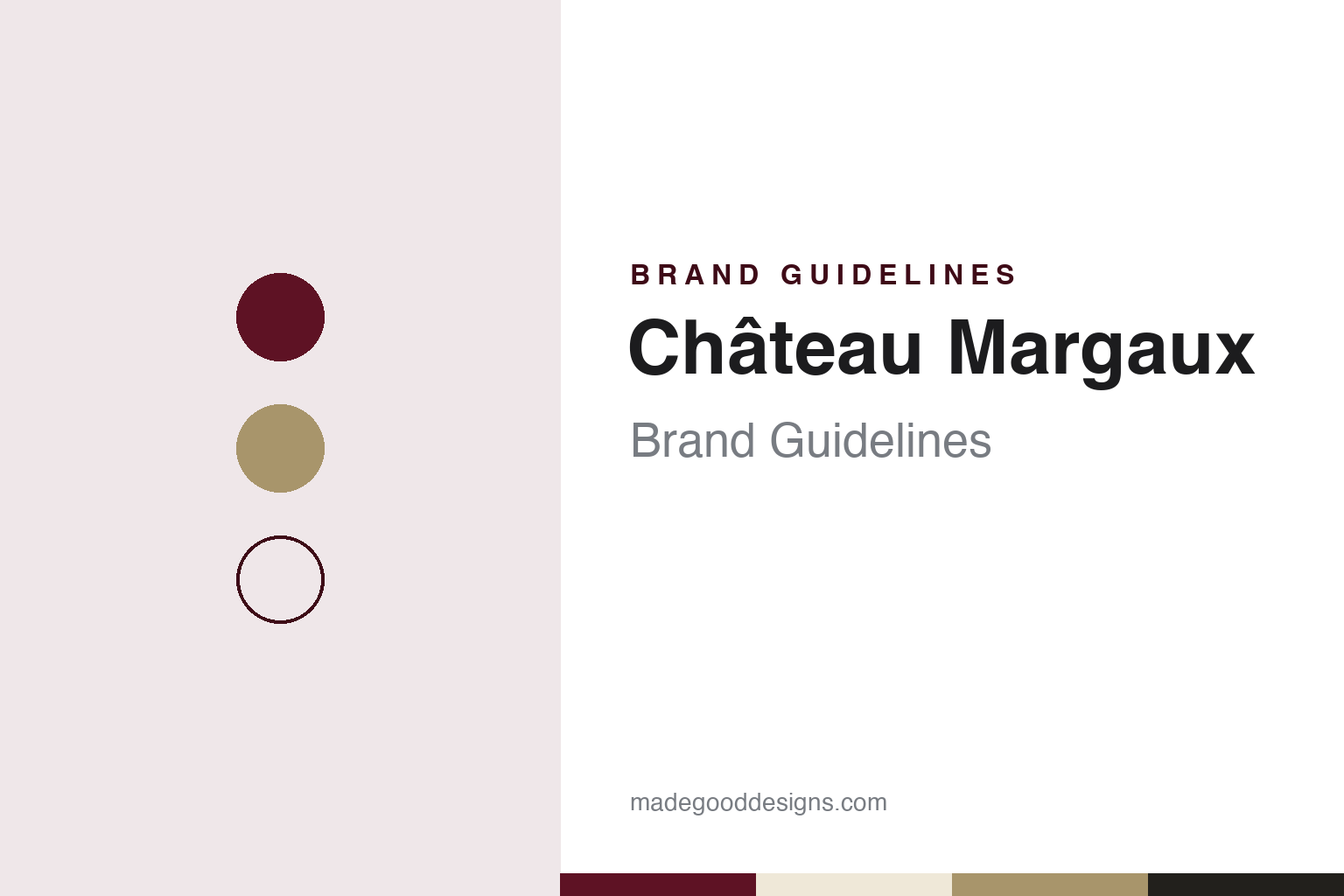
Two constants: a claret, gravel gold and façade stone palette and a classical book serif register. Abstract homage — not a Château Margaux product or mark; no label, logo or bottle is reproduced.
La Mothe and the Lestonnacs
A fortified mound, a line of noble owners and a first growth.
Château Margaux stands in the commune of Margaux, on the left bank of the Gironde estuary in the Médoc, and its red wine belongs to the Margaux appellation. The site is old. French Wikipedia traces it to a thirteenth-century fortress known as the château de La Mothe Margaux, and English Wikipedia gives the archaic name of the estate as La Mothe de Margaux, from motte, a small rise in the land. Wine under names such as “Margou” was known by the fifteenth century, English Wikipedia says.
Wine became central under the Lestonnac family in the sixteenth century. English Wikipedia says Pierre de Lestonnac expanded the property in the 1570s and cleared grain fields to plant vines, and French Wikipedia credits Olive de Lestonnac, who bought the noble house of Lamothe-Margaux in 1610, with forming the heart of the estate. Ownership then passed through related families, including the d’Aulède and Fumel lines, and a 1654 marriage alliance with the Pontac family of Château Haut-Brion. By the early eighteenth century the estate covered 265 hectares, about a third of them under vine, close to its modern shape, and an estate manager named Berlon changed the way the wine was made, banning early-morning picking of dew-covered grapes, English Wikipedia says.
Its reputation spread abroad. English Wikipedia says that in 1771 wine from the estate became the first claret sold at Christie’s, and that Thomas Jefferson, visiting Bordeaux in 1787, counted Château Margaux among the “four vineyards of first quality.” The French Revolution broke the old line: the owner, Élie du Barry, was executed, and the estate was confiscated. In 1802 it was bought by Bertrand Douat, who styled himself the Marquis de la Colonilla.
In the Bordeaux classification of 1855, Château Margaux was ranked a first growth, or premier cru. French Wikipedia notes that it shares that rank with Lafite Rothschild, Latour, Mouton Rothschild and Haut-Brion.
Colour
Louis Combes, a neo-Palladian house and a run of owners.
The building that gives the estate its image came from Douat. French Wikipedia says he had the old fortified château and its outbuildings demolished, keeping only an eighteenth-century orangery, and in 1810 commissioned the Bordeaux architect Louis Combes to rebuild in a neoclassical style. The present château, built between 1810 and 1815, is neo-Palladian, with a colossal portico of four Ionic columns under a triangular pediment; French Wikipedia calls it the most important neoclassical building in the Bordeaux region. The chais, the barrel halls, are a hundred metres long, with an oak roof frame carried on Doric columns, and the park was laid out by Toussaint-Yves Catros. The château was listed as a historic monument in 1946, a listing confirmed in 1965.
Owners came and went through the nineteenth and twentieth centuries. In 1816 the estate passed from Douat to his four children. On 17 August 1835 it was bought by the Spanish-born banker Alejandro María Aguado, who hosted friends there such as the composer Rossini, French Wikipedia says. In 1879 it was bought by Frédéric Pillet-Will, a regent of the Banque de France, and French Wikipedia credits him with creating the estate’s second wine, Pavillon Rouge, before phylloxera undid much of his work.
In 1925 shares in the estate went to a company led by the wine broker Pierre Moreau, and the Bordeaux merchant Fernand Ginestet bought a large stake the same year, English Wikipedia says; his son Pierre Ginestet became sole owner in 1949. In 1965 Pierre Ginestet decided that the vintage year would appear only on great vintages, with lesser years sold without one, as in Champagne. Margaux’s name reached the stage too: Chateau Margaux, a one-act zarzuela by Manuel Fernández Caballero, opened at the Teatro Variedades in Madrid on 5 October 1887, French Wikipedia says.
Today the vineyard covers about 87 hectares entitled to the Margaux appellation, planted mostly with Cabernet Sauvignon, with Merlot and small amounts of Cabernet Franc and Petit Verdot, and 12 hectares of Sauvignon Blanc for the white Pavillon Blanc, English Wikipedia says.
Typography
Design and documentation.
The seven brands in this group are all French wine names: Château Lafite Rothschild, Château Mouton Rothschild, Pétrus, Château Margaux, Château d’Yquem, Whispering Angel and Miraval. French wine brands in general sit at many different points in the trade, from old estates that have carried the same name for centuries to labels that now belong to families, investors or much larger drinks groups, and a single name can be poured everywhere from a neighbourhood bistro to a grand restaurant list.
A wine brand’s identity is usually carried less by a single bottle than by a label, a name and the place it promises, because the company behind the name may have changed hands, added new wines or grown far beyond the estate where it started. That makes the questions behind each name worth asking plainly: who started it, who owns it now, and where its wine is actually grown, made and bottled.
Each guide separates what independent sources record from what the company says about itself — its founding story, its owners over time, where its wine is made and how its labels have changed — and marks plainly what rests only on the company’s own word.
Aa
A classical book serif for a first growth with a neoclassical château built from 1810. (Specimen set in Cormorant Garamond, a serif STAND-IN; NOT the Château Margaux logo.)
Château Margaux
The Mentzelopoulos years and a Norman Foster cellar.
After the Bordeaux market crisis of 1973, the Ginestet family had to sell. English Wikipedia says an attempt by the American firm National Distillers & Chemical Corporation to buy the estate was blocked by the French government, which regarded Château Margaux as a national treasure. The buyer was André Mentzelopoulos, the Greek-born head of the French grocery group Félix Potin: French Wikipedia dates his purchase to 1977, English Wikipedia to 1976. He restored the vineyard, cellars and house, with the oenologist Émile Peynaud advising, and the 1978 and 1979 vintages were declared exceptional.
His daughter Corinne Mentzelopoulos then ran the estate for 43 years. In 1990 she brought in the Agnelli family as majority partner, French Wikipedia says, and in 2003 she bought back their stake to become sole shareholder. She worked with Paul Pontallier, who joined in 1983, became managing director in 1990 and founded a research and development department in 2000; Philippe Bascaules, who first joined in 1990, succeeded him as head of the estate. At the end of 2023 Corinne’s son Alexis Leven-Mentzelopoulos became chief executive, the estate says, and her daughter Alexandra Petit-Mentzelopoulos chairs the supervisory board of the family holding company.
The house has been joined by new architecture. On 16 June 2015, during the bicentenary of the château, the estate opened buildings designed by Lord Norman Foster: an 800-square-metre cellar extending the old chais, with the research centre at its heart, an underground library of past vintages and a new visitor centre, French Wikipedia says. Decanter reported that the new cellar would let the red and white wines be made in the same part of the estate for the first time since the late 1970s.
Beside the Grand Vin, the estate makes Pavillon Rouge du Château Margaux, a third wine called Margaux du Château Margaux since 2009, and Pavillon Blanc du Château Margaux, a Sauvignon Blanc sold as Bordeaux because the Margaux appellation covers only red wine; a Pavillon Blanc Second Vin followed in 2024.
For a design guide, Château Margaux shows how a single neoclassical façade, built two centuries ago, can serve as a brand’s face. Compare Château Lafite, a fellow Médoc first growth of 1855, and Pétrus, the Pomerol estate with no château at all. For this guide we use claret, gravel gold and façade stone with a classical serif, an unofficial interpretation; no product or logo is reproduced.
Explore & save
Keep Château Margaux’s identity on hand — save it to a board in the Made Good inspiration library.
Château Margaux identity set
Pin the Château Margaux claret, gravel gold and façade stone palette and the classical book serif register to your own board.