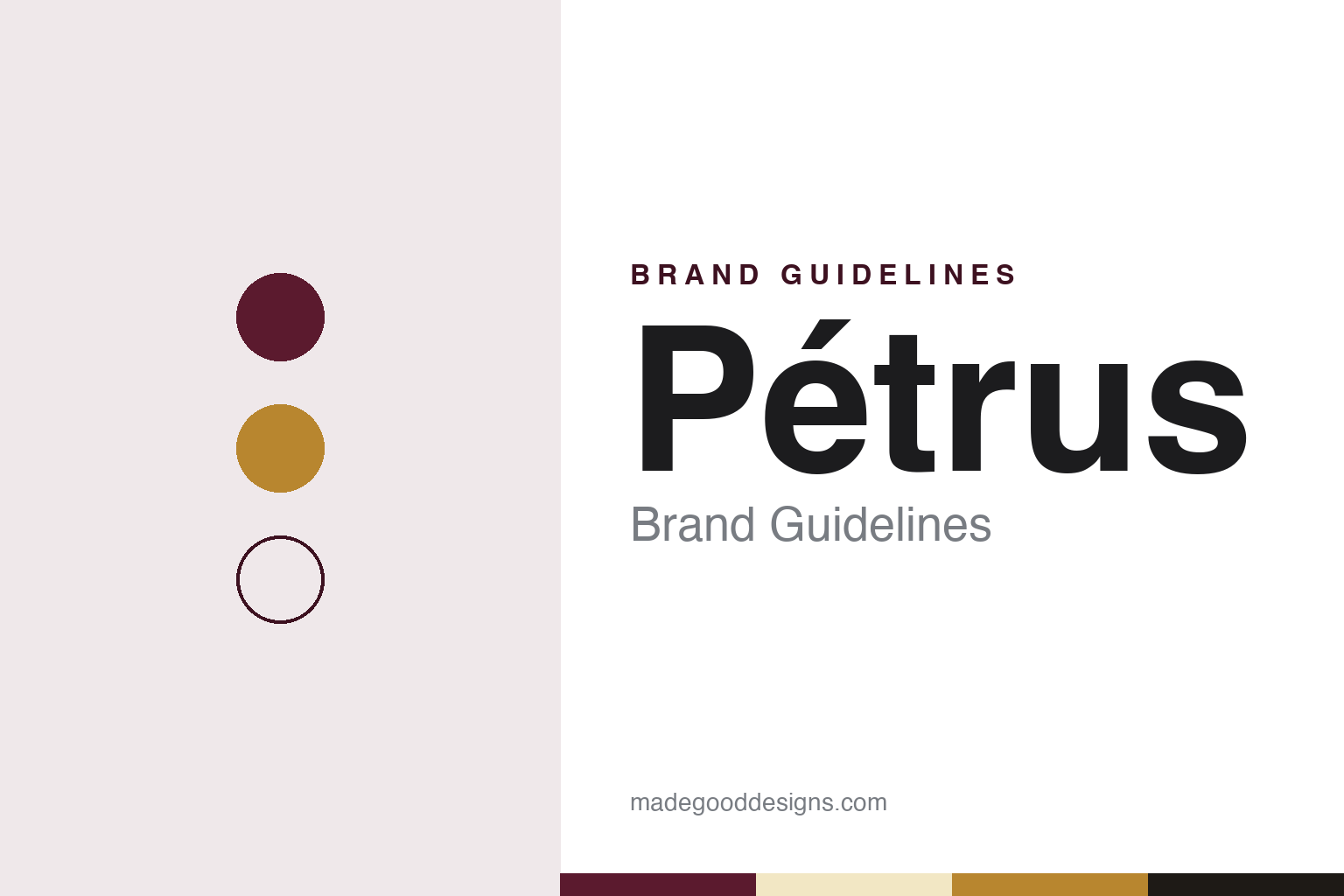
Pétrus Brand Guidelines
The Pomerol Merlot estate of Madame Loubat and the Moueix family.
Aa
Two constants: a Merlot plum, key gold and pale label yellow palette and a classical book serif register. Abstract homage — not a Pétrus product or mark; no label, logo or bottle is reproduced.
The Arnaud years and Madame Loubat
A small Pomerol vineyard, a gold medal and a hotelier’s widow from Libourne.
Pétrus is a wine estate in Pomerol, the small Bordeaux appellation on the right bank, close to its eastern border with Saint-Émilion. English Wikipedia says the vineyard was owned by the Arnaud family from the end of the eighteenth century and that the name first appears in records in 1837. In the 1868 edition of Cocks & Féret, the Bordeaux reference guide, Pétrus was listed behind Vieux Château Certan and alongside Château Trotanoy, and some vintages of the period were labelled “Petrus-Arnaud.”
The estate’s first public success came in Paris. English Wikipedia says Pétrus won a gold medal at the Exposition Universelle of 1878, which lifted it to the standing of a Médoc second growth, the first Pomerol wine to reach that level. Pomerol has never had an official classification, so reputation, rather than a ranking, has carried the name ever since.
In 1917 the Arnaud family sold, and a share-holding company, the Société Civile du Château Pétrus, was set up. Around 1925 Madame Loubat, the widow of Edmond Loubat and owner of the Hôtel Loubat in Libourne, began buying shares. English Wikipedia says she kept buying until 1945, when she became sole owner. She also owned Château Latour à Pomerol, and she is remembered for her close attention to detail and her insistence that her wine stood level with the great crus of the Médoc. In 1947, English Wikipedia says, she presented two magnums of the 1938 vintage to the Lord Mayor of London, on a visit to Pomerol, for the wedding of Princess Elizabeth.
The vineyard nearly failed in the winter of 1956, when frost killed about two-thirds of the vines. Rather than replant, Madame Loubat had the surviving vines cut back hard so they could regrow from their old rootstocks, a practice known as recépage. English Wikipedia says the method had not been tried in the region before, and that it kept the average age of the vines high.
Colour
Jean-Pierre Moueix, the Berrouets and a single grape.
The second family in the story arrived in 1945. That year Jean-Pierre Moueix, whose négociant house, Établissements Jean-Pierre Moueix, was based in Libourne, took the exclusive right to sell Pétrus, English Wikipedia says. The wine writer David Peppercorn, quoted there, dated “the great age of Petrus” from the end of the Second World War and the 1945 vintage. Pétrus reached the United States, and in the 1960s it was promoted by Henri Soulé, the owner of the New York restaurant Le Pavillon.
In 1961 the estate passed to Madame Loubat’s niece, Lily Lacoste-Loubat, and her nephew, M. Lignac, with a share left to Jean-Pierre Moueix to settle any deadlock between them. In 1964 Moueix bought the Lignac shares, and the oenologist Jean-Claude Berrouet joined Pétrus for good; Émile Peynaud had earlier advised the estate part-time. In 1969 five hectares bought from neighbouring Château Gazin enlarged the vineyard from seven to 11.4 hectares, the size it remains today.
Jean-Claude Berrouet made the wine for 45 vintages and retired as technical director in 2008, English Wikipedia says; his son Olivier Berrouet took over the vineyard and the cellar, and Decanter dates the handover to January 2008. The vineyard sits on a plateau in the east of Pomerol, on a mound that English Wikipedia calls the Pétrus “boutonnière,” or buttonhole, where the soils are rich in iron-bearing clay rather than the gravel and sand of the neighbours. The estate was among the first in Bordeaux to thin out bunches in summer to lower yields, a practice called green harvesting.
Pétrus makes a single wine and no second wine. Since the end of 2010 the vineyard has been planted entirely with Merlot. English Wikipedia says the grapes are picked by hand over two or three days and aged in oak barrels, half of them new, for between 12 and 16 months, and that in 1956, 1965 and 1991 no Pétrus was made at all because the harvest was not good enough. Decanter lists 2012 as the first vintage made in new vinification cellars, with twelve unlined concrete vats in place of the earlier eight.
Typography
Design and documentation.
The seven brands in this group are all French wine names: Château Lafite Rothschild, Château Mouton Rothschild, Pétrus, Château Margaux, Château d’Yquem, Whispering Angel and Miraval. French wine brands in general sit at many different points in the trade, from old estates that have carried the same name for centuries to labels that now belong to families, investors or much larger drinks groups, and a single name can be poured everywhere from a neighbourhood bistro to a grand restaurant list.
A wine brand’s identity is usually carried less by a single bottle than by a label, a name and the place it promises, because the company behind the name may have changed hands, added new wines or grown far beyond the estate where it started. That makes the questions behind each name worth asking plainly: who started it, who owns it now, and where its wine is actually grown, made and bottled.
Each guide separates what independent sources record from what the company says about itself — its founding story, its owners over time, where its wine is made and how its labels have changed — and marks plainly what rests only on the company’s own word.
Aa
A classical book serif for a Pomerol estate named in records from 1837. (Specimen set in Cormorant Garamond, a serif STAND-IN; NOT the Pétrus logo.)
Pétrus
Saint Peter, a key and a name without “château”.
The name and the label point to Saint Peter, whose Latin name is Petrus. Decanter says the image of the saint first appeared on the Pétrus label in the 1940s, commissioned by Madame Loubat, and that the iron railings at the estate entrance carry the crossed keys of Saint Peter. The wine writer behind The Wine Doctor describes the label as pale yellow, with Saint Peter holding the key to the gates of heaven. A United States trademark record for the “P Petrus Pomerol Grand Vin” mark describes a shield framed with vines, a man holding a key and the letter P.
The estate has also trimmed its own name. English Wikipedia calls it Petrus, “formerly known as Château Pétrus,” and Decanter notes that it no longer uses the word “château,” and that there is no château building on the estate. This guide keeps the accented spelling, Pétrus.
Ownership has stayed in one family line since the 1960s. After 2003 the estate passed from Jean-Pierre Moueix to his son Jean-François Moueix, the head of Groupe Duclot, English Wikipedia says, and he and his children now own it. Sales moved from the Moueix négociant house to a family company, Clés Distribution, in the early 2010s; Decanter dates the change to 2012, The Drinks Business to 2013 and English Wikipedia to 2014. In September 2018, English Wikipedia says, people close to Jean-François Moueix confirmed that a 20 percent stake in the company had been sold to the businessman Alejandro Santo Domingo.
The name should not be confused with Château La Fleur-Pétrus, a separate Pomerol estate.
For a design guide, Pétrus shows how a saint’s name, a single key and a pale label can carry a wine with no château, no second wine and no official classification. Compare Château Margaux, the Médoc first growth with a château on its label, and Bollinger, another French wine house still in family hands. For this guide we use Merlot plum, key gold and pale label yellow with a classical serif, an unofficial interpretation; no product or logo is reproduced.
Explore & save
Keep Pétrus’s identity on hand — save it to a board in the Made Good inspiration library.
Pétrus identity set
Pin the Pétrus Merlot plum, key gold and pale label yellow palette and the classical book serif register to your own board.