Château Lafite Rothschild Brand Guidelines
The Pauillac first growth owned by the Rothschilds since 1868.
Aa
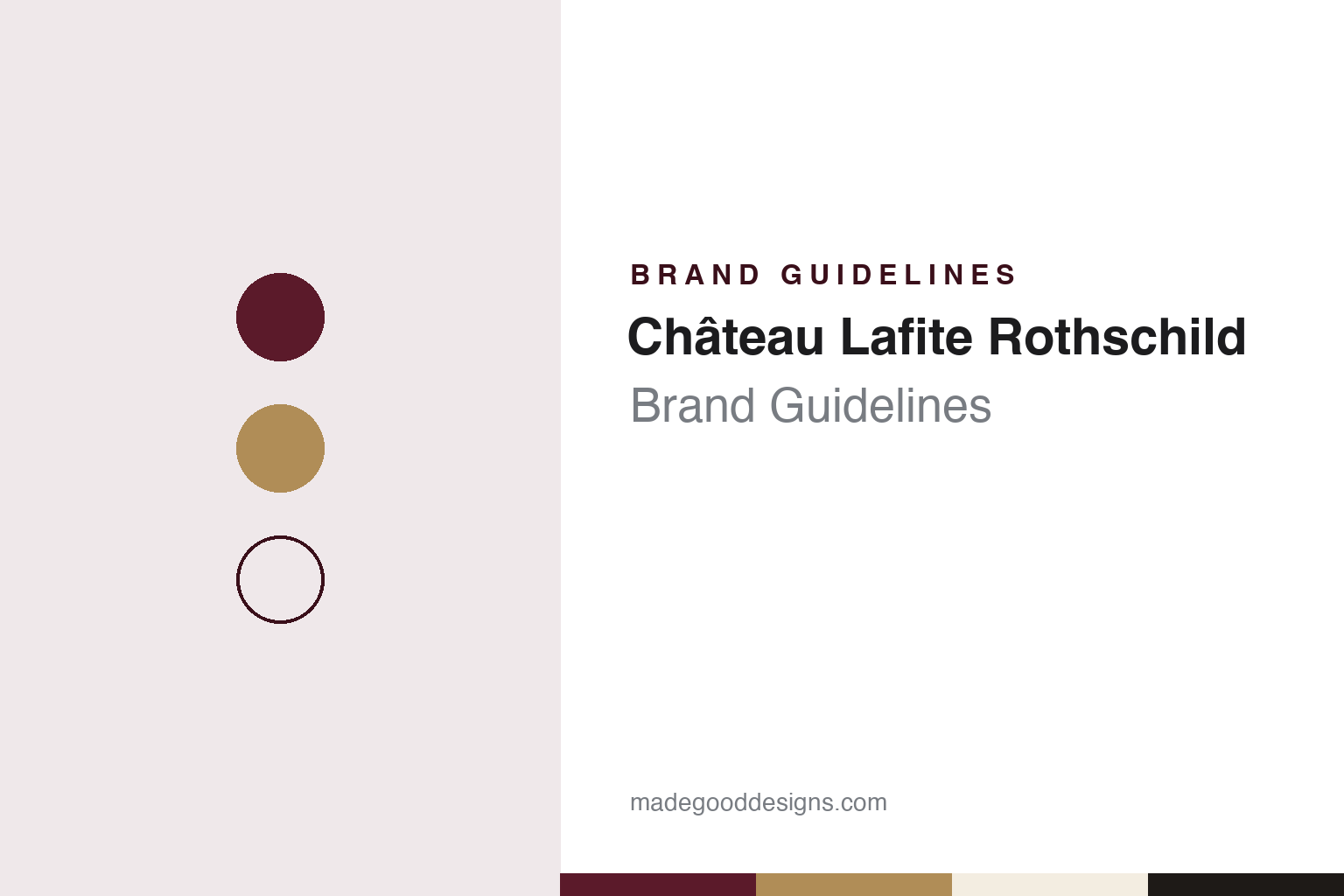
Two constants: a claret, old gold and label cream palette and a classical engraved serif register. Abstract homage — not a Château Lafite Rothschild product or mark; no label, logo or bottle is reproduced.
From the Ségurs to the Rothschilds
An estate with a long record before the family arrived.
Château Lafite Rothschild is a wine estate in Pauillac, in the Médoc north of Bordeaux. Its own history page says the château is cited as a wine producer in 1234, and English Wikipedia names Gombaud de Lafite as its holder in that year. The vineyard as it is known today took shape under the Ségur family, who bought the estate in the 17th century: French Wikipedia dates the first trace of a significant vineyard to about 1680, planted by Jacques de Ségur, and English Wikipedia says that in the early 18th century Nicolas-Alexandre, marquis de Ségur, refined the winemaking and became known as the “Wine Prince.” French Wikipedia says the Duke of Richelieu introduced the wine to the court at Versailles around 1760.
The Revolution ended the Ségur period. English Wikipedia says the estate became public property in the 1790s and was sold in 1797 to a group of Dutch merchants; in the first half of the 19th century it belonged to the Vanlerberghe family.
In the 1855 classification of Bordeaux wines Lafite was one of the four estates ranked premier cru, or first growth. Thirteen years later the Rothschilds arrived. French Wikipedia says that on 8 August 1868 Baron James de Rothschild bought the château at a public sale following the Vanlerberghe estate, and the property took the name Château Lafite Rothschild. English Wikipedia says that the same year it passed jointly to his three sons, Alphonse, Gustave and Edmond.
The company’s history page describes the generations that followed managing the estate “from the phylloxera crisis to the Great Depression, in peace and in war.” English Wikipedia says the German army occupied the château during the Second World War and plundered its cellars.
Colour
Three parcels, one grand vin and a second wine named after a plateau.
The post-war estate was shaped by three family members in turn. French Wikipedia says Élie de Rothschild ran Lafite from 1946 to 1974 and was succeeded by his nephew Éric de Rothschild; English Wikipedia dates Éric’s tenure from 1974 and French Wikipedia from 1975. Decanter reported at the end of 2017 that Éric would step down as chairman after 35 years at the head of the group, and that his daughter Saskia de Rothschild, co-chairman with him for two years, would take over from April 2018. The company calls her a member of the sixth generation.
The vineyard is one of the largest in the Médoc. French Wikipedia describes three parcels: the slopes around the château, the Carruades plateau to the west, and a plot of about 4.5 hectares in the neighbouring Saint-Estèphe appellation. English Wikipedia gives the plantings as about 70 percent Cabernet Sauvignon and 25 percent Merlot, with small amounts of Cabernet Franc and Petit Verdot, and notes that the 1961 vintage was made entirely from Cabernet Sauvignon. French Wikipedia says the château was listed as a French historic monument on 22 November 1989.
The second wine is Carruades de Lafite. The company’s wine directory says the Carruades plateau, next to the estate’s best vineyards, was bought in 1845, and that the second wine was called “Moulin des Carruades” before the 1980s. English Wikipedia says about a third of production is released under the Carruades name.
The name itself has been contested. French Wikipedia says Lafite began trying in 2003 to block a “Château Lafitte” brand owned by another family; the Cour de cassation, France’s highest court, rejected Lafite’s claims in 2010, and in September 2015 China’s trademark authority rejected its challenge there.
Typography
Design and documentation.
The seven brands in this group are all French wine names: Château Lafite Rothschild, Château Mouton Rothschild, Pétrus, Château Margaux, Château d’Yquem, Whispering Angel and Miraval. French wine brands in general sit at many different points in the trade, from old estates that have carried the same name for centuries to labels that now belong to families, investors or much larger drinks groups, and a single name can be poured everywhere from a neighbourhood bistro to a grand restaurant list.
A wine brand’s identity is usually carried less by a single bottle than by a label, a name and the place it promises, because the company behind the name may have changed hands, added new wines or grown far beyond the estate where it started. That makes the questions behind each name worth asking plainly: who started it, who owns it now, and where its wine is actually grown, made and bottled.
Each guide separates what independent sources record from what the company says about itself — its founding story, its owners over time, where its wine is made and how its labels have changed — and marks plainly what rests only on the company’s own word.
Aa
A classical engraved serif in the spirit of a Bordeaux château label. (Specimen set in Cormorant Garamond, a serif STAND-IN; NOT the Château Lafite Rothschild logo.)
Château Lafite Rothschild
One château at the centre of a group of estates.
Lafite is the flagship of Domaines Barons de Rothschild (Lafite), often shortened to DBR Lafite. The company’s own timeline lists how the group grew around it: Château Duhart-Milon in Pauillac in 1962; Château Paradis Casseuil in Entre-deux-Mers and Château Rieussec in Sauternes in 1984; Viña Los Vascos in Chile in 1988; Château L’Évangile in Pomerol in 1990; Domaine d’Aussières in Corbières, Bodegas CARO in Mendoza and the Les Légendes R range of Bordeaux wines in 1999; Domaine de Long Dai in Shandong, China, in 2008; and Domaine William Fèvre in Chablis in 2024.
Long Dai is the group’s furthest reach. English Wikipedia, citing The Economist of September 2019, describes a vineyard of about 30 hectares in Shandong planted with vines brought from France, and says the estate released its first vintage in 2019. The company presents its work across these estates as one family approach applied “hand in hand with nature,” and French Wikipedia says Lafite holds B Corp certification.
It is worth keeping the two Rothschild first growths apart. Lafite belongs to the branch descended from Baron James; its Pauillac neighbour Château Mouton Rothschild, bought by Baron Nathaniel de Rothschild in 1853, is owned by a separate company, Baron Philippe de Rothschild SA.
For a design guide, Château Lafite Rothschild shows how a name, a place and an 1855 rank can serve as an identity on their own. Compare Château Mouton Rothschild, the neighbour that made its labels a gallery, and Château Margaux, another 1855 first growth. For this guide we use claret, old gold and a cream with a serif, an unofficial interpretation; no product or logo is reproduced.
Explore & save
Keep Château Lafite Rothschild’s identity on hand — save it to a board in the Made Good inspiration library.
Château Lafite Rothschild identity set
Pin the Château Lafite Rothschild claret, old gold and label cream palette and the classical engraved serif register to your own board.