Château d’Yquem Brand Guidelines
The Sauternes estate ranked above every other in 1855.
Aa
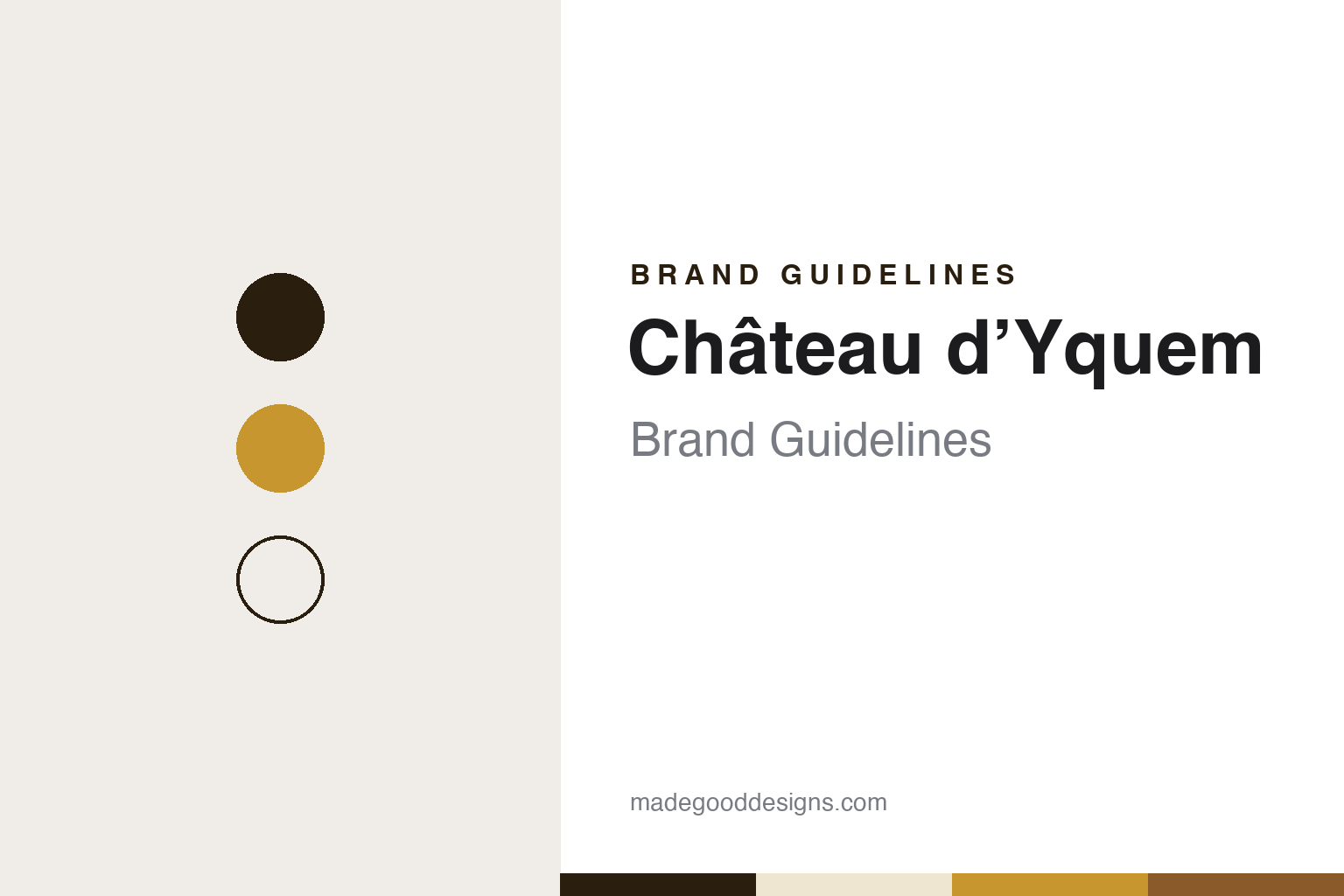
Two constants: a Sauternes gold, deep amber and chalk stone palette and an old-style Garamond serif register. Abstract homage — not a Château d’Yquem product or mark; no bottle, label or logo is reproduced.
Sauvage and Lur-Saluces
Two families, one hill and four centuries.
Château d’Yquem stands on a hill in Sauternes, in the south of the Bordeaux vineyards, above the valley of the little river Ciron. Its recorded history as a family property begins on 8 December 1593, when, French Wikipedia says citing the historian Marguerite Figeac-Monthus, a local notable named Jacques Sauvage became tenant of Yquem and rebuilt the château. LVMH, the estate’s owner today, tells the same story: a century after Aquitaine passed from the English crown to France in 1453, Jacques Sauvage was granted the tenure of Yquem and became the first of a long line of growers. On 16 July 1711 his descendant Léon de Sauvage d’Yquem bought the fief outright and was ennobled. The buildings that survive, a quadrangle around a large courtyard, date from the 16th and 17th centuries; they were listed as a historic monument in 2003 for their chapel frescoes, fireplaces and painted interiors.
The second family arrived by marriage. On 6 June 1785 the last heiress, Françoise-Joséphine de Sauvage d’Yquem, married Louis-Amédée de Lur-Saluces, a cavalry colonel. Within three years she was a widow, and the estate was hers to run; LVMH says she took full charge at the age of about 20 and carried the reputation of Yquem beyond France, before handing on to her grandson in 1851 one of the most prosperous properties in the Bordelais. The best-known early admirer was Thomas Jefferson, who, English Wikipedia says citing Alexis Lichine’s wine encyclopedia, called Sauternes the best white wine of France and named Lur-Saluces as its best maker. In a 1790 letter quoted on French Wikipedia from the estate’s archive, Jefferson ordered wine for himself and for George Washington.
Then came the ranking that still defines the brand. In the official Bordeaux classification of 1855, drawn up for the Paris Exposition Universelle, Yquem was the only wine given the rank of Premier Cru Supérieur, a “superior first growth” placed above every other Sauternes, as LVMH and both English and French Wikipedia note. French Wikipedia credits Romain-Bertrand de Lur-Saluces, who had taken over in 1851, with securing that rank. The Lur-Saluces family would hold the estate for more than two centuries.
Colour
Noble rot, slow picking and a wine withheld.
Yquem is a sweet white wine made from grapes shrivelled by noble rot, the Botrytis cinerea fungus that in some autumns turns from a grower’s enemy into the source of the wine. The estate’s site helps it along: French Wikipedia explains that morning mists rising from the Ciron, followed by dry, windy afternoons, let the fungus concentrate the grapes rather than spoil them. The vineyard is planted with just two grapes, Sémillon and Sauvignon Blanc, with Sémillon the larger share; LVMH speaks of about a hundred hectares of vines on a mosaic of soils.
The work is slow by design. Pickers go through the vineyard several times each autumn, taking only the berries the rot has reached; English Wikipedia, citing the critic Clive Coates, puts the average at six passes and the yield at about nine hectolitres per hectare, well below the Sauternes norm. The grapes are pressed several times, and the wine ages in oak for around three years before bottling. In 2019 the wine magazine Decanter reported that, under Pierre Lurton, that barrel time was shortened to no more than 30 months to reduce the risk of oxidation.
The most telling brand decision at Yquem is the one to sell nothing. When a vintage falls short, no wine is released under the château’s name. An estate booklet published by LVMH in 2010, cited by English Wikipedia, lists nine such years in the 20th century, among them 1910, 1930, 1964, 1972 and 1992, and LVMH’s own page counts “nine missing vintages” in that century. Decanter reported in December 2012 that there would be no 2012 Yquem either. Its cellarmaster Sandrine Garbay told the magazine the vintage was simply too light for what customers expect of Yquem.
Since 1959 the estate has also made a dry white, Ygrec, named after the French word for the letter Y. It is made mainly from Sauvignon Blanc, and English Wikipedia says that after years of appearing only in selected vintages it has been made every year since 2004.
Typography
Design and documentation.
The seven brands in this group are all French wine names: Château Lafite Rothschild, Château Mouton Rothschild, Pétrus, Château Margaux, Château d’Yquem, Whispering Angel and Miraval. French wine brands in general sit at many different points in the trade, from old estates that have carried the same name for centuries to labels that now belong to families, investors or much larger drinks groups, and a single name can be poured everywhere from a neighbourhood bistro to a grand restaurant list.
A wine brand’s identity is usually carried less by a single bottle than by a label, a name and the place it promises, because the company behind the name may have changed hands, added new wines or grown far beyond the estate where it started. That makes the questions behind each name worth asking plainly: who started it, who owns it now, and where its wine is actually grown, made and bottled.
Each guide separates what independent sources record from what the company says about itself — its founding story, its owners over time, where its wine is made and how its labels have changed — and marks plainly what rests only on the company’s own word.
Yquem
An old-style Garamond serif for a Sauternes estate whose papers go back to 1593. (Specimen set in Cormorant Garamond, a serif STAND-IN; NOT the Château d’Yquem logo or label lettering.)
Château d’Yquem
A contested sale, a new president and a change of farming.
The Lur-Saluces era ended in a long public fight. In 1968 the running of Yquem passed from Bertrand de Lur-Saluces, who had led the Sauternes and Barsac growers’ union and pressed for a protected appellation, to his nephew Comte Alexandre de Lur-Saluces. BusinessWeek reported in November 2000 that the comte held only a minority of the shares. In 1996 LVMH, the luxury group chaired by Bernard Arnault, announced it was buying a majority stake from other members of the family; the comte challenged the sale in court, and in December 1998 the Bordeaux Court of Appeal upheld LVMH’s purchase of a first block of shares. Decanter wrote in 2019 that the estate had some 50 shareholders, many ready to sell, and that in 1999 LVMH became the majority shareholder; LVMH dates its acquisition to 1999, and French Wikipedia puts its holding at about 64%.
On 17 May 2004 the comte retired and Pierre Lurton, already head of LVMH’s Château Cheval Blanc in Saint-Émilion, took over; LVMH names him president of Château d’Yquem. Decanter reported that Lurton began offering Yquem en primeur, a sale before bottling that the estate had never used under Lur-Saluces, while keeping the existing team, including technical director Francis Mayeur and cellarmaster Sandrine Garbay, and bringing in the Bordeaux oenology professor Denis Dubourdieu as a consultant. In May 2019, La Revue du vin de France reported, Bernard Arnault announced that Yquem would convert to biodynamic farming.
The estate’s public face is restrained. Its website, yquem.fr, leads with the vintage, the visits and the estate address in Sauternes, and LVMH’s page frames the brand around a handful of numbers: two grape varieties, nine missing vintages, thirteen generations of growers since 1593. The site loads two web fonts, the Söhne sans and a face named Immortel Infra. No official colour palette has been published.
For a design guide, Château d’Yquem shows how a single rank awarded in 1855, a family name kept on the label for two centuries and a habit of withholding weak vintages can carry a brand more than any advertising. Compare Château Margaux, a fellow 1855 first growth, and Château Lafite, the Pauillac first growth; within LVMH, see Dom Pérignon. For this guide we use a Sauternes gold, a deep amber and a chalk stone with a Garamond-style serif, an unofficial interpretation; no product or logo is reproduced.
Explore & save
Keep Château d’Yquem’s identity on hand — save it to a board in the Made Good inspiration library.
Château d’Yquem identity set
Pin the Château d’Yquem Sauternes gold, deep amber and chalk stone palette and the old-style Garamond serif register to your own board.