Cupcake Vineyards Brand Guidelines
The Wine Group’s dessert-named wine, launched 2008.
Aa
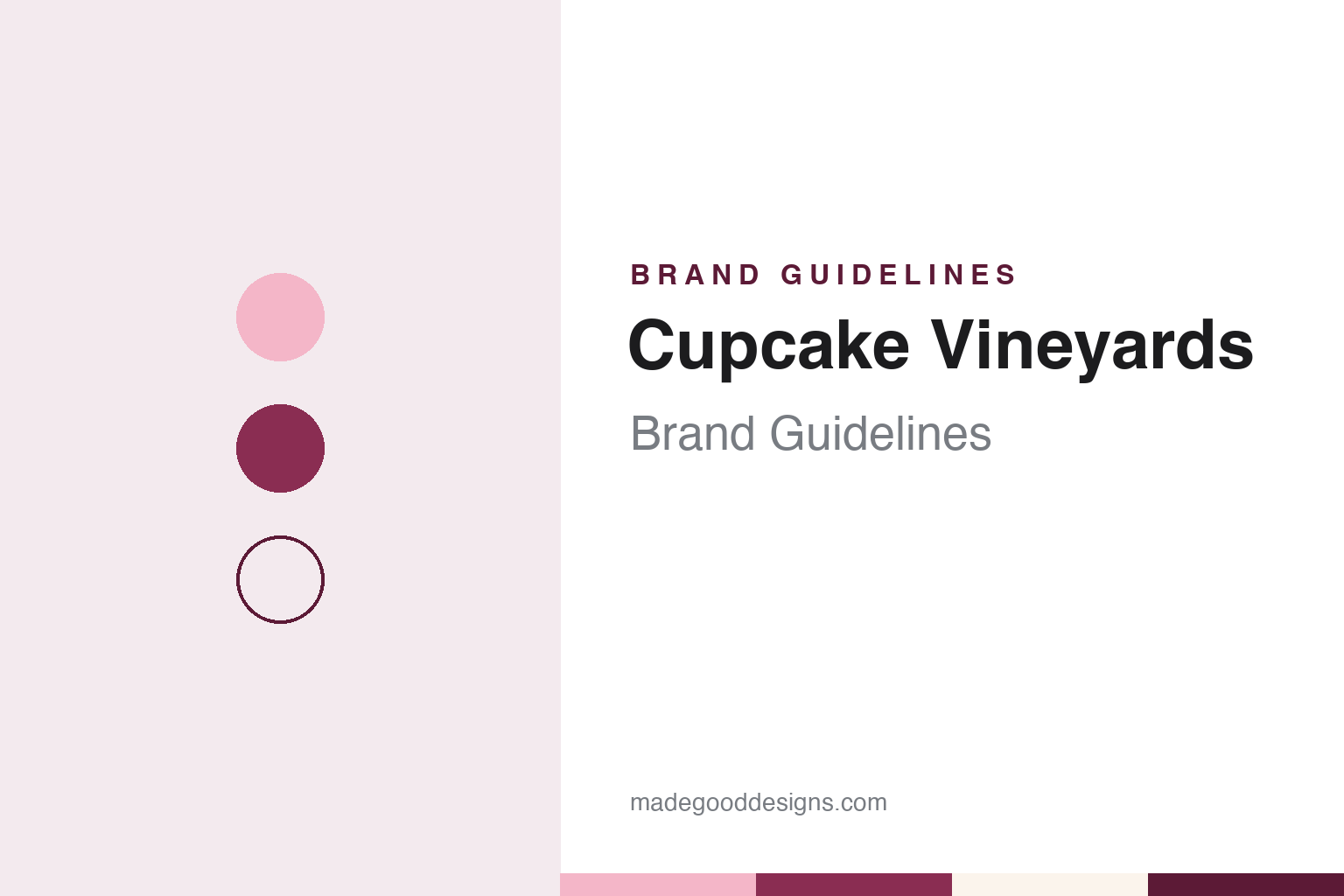
Two constants: a frosting pink, berry and buttercream palette and a soft display serif register. Abstract homage — not a Cupcake Vineyards product or mark; no label, logo or bottle is reproduced.
A brand from The Wine Group
A dessert name on a bottle of everyday wine.
Cupcake Vineyards is not a single estate but a brand, and it belongs to The Wine Group, one of the largest wine companies in the United States. English Wikipedia gives The Wine Group’s founding year as 1981 and its base as Livermore, California, in the Livermore Valley east of San Francisco Bay, and lists Cupcake alongside Franzia, Almaden and Benziger among its brands. The North Bay Business Journal reported in 2018 that the company had become the second-largest wine company in the United States.
The brand itself is young. Shanken News Daily wrote in September 2016 that The Wine Group launched Cupcake Vineyards in 2008 and that it quickly rose to become one of the company’s top-selling brands. The same report, citing Impact Databank, said Cupcake passed one million cases by 2010 and reached about 2.5 million cases by 2013.
Retail data told the same story at the time. Massachusetts Beverage Business reported in April 2012 that Cupcake had again taken the top spot in SymphonyIRI’s annual list of the Top 30 Momentum Wine Brands, a ranking built only from sales measures across brands selling at least 100,000 cases in American food and drug stores in 2011. Barefoot, the Gallo brand, came second that year.
Before 2013 the brand’s winemaker was Adam Richardson: Shanken News Daily reported in October 2013 that he had most recently been winemaker for The Wine Group’s Cupcake brand when he moved to Treasury Wine Estates as chief winemaker for the Americas. Jessica Tomei told VinePair in April 2021 that she was hired in 2013, and the company still names her as Cupcake’s winemaker.
Colour
Dessert names, a pastel register and a joke the brand tells on itself.
The name sets the tone, and the range follows it. Wines are named after desserts and sweet things: the Red Velvet red blend, the Butterkissed Chardonnay, the Black Forest red blend, which Shanken News Daily reported as a new addition in October 2015, and a Citruskissed Pinot Grigio. The idea extended to the brand’s social media: a 2013 Instagram contest called “Share Deliciously” asked fans to suggest a dessert and a label name as inspiration for a new blend, the hospitality-marketing site Social Hospitality reported in January 2013.
The other idea is geography. Tomei told VinePair in 2021 that Cupcake is based in California but was “one of the first brands that were globally grown,” and the company’s site today names three growing areas: Monterey County in California, Marlborough in New Zealand for its Sauvignon Blanc, and the Delle Venezie DOC in north-eastern Italy, with partners in Italy for its Prosecco.
In 2024 the brand chose to make fun of its own name. The trade site shots reported in November 2024 that Erich & Kallman, a San Francisco agency recently appointed to handle creative work for Cupcake and Franzia, had made its first campaign for The Wine Group: three short films, directed by Andrew Laurich, in which a wine expert praising the vineyards is interrupted by people who cannot believe the wine is called Cupcake. The films introduced the tagline “Serious wine. Unserious name.”, which now heads the brand’s website. “The name gave us so much to play with,” the agency’s founder Eric Kallman said, and The Wine Group’s chief marketing officer Helen Kurz said the work kept the brand’s promise of “sparking joy.”
The brand has not always grown in a straight line. In September 2016 Shanken News Daily headlined a report on the brand “Seeking A Comeback, Cupcake Bets On Red Blend And Sparkling Segments.”
Typography
Design and documentation.
The seven brands in this group are all wine names: Chateau Ste. Michelle, Bogle, 14 Hands, Dark Horse, Cupcake, Ménage à Trois and Chandon. Wine brands in general sit at many different points in the trade, from family houses that still carry a founder’s name to labels that now belong to much larger drinks groups, and a single brand can be sold everywhere from a corner shop to a restaurant list.
A wine brand’s identity is usually carried less by a single bottle than by a label, a name and the place it promises, because the company behind the name may have changed hands, moved its production or grown far beyond the place where it started. That makes the questions behind each name worth asking plainly: who started it, who owns it now, and where its wine is actually made and bottled.
Each guide separates what independent sources record from what the company says about itself — its founding story, its owners over time, where its wine is made and how its labels have changed — and marks plainly what rests only on the company’s own word.
Aa
A soft display serif for a brand named after a dessert. (Specimen set in Fraunces, a serif STAND-IN; NOT the Cupcake Vineyards logo.)
Cupcake Vineyards
New formats, and an owner on the move.
The range has kept widening into new formats. Wine Industry Advisor reported in June 2020 on the launch of Cupcake LightHearted, a separate collection of lighter wines, and Tomei told VinePair in 2021 that the brand had begun selling wine in cans. In March 2025 the company announced ready-to-serve Classic and Mango Mimosas and an alcohol-removed Sauvignon Blanc, in a release published on Business Wire. Its website now sorts the wines into four groups: whites and rosé, reds, bubbles, and low and no alcohol.
The owner’s own map has also been changing. Just Drinks reported in November 2024 that The Wine Group had sold Concannon Vineyard, the historic Livermore Valley winery it had owned since 2004, to two Livermore family wine businesses, and that one of the buyers would move into the former Wine Group headquarters building. In July 2026 the Hacienda business community reported that The Wine Group had chosen Hacienda for its corporate center in April 2026 and expected its Livermore office to be fully relocated by early September. Both the Cupcake and Wine Group websites now carry a Ripon, California address, and the Modesto Bee has described the company’s largest production site as lying along Highway 120 north-east of Ripon, in the Central Valley.
The name needs a little care online. “Cupcake” was also the code name of version 1.5 of Google’s Android operating system; the wine brand’s own site is cupcakevineyards.com. The question of the brand’s lettering is covered in our separate note, What Font Does Cupcake Vineyards Use?
For a design guide, Cupcake Vineyards shows how a single playful word, a family of dessert names and, later, a willingness to laugh at itself can carry a wine brand from launch to millions of cases in a few years. Compare Barefoot, the Californian footprint wine that finished second to it on the 2012 momentum list, and 14 Hands, another wine brand built for supermarket shelves. For this guide we use frosting pink, berry and buttercream with a serif, an unofficial interpretation; no product or logo is reproduced.
Explore & save
Keep Cupcake Vineyards’s identity on hand — save it to a board in the Made Good inspiration library.
Cupcake Vineyards identity set
Pin the Cupcake Vineyards frosting pink, berry and buttercream palette and the soft display serif register to your own board.