Barefoot Brand Guidelines
The footprint wine revived in a Sonoma laundry room.
Aa
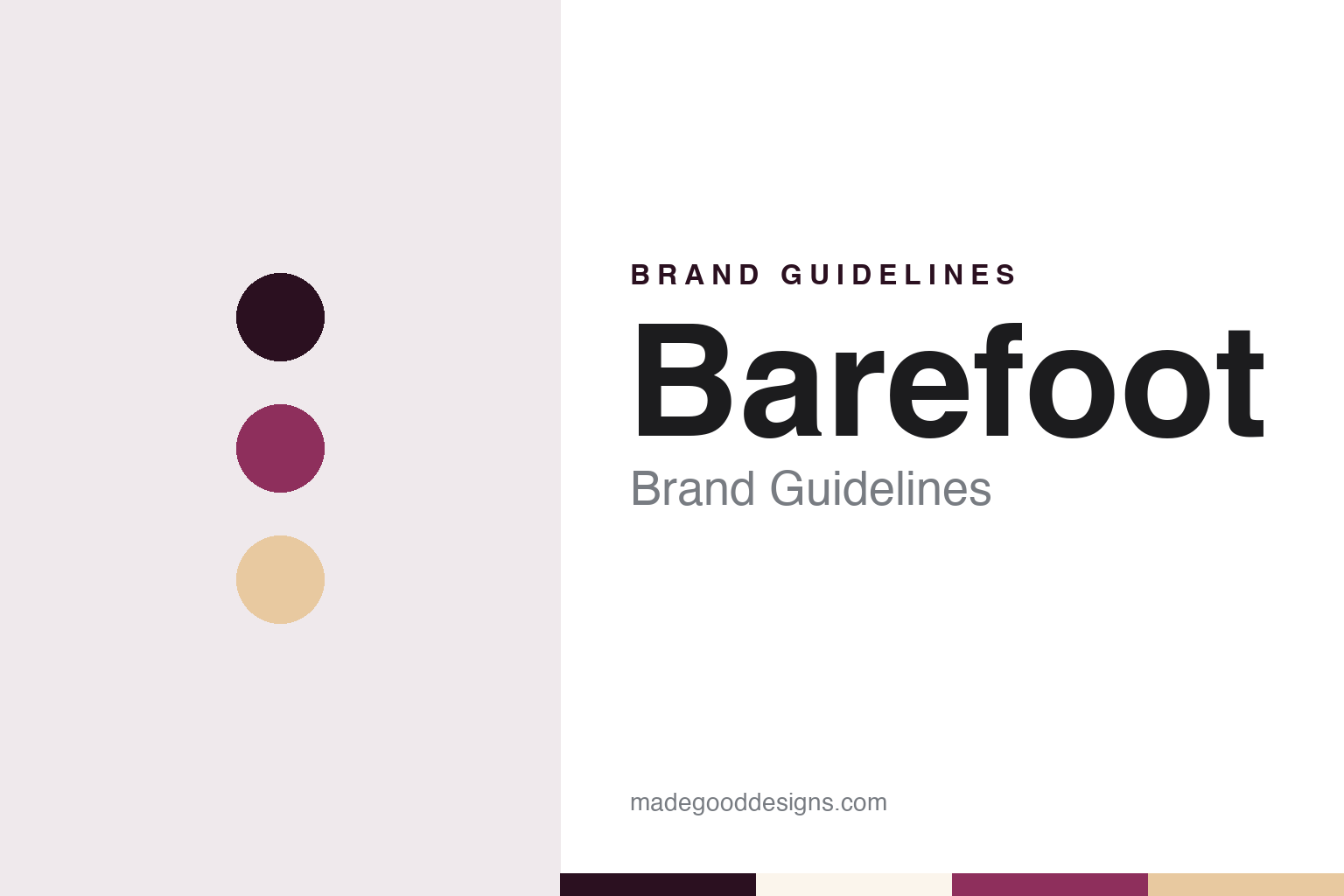
Two constants: a Merlot plum, footprint ink and sand palette and a rounded casual sans register. Abstract homage — not a Barefoot product or mark; no bottle, label or footprint is reproduced.
Barefoot Bynum
A Berkeley-area winemaker and a name about feet.
Barefoot began with Davis Bynum, a former newspaper journalist who turned a home-winemaking hobby into a career. Wine Spectator, which reported his death in December 2017 at the age of 92, says Bynum decided to make wine professionally in 1965, at the age of 40, and set up his first winery in a former plumbing warehouse in Albany, California, near the University of California at Berkeley; the Press Democrat of Santa Rosa described the business in 1995 as beginning in the back of a vacant plumbing warehouse. A 2023 feature on VinePair, published as sponsored content, says Barefoot started there in 1965 and that the name refers to the old practice of crushing grapes with bare feet. Wine-trade accounts give the original wine as “Barefoot Bynum,” a red sold with a bare-footprint motif on the label.
Bynum’s interests lay elsewhere. Wine Spectator says he bought a vineyard in Napa in 1971, and the Press Democrat reported in 2013 that local opposition to new wineries there led him instead to Sonoma County in 1973. He bought unplanted land with an old hop kiln on Westside Road in the Russian River Valley and built the first winery on that road, the one that carried his own name. The wine site Prince of Pinot credits it with the Russian River Valley’s first single-vineyard Pinot Noir, a 1973 bottling from the Rochioli vineyard. Trade accounts say that Bynum chose to concentrate on premium wines at this point, and that the inexpensive Barefoot label then lay dormant for more than a decade.
The name was revived by Michael Houlihan and Bonnie Harvey. The Cal State Long Beach alumni magazine, in a 2014 profile of Houlihan, a 1968 graduate, says the couple created Barefoot Cellars in 1986; trade accounts say they acquired the name from Bynum, while the VinePair feature dates their takeover to 1985. They ran the business from the laundry room of their home in Sonoma County, the magazine says. Trade accounts say the relaunch began with a California Cabernet Sauvignon and a California Sauvignon Blanc, and the VinePair feature adds the popular White Zinfandel to the early line-up. Their company was called Grape Links, Inc., the name used in the 2005 sale announcement.
Colour
A footprint, a cause and a supermarket shelf.
The label’s most recognisable element is a single bare footprint. According to the Cal State Long Beach profile, the image on the label is Bonnie Harvey’s own footprint, which gave the brand a double meaning: Barefoot, and the bare foot. The VinePair feature says the couple read the foot as an invitation to relax, a promise that wine did not need to be formal or intimidating.
Houlihan and Harvey had little money for advertising, so they built the brand through what they called “worthy cause” marketing. Rather than buying media, they poured their wines at events run by community organisations and charities. In the VinePair feature, winemaker Jennifer Wall recalls Randy Arnold, the first sales manager, pouring at nonprofit events and pointing guests to local independent stores. Houlihan told the alumni magazine that a brand should find a cause that matches its passions and products and support it, because members of that cause may have a social reason to buy that is stronger than a commercial one.
On 19 January 2005, Gismondi on Wine reported the press release in which the Gallo family announced E. & J. Gallo Winery’s acquisition of Grape Links, Inc., the producer of Barefoot Cellars. Joseph E. Gallo, Gallo’s co-president and chief executive, called it an opportunity to expand the portfolio with the “unique equities” of the Barefoot brand. Houlihan, described as founder and former chief executive of Grape Links, said the venture had begun more than 19 years earlier, and the couple stayed on as consultants for a year.
Typography
Design and documentation.
The seven brands in this group are all wine and sake names: Yellow Tail, Jacob’s Creek, Penfolds, Casillero del Diablo, Concha y Toro, Barefoot and Gekkeikan. Wine and sake brands in general sit at many different points in the trade, from family houses that still carry a founder’s name to labels that now belong to much larger drinks groups, and a single brand can be sold everywhere from a corner shop to a restaurant list.
A wine or sake brand’s identity is usually carried less by a single bottle than by a label, a name and the place it promises, because the company behind the name may have changed hands, moved its production or grown far beyond the place where it started. That makes the questions behind each name worth asking plainly: who started it, who owns it now, and where its wine or sake is actually made and bottled.
Each guide separates what independent sources record from what the company says about itself — its founding story, its owners over time, where its wine or sake is made and how its labels have changed — and marks plainly what rests only on the company’s own word.
Aa
A rounded casual sans for a wine named after a bare foot. (Specimen set in Baloo 2, a sans STAND-IN; NOT the Barefoot logo.)
Barefoot
From a couple’s brand to Gallo’s best-seller.
Under Gallo, Barefoot grew from a handful of varietals into a broad range. The VinePair feature dates the brand’s Pinot Grigio to 2006 and its Moscato to 2008; Jennifer Wall, who the feature says has spent 28 years making the brand’s wines, is quoted saying that the Moscato “changed the perception of the wine sweetness scale.” The range now includes Barefoot Bubbly sparkling wines, a three-litre Barefoot On Tap box, a canned Wine-to-Go Rosé, spritzers and blends, and in June 2020 the brand released its first Pride packaging; the feature names Free Mom Hugs and the National Center for Transgender Equality among its partner organisations. Citing IRI dollar-sales data for the 52 weeks to April 2023, the feature calls Barefoot the number one wine brand in America and its Pinot Grigio the best-selling in the United States.
The founders turned their story into a second career. Houlihan and Harvey wrote The Barefoot Spirit: How Hardship, Hustle and Heart Built America’s #1 Wine Brand, and the Cal State Long Beach profile says they went on to run an entrepreneurship consultancy, also called Barefoot Spirit, and to write a second book on company culture.
For a design guide, Barefoot shows how one honest, homemade image — a real person’s footprint — can carry a mass-market brand for four decades and through a change of owner. Compare the kangaroo of Australia’s [yellow tail] and the Barossa-born Jacob’s Creek. For this guide we use Merlot plum, footprint ink and sand with a rounded sans, an unofficial interpretation; no product or logo is reproduced.
Explore & save
Keep Barefoot’s identity on hand — save it to a board in the Made Good inspiration library.
Barefoot identity set
Pin the Barefoot Merlot plum, footprint ink and sand palette and the rounded casual sans register to your own board.