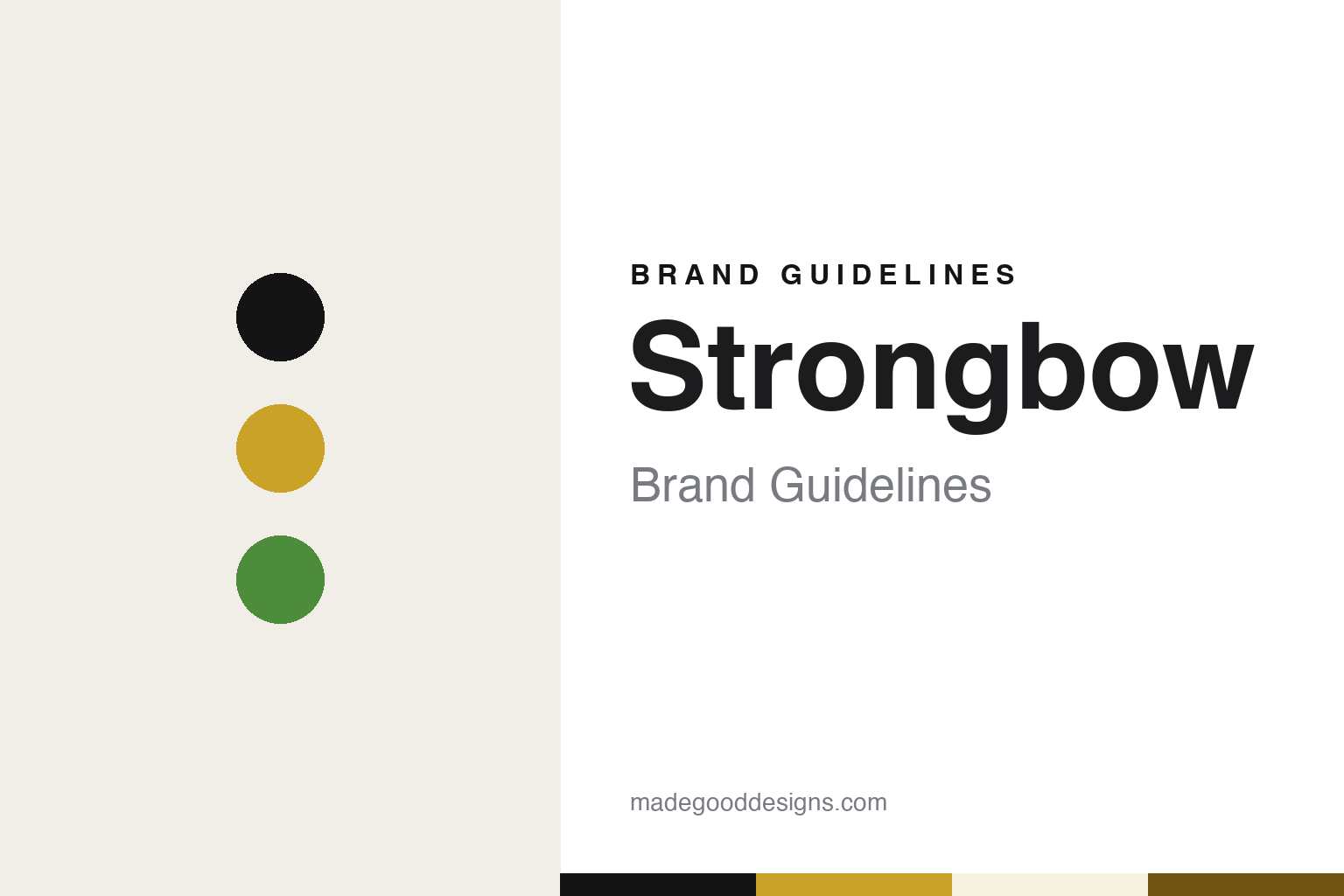
Strongbow Brand Guidelines
The Hereford cider with the Norman archer, launched 1960.
Aa
Two constants: a Strongbow black and gold palette and an inscriptional serif register. Abstract homage — not a Strongbow product or mark; no can, archer or logo is reproduced.
A cider from Hereford
A rector’s son, a cider mill and a knight’s nickname.
Strongbow is the best-known cider of H. P. Bulmer, the Hereford company that Henry Percival “Percy” Bulmer, a son of the rector of Credenhill, started in 1887, English Wikipedia says. His elder brother Fred joined him two years later, and the brothers built their first cider mill on a field just outside the city. The firm received its first Royal Warrant in 1911. English Wikipedia, citing the brand’s archived website, dates the launch of Strongbow to 1960; Heineken UK spoke of “63 years of Strongbow” in 2023.
The name is borrowed from a medieval knight. Strongbow was the nickname of Richard de Clare, 2nd Earl of Pembroke, the Anglo-Norman lord who took part in the invasion of Ireland in the twelfth century. The brand’s Australian website links the nickname to his reliance on archers; the Oxford Dictionary of National Biography, in its 2004 entry on him, notes that his father, Gilbert de Clare, was also called Strongbow, so the name may simply have been inherited. Either way, the archer became the brand’s figure. Early advertising was blunt: The Times carried Strongbow advertising in 1962 that called it “the strong cider for men,” English Wikipedia notes.
Bulmer grew into the largest cider maker in the world by the time its shares were offered on the Stock Exchange in December 1970, English Wikipedia says, and Strongbow was sold alongside its older stablemate, Woodpecker. By 2001 The Times counted Strongbow among the ten best-selling drinks in the pubs and bars of England and Wales.
Ownership then changed twice in five years. The Guardian reported in April 2003 that Scottish & Newcastle had completed its purchase of Bulmers. In January 2008 Carlsberg and Heineken agreed to buy Scottish & Newcastle together and divide its businesses, Bloomberg reported, and the British business, Bulmer included, went to Heineken. In January 2011 The Daily Telegraph reported Heineken’s plan to take Strongbow global.
Most Strongbow is still made at Bulmer’s plant in Hereford, English Wikipedia says, with variants also produced at Heineken’s Stassen cider mill in Belgium and in Australia. The Times reported in 2014 that Bulmers took 90 per cent of its apples from orchards in Herefordshire.
Colour
One archer, redrawn for each decade.
The archer has a notable author. Barney Bubbles, the graphic designer born Colin Fulcher who later became known for record sleeves, joined The Conran Group as a senior graphic designer in May 1965, and among his commissions there was the Norman-style archer logo for Strongbow, English Wikipedia says, citing Paul Gorman’s book on his life and work. A 2008 review in Eye magazine likewise named Strongbow among the identities he drew at Conran.
The arrows matter as much as the archer. The Daily Telegraph wrote in January 2011 that “thudding arrows” had been a signature of Strongbow’s television advertising since the 1960s; the ads typically end with two arrows striking a bar counter beside a glass or pump.
The figure has been redrawn several times. Design Week reported in April 1997 that PI Design had recreated the archer as part of a packaging overhaul, quoting the brand’s marketing manager as saying the old archer “didn’t have much personality” and the new one was “meaner.” In August 2002 the magazine reported that Coley Porter Bell had revamped the identity, with a new logo, packaging and brand guidelines for marketing and point-of-sale material. In May 2012 Design Week reported that Bulletproof had introduced a redrawn brand mark and an embellished version of the arrow device, keeping the strong black and gold colourways.
The largest change came in March 2023. It’s Nice That reported on 7 March 2023 that the studio Otherway had redesigned Strongbow across its range, replacing the black and gold look that had been on the cans since the cider was created with a bright palette running from light pink to grassy green. The archer stayed at the centre of the packaging and the typography was kept consistent, while patterned details were stripped away. Rachel Holms, cider marketing director at Heineken UK, called it “a huge milestone in 63 years of Strongbow.”
Black and gold therefore describe the long middle of the brand’s life rather than its present, and the redesign kept the two elements that have run through every version: the archer and the arrow.
Typography
Design and documentation.
The seven brands in this group are all cider names: Strongbow, Magners, Bulmers, Somersby, Kopparberg, Rekorderlig and Thatchers. Cider brands in general sit at many different points in the trade, from family farms that still carry a founder’s name to labels that now belong to much larger drinks groups, and a single brand can be sold everywhere from a corner shop to a pub bar.
A cider brand’s identity is usually carried less by a single bottle or can than by a label, a name and the place it promises, because the company behind the name may have changed hands, moved its production or grown far beyond the place where it started. That makes the questions behind each name worth asking plainly: who started it, who owns it now, and where its cider is actually made and packed.
Each guide separates what independent sources record from what the company says about itself — its founding story, its owners over time, where its cider is made and how its labels have changed — and marks plainly what rests only on the company’s own word.
Aa
An inscriptional serif for a knight’s name. (Specimen set in Cinzel, a serif STAND-IN; NOT the Strongbow logo or lettering.)
Strongbow
A pub cider that learned to travel.
Strongbow’s advertising has leaned on humour. Marketing Week reported in May 2002 that the brand was dropping the presenter Johnny Vaughan, whose “live to loaf” campaign had run since 1998 and whom Bulmers credited with building the brand’s standing among young drinkers. In the United States, Adweek reported in March 2015 that the agency Droga5 had cast the actor Patrick Stewart in Strongbow advertising. The brand also sponsored football shirts, for Heart of Midlothian from 1992 to 2002 and for Leeds United from 2000 to 2003.
Markets abroad have had their own histories. English Wikipedia says Strongbow was launched in Australia in 1970 and was later produced there under licence by Foster’s Group; FoodBev Media reported in October 2020 that Heineken had agreed to buy the Australian rights from Asahi, reuniting the brand’s global portfolio. A bottled Strongbow Gold, made at Stassen in Belgium, went on sale in mainland Europe in 2012, and Dark Fruit, with blackcurrant and blackberry, followed in the UK in 2013.
Not every change was welcomed. In March 2014 Heineken USA introduced two sweeter ciders, Gold Apple and Honey & Apple, and the original dry Strongbow was dropped from the American range, drawing complaints from drinkers online; Brewbound reported in May 2018 that Heineken would bring the original dry cider back to the United States.
The name needs care. “Strongbow” is also the historical nickname of Richard de Clare and of his father, and the cider’s own sites sit under strongbow.com. The Hereford maker’s other brand, Bulmers, is separate from the Irish cider sold as Bulmers in the Republic of Ireland and as Magners everywhere else.
For a design guide, Strongbow shows how one emblem, a Norman archer first drawn in the 1960s, can survive half a dozen redesigns and even the loss of the colours it was known by. Compare Bulmers, its Hereford stablemate, and Savanna, the South African dry cider. For this guide we use archer black, Strongbow gold and orchard green with a serif, an unofficial interpretation; no product or logo is reproduced.
Explore & save
Keep Strongbow’s identity on hand — save it to a board in the Made Good inspiration library.
Strongbow identity set
Pin the Strongbow archer black, gold and orchard green palette and the inscriptional serif register to your own board.