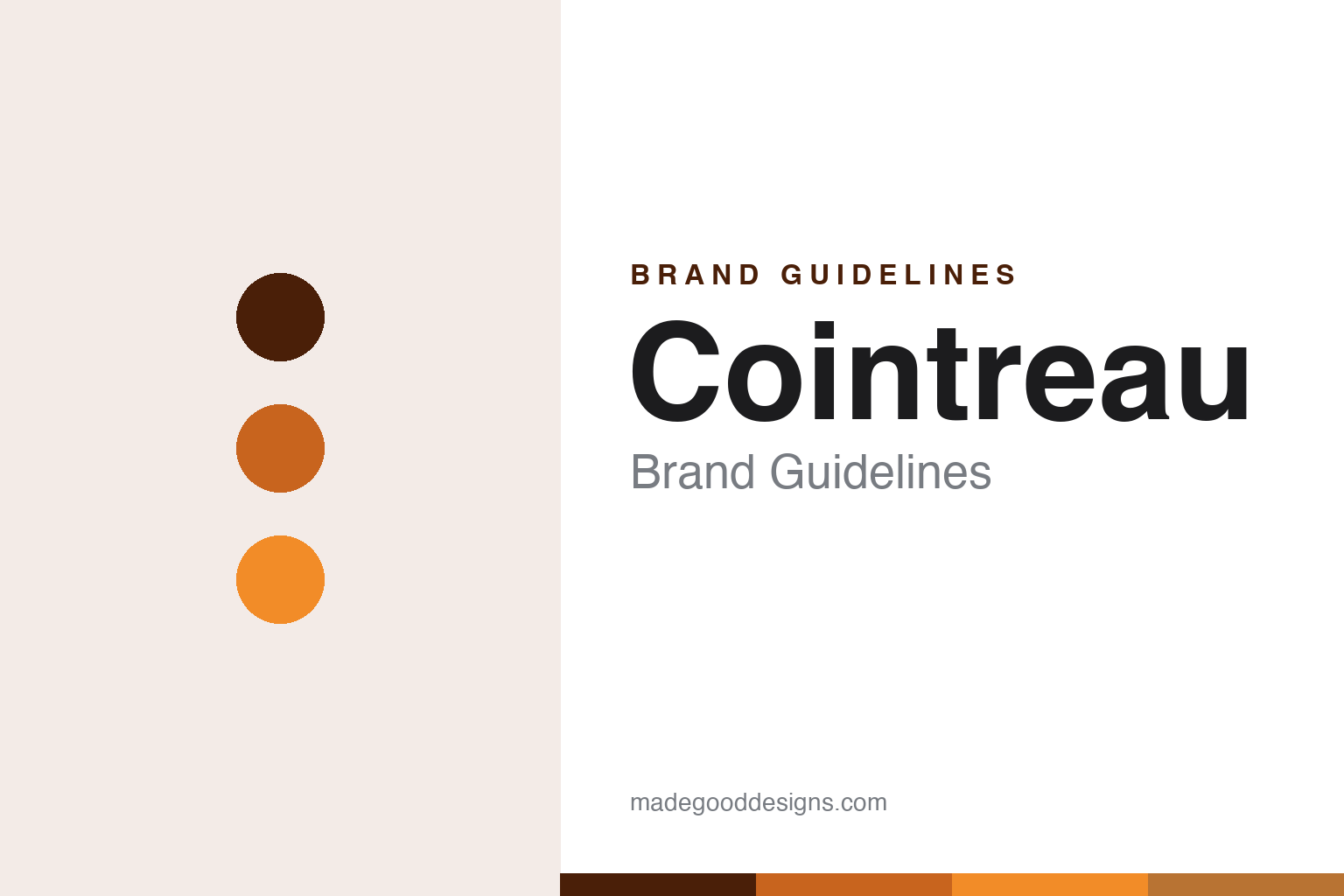
Cointreau Brand Guidelines
The Angers orange liqueur in a square amber bottle.
Aa
Two constants: an amber, orange and copper palette and a high-contrast didone serif register. Abstract homage — not a Cointreau product or mark; no bottle, label or logo is reproduced.
Angers
Two brothers, a cherry liqueur and an orange.
Cointreau began in Angers, in western France, in 1849. The company says Adolphe Cointreau, a confectioner in the town, started that year to turn the family business toward liqueurs, and that his brother Édouard-Jean Cointreau joined him in 1856. French Wikipedia, citing the Musée Cointreau and the French culture ministry’s heritage inventory, names both brothers as founders of the distillery in 1849. Their first success was not orange at all but guignolet, a cherry liqueur from the Anjou region.
The orange came with the next generation. Édouard Cointreau, Édouard-Jean’s son, joined the business in 1875 with his wife, Louisa, and the company says he refocused the house on the orange. Sources differ on when his liqueur was born. French Wikipedia, citing L’Expansion in 2009, dates his new distillation process to 1875; the company’s own history gives 1885, the year it says Édouard created “a perfectly balanced, crystalline liqueur” three times more concentrated in flavour and less sweet than its rivals. Both accounts describe the same idea: a clear spirit made from sweet and bitter orange peels. English Wikipedia, citing Lichine, says it was first sold as “Curaçao Blanco Triple Sec”.
The name was protected early. French Wikipedia says the Cointreau mark for its triple sec was filed with the Angers commercial court on 20 May 1885, citing the departmental archives of Maine-et-Loire, and the company says Édouard registered trademarks that year for both the brand and its square bottle.
Colour
A square bottle, a Pierrot and a cocktail shaker.
The square amber bottle is the brand’s most constant asset. The liqueur inside is colourless, English Wikipedia notes, so the glass does the work of signalling orange. The company dates the trademark for the “distinctive square bottle” to 1885, and in 1889 it installed one of its copper alembics at the Paris World’s Fair, where it says the house won a medal.
Advertising followed. In 1898, the company says, it set up an in-house advertising studio, where the poster artist Nicolas Tamagno created the “Pierrot Cointreau”, a character that French Wikipedia says the brand used for about 50 years. The cocktail era then gave the brand a second identity. The company says the first Sidecar recipes using Cointreau appeared in two cocktail books in 1922; it credits the Margarita to Margaret Sames in Acapulco in 1948, one of several origin stories for that drink, and the Cosmopolitan to the New York bartender Toby Cecchini in 1988. Cointreau appears in the International Bartenders Association’s official recipes for the Cosmopolitan and the Corpse Reviver #2, English Wikipedia says.
Later campaigns kept that cocktail focus. English Wikipedia lists “Be Cointreauversial”, created in 2003 by the New York agency KraftWorks; the burlesque performer Dita Von Teese as the face of the brand from 2008; and the “MargaRight” campaign with the actor Aubrey Plaza in 2023.
The bottle itself was revised in 2022. The Spirits Business reported in September that year that Cointreau called it the biggest change in the bottle’s history: an orange shown on the label for the first time, a label background drawn from the door of the first Angers distillery, embossed copper-coloured details recalling the copper stills, the distillery’s stained-glass windows raised on the side, more pronounced corners, and glass two-thirds recycled. The magazine said the new bottle would reach the UK in autumn 2022 and the rest of the world by the end of that year, and that it stands 4mm taller than before, with a copper-coloured cap textured like orange peel.
Typography
Design and documentation.
The seven brands in this group are all liqueurs from France and elsewhere in Europe: Cointreau, Grand Marnier, Chartreuse, Bénédictine, Chambord, St-Germain and Cherry Heering. European liqueur brands in general sit at many different points in the trade, from family houses that still carry a founder’s name to names that now belong to much larger drinks groups, and a single brand can be poured everywhere from a hotel bar to a kitchen table.
A liqueur brand’s identity is usually carried less by a single product than by a bottle, a name and the drink it promises, because the company behind the name may have changed hands, moved its production or grown far beyond the place where it started. That makes the questions behind each name worth asking plainly: who started it, who owns it now, and where its liqueurs are actually made and bottled.
Each guide separates what independent sources record from what the company says about itself — its founding story, its owners over time, where its liqueurs are made and how its bottles and labels have changed — and marks plainly what rests only on the company’s own word.
Aa
A high-contrast didone serif for a liqueur sold in a perfume-like square bottle. (Specimen set in Bodoni Moda, a serif STAND-IN; NOT the Cointreau logo.)
Cointreau
From family firm to Rémy Cointreau.
Cointreau stayed in family hands for well over a century. French Wikipedia says production moved within Angers to the quai Gambetta in 1857 and later to a new site at Saint-Barthélemy-d’Anjou, on the edge of the city; the company dates the opening of that distillery to 1972. L’Express reported in 2011 that Pierre Cointreau, Édouard’s grandson, had led the company from 1963 to 1997.
The big corporate change came at the end of the 1980s. The New York Times reported a planned merger between Cointreau and the Hériard Dubreuil family’s cognac house, Rémy Martin, in November 1989. The company says the agreement was signed at the Carré Cointreau in 1989; Rémy Cointreau’s own history describes a 1990 merger of the two families’ holding companies and the adoption of the name Rémy Cointreau in 1991. Cointreau has been one of the group’s core brands since, alongside Rémy Martin cognac and, among others, the Barbados rum Mount Gay. English Wikipedia lists Cointreau Noir as the brand’s main variant.
The distillery doubles as a visitor site. French Wikipedia says the Carré Cointreau museum opened there in 1999, for the brand’s 150th anniversary, citing Ouest-France. English Wikipedia, citing Rémy Cointreau, says the liqueur is sold in more than 150 countries and that about 90% of production is exported, and that the recipe and production methods are kept as a family secret.
For a design guide, Cointreau shows how a single bottle shape, a single colour of glass and a cocktail repertoire can carry a brand for well over a century. Compare Grand Marnier, the other great French orange liqueur, and Mount Gay, its sister brand within Rémy Cointreau; For this guide we use amber glass, a bitter-peel brown, a bright orange and a copper accent with a high-contrast serif, an unofficial interpretation; no product or logo is reproduced.
Explore & save
Keep Cointreau’s identity on hand — save it to a board in the Made Good inspiration library.
Cointreau identity set
Pin the Cointreau amber, orange and copper palette and the high-contrast didone serif register to your own board.