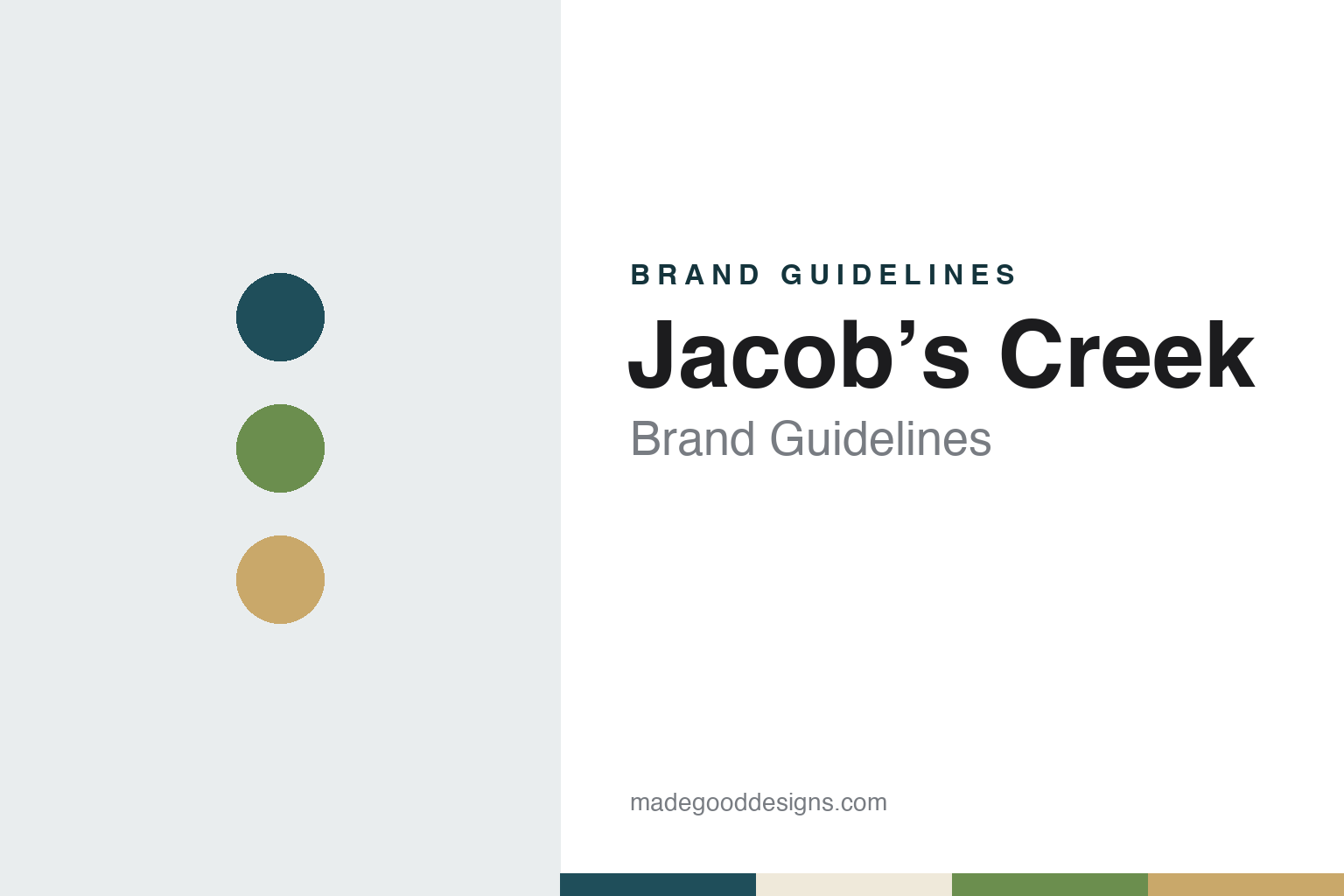
Jacob’s Creek Brand Guidelines
The Barossa wine named for Gramp’s 1847 vineyard.
Aa
Two constants: a creek teal, vine leaf and Barossa gold palette and a transitional book serif register. Abstract homage — not a Jacob’s Creek product or mark; no label, logo or bottle is reproduced.
A Bavarian settler and a Barossa creek
Johann Gramp, a vineyard on a creek bank and the first Barossa wine.
The story behind Jacob’s Creek begins with Johann Gramp, born in 1819 at Eichigt, near Kulmbach in Bavaria. The Australian Dictionary of Biography says he arrived at Kingscote on Kangaroo Island in October 1837 aboard the Solway and later moved to the Barossa. There, in 1847, he planted a vineyard on the banks of Jacob’s Creek, and in 1850 he made his first wine, a white in the hock style later sold as Carte Blanche, the dictionary says.
The State Library of South Australia’s wine-literature pages describe the planting as the first commercial vineyard in the Barossa Valley, on land Gramp had bought further up the creek in 1846. The creek itself carries the name of William Jacob, an assistant surveyor to Colonel William Light, the colony’s surveyor-general, English Wikipedia says.
The business grew under the next generation. The Australian Dictionary of Biography says Johann’s son Gustav Gramp took over and in 1877 moved the winery to Rowland Flat, where new cellars were built in 1886, and that in 1912 the firm became a limited company, G. Gramp & Sons. Its wines were sold under the name Orlando, and Orlando remained a Gramp family company for more than a century after the first vines went in. Rowland Flat is still the home of the brand: the Jacob’s Creek visitor centre opened there in 2002, English Wikipedia says, and a time capsule laid at the site is due to be opened in 2027.
Colour
A 1973 red, a place name and an award first given to a wine.
The brand name came long after the vineyard. The State Library of South Australia says Jacob’s Creek was first released in 1976, with a 1973 Shiraz Cabernet Malbec blend, by which time Orlando belonged to new owners.
Recognition followed at home and abroad. The library records that Orlando Wyndham was named Australian Exporter of the Year in 1993, and that in 1994 Jacob’s Creek received the Maurice O’Shea Award — the first time the award, usually given to a person, went to a wine. Sport carried the name further: English Wikipedia says the brand ran its “Open Up” campaign with the tennis player Andre Agassi from 2012 to 2014 and its “Made By Moments” campaign with Novak Djokovic in 2015, and The Drinks Business reported in September 2025 that Jacob’s Creek had returned as official wine partner of the Australian Open.
The current logo dates from a 2014 relaunch, unveiled at The Island on Sydney Harbour. The food and wine site Gourmantic reported in February 2014 that the new mark joins a wine glass with a flowing river, a reminder that Jacob’s Creek is a real place, and adds two leaves for Gramp’s vineyards. In 2026 the brand reworked its range again in the United Kingdom, which Global Drinks Intel describes as its second-largest market after Australia: Retail Times reported in July 2026 that labels refreshed from April were organised by taste, occasion and mood, and a new global platform, “Welcome to the Creek,” launched in the UK that July.
Typography
Design and documentation.
The seven brands in this group are all wine and sake names: Yellow Tail, Jacob’s Creek, Penfolds, Casillero del Diablo, Concha y Toro, Barefoot and Gekkeikan. Wine and sake brands in general sit at many different points in the trade, from family houses that still carry a founder’s name to labels that now belong to much larger drinks groups, and a single brand can be sold everywhere from a corner shop to a restaurant list.
A wine or sake brand’s identity is usually carried less by a single bottle than by a label, a name and the place it promises, because the company behind the name may have changed hands, moved its production or grown far beyond the place where it started. That makes the questions behind each name worth asking plainly: who started it, who owns it now, and where its wine or sake is actually made and bottled.
Each guide separates what independent sources record from what the company says about itself — its founding story, its owners over time, where its wine or sake is made and how its labels have changed — and marks plainly what rests only on the company’s own word.
Aa
A transitional book serif for a wine named after a place. (Specimen set in Libre Baskerville, a serif STAND-IN; NOT the Jacob’s Creek logo.)
Jacob’s Creek
From a family firm to Pernod Ricard, and on to Vinarchy.
The Gramp family sold Orlando in 1971 to Reckitt & Colman Australia, the Australian Dictionary of Biography says. According to the SA History Hub, a group of four directors bought the business back in 1988 with a guarantee from the South Australian government, and in 1989 it passed to the French drinks group Pernod Ricard. A 1990 merger with Wyndham Estate created the Orlando Wyndham Group, English Wikipedia says; the business was renamed Premium Wine Brands in 2010 and Pernod Ricard Winemakers in 2013.
That chapter has now closed. Pernod Ricard announced in July 2024 that it would sell most of its international wine portfolio, and on 30 April 2025 the sale to Australian Wine Holdco, the owner of Accolade Wines, was completed, The Drinks Business and Shanken News Daily reported. The deal took in Jacob’s Creek, Orlando and St Hugo from Australia, Brancott Estate, Stoneleigh and Church Road from New Zealand, and Campo Viejo, Ysios, Tarsus and Azpilicueta from Spain. The combined company took the name Vinarchy, and trade press reported that it treats Hardys, Campo Viejo and Jacob’s Creek as its three global brands. After a short transition in which Pernod Ricard continued to distribute the wines, Vinarchy took over distribution in Australia and New Zealand from 1 September 2025, Drinks Biz reported.
One practical note: “Jacobs Creek” is also the name of several places and streams in North America, and of an American golf tournament, so the apostrophe and the Barossa link matter when searching for the wine.
For a design guide, Jacob’s Creek shows how a brand launched in 1976 can borrow its authority from a vineyard planted in 1847, and how a logo can carry a place — a glass, a river and two leaves — rather than a person. Compare Penfolds, another South Australian wine house of the 1840s, and [yellow tail], the Riverina wine built for export. For this guide we use creek teal, vine leaf and Barossa gold with a book serif, an unofficial interpretation; no product or logo is reproduced.
Explore & save
Keep Jacob’s Creek’s identity on hand — save it to a board in the Made Good inspiration library.
Jacob’s Creek identity set
Pin the Jacob’s Creek creek teal, vine leaf and Barossa gold palette and the transitional book serif register to your own board.