Moutai Brand Guidelines
A state-owned baijiu from a town on the Chishui River.
Aa
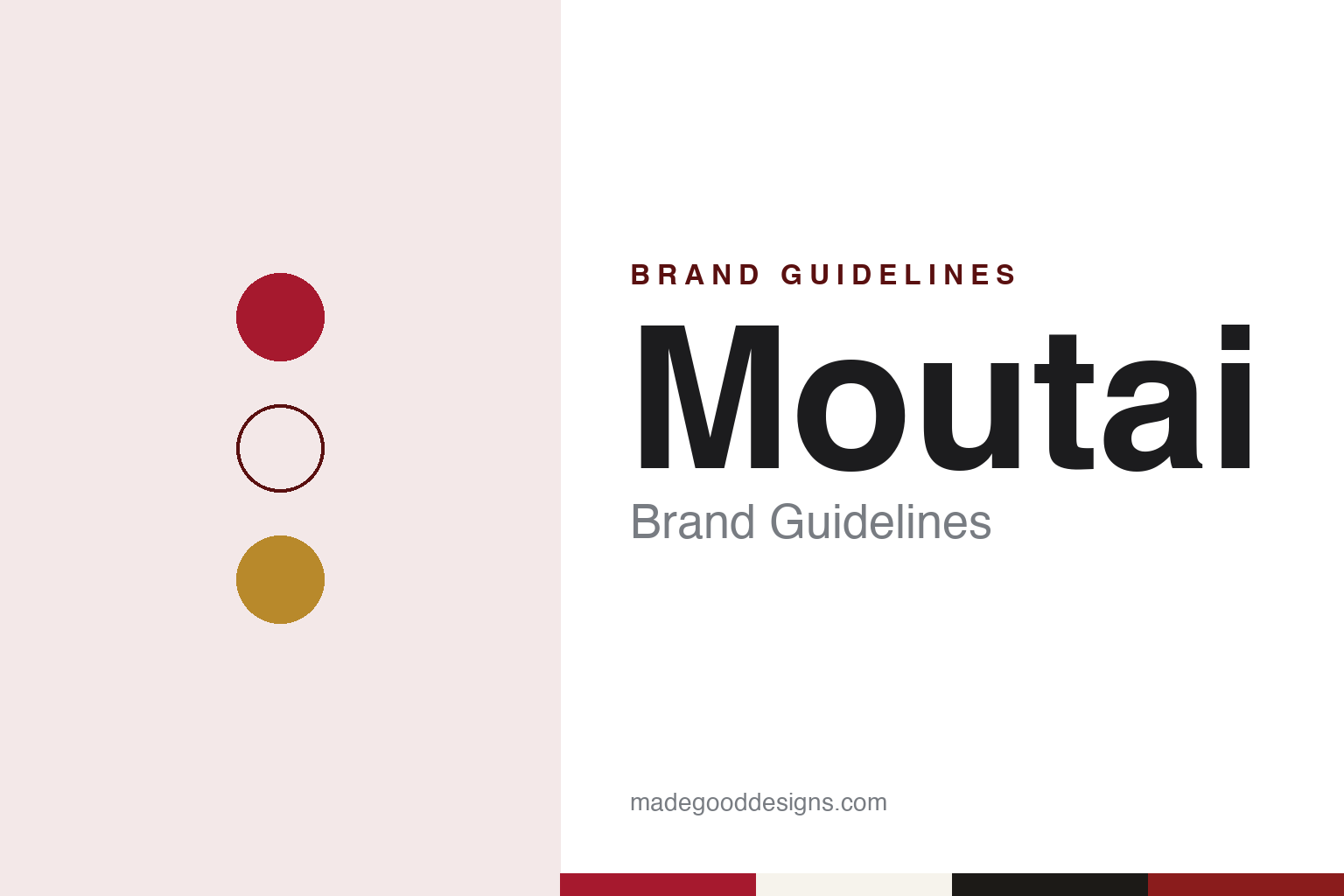
Two constants: a ribbon red, porcelain white and old gold palette and a classical serif register. Abstract homage — not a Moutai product or mark; no label, logo or bottle is reproduced.
Three distilleries, one town
From Qing-era stills to a state company.
Maotai, also spelled Moutai, is both a place and a style of drink. English Wikipedia describes it as a style of baijiu, the Chinese grain spirit, made in the town of Maotai in Guizhou province from sorghum, a wheat-based starter called qu, and water from the Chishui River; to carry the name it must be made in the town under regulated production rules. The best-known maker is Kweichow Moutai, but it is not the only one.
The spirit’s roots are older than the company. The writer Derek Sandhaus, in Baijiu: The Essential Guide to Chinese Spirits (2014), traces the style to the Qing dynasty, and English Wikipedia says the earliest explicit written record dates from 1704. According to the same article, the town was wrecked during the Taiping Rebellion in 1854; a salt merchant founded the Chengyi distillery on an abandoned site in 1863, three local landowners opened Ronghe in 1879, and a third distillery, Hengxing, followed in 1929.
The spirit’s first international stage came in between. English Wikipedia says Maotai was presented at the 1915 Panama-Pacific International Exposition in San Francisco and won a medal, which raised demand at home. A 2021 historical study in the International Journal of Business Administration set out to test that story, and concluded that Maotai was indeed chosen to represent China at the exposition and received a grand prize.
The modern company dates from 1951. After the founding of the People’s Republic, the three distilleries were merged into a single state-owned enterprise, Kweichow Moutai, English Wikipedia says, citing the company’s own history. It records a group company formed in the late 1990s and a listing on the Shanghai Stock Exchange in 2001, and lists the Guizhou provincial State-owned Assets Supervision and Administration Commission as the controlling owner, with headquarters in Maotai town, part of Renhuai city.
Colour
Sorghum, a river and a long cycle.
Moutai is the reference point for the sauce-aroma style of baijiu, jiangxiang in Chinese, a name taken from its savoury, soy-like smell. English Wikipedia, citing Sandhaus, describes its aroma and flavour as nutty, grainy and savoury. The process is long. China Daily reported in October 2024 that the spirit is steamed nine times, fermented eight times and distilled seven times, and that the whole process takes five years, ageing included. Chinese Wikipedia notes that the Moutai production technique was added to China’s national list of intangible cultural heritage in 2006.
The labels have their own history. Sotheby’s, which holds dedicated Moutai auctions, says on its brand page that the Flying Fairy emblem was drawn from the cave paintings of the Mogao caves at Dunhuang. During the Cultural Revolution the image was classed among the “four olds,” and a Sun Flower label took over the export bottles from 1969, Sotheby’s says, with the last batch reaching the market around 1983. Sotheby’s sale catalogues also list bottlings under a second long-running label, Five Star. The spirit itself is clear, and English Wikipedia illustrates vintage bottles in white porcelain.
Moutai’s fame owes much to the banquet table. English Wikipedia, citing Margaret MacMillan’s Nixon and Mao (2007), says it was served at the welcoming banquet for Richard Nixon’s 1972 visit to China, and that it appeared again at the 2013 meeting between Xi Jinping and Barack Obama in California.
The brand’s ambitions have occasionally run into the rules. Caixin Global reported on 4 January 2017 that China’s Trademark Office had rejected Moutai’s application to register “national liquor” as a trademark, saying the phrase could suggest it was the best liquor in China and harm fair competition; rivals including Wuliangye had objected. The Drinks Business reported in August 2018 that Moutai had withdrawn its appeal.
Typography
Design and documentation.
The seven brands in this group are all cider and spirits names: Westons, Aspall, Angry Orchard, Moutai, Wuliangye, Kavalan and Amrut. Cider and spirits brands in general sit at many different points in the trade, from family houses that still carry a founder’s name to labels that now belong to much larger drinks groups, and a single brand can be sold everywhere from a corner shop to a bar list.
A cider or spirits brand’s identity is usually carried less by a single bottle than by a label, a name and the place it promises, because the company behind the name may have changed hands, moved its production or grown far beyond the place where it started. That makes the questions behind each name worth asking plainly: who started it, who owns it now, and where its cider or spirit is actually made and bottled.
Each guide separates what independent sources record from what the company says about itself — its founding story, its owners over time, where its cider or spirit is made and how its labels have changed — and marks plainly what rests only on the company’s own word.
Aa
A classical serif for a spirit with a long written history. (Specimen set in Noto Serif SC, a serif STAND-IN; NOT the Moutai logo.)
Moutai
A state spirit that reaches for younger drinkers.
Abroad, Moutai has long worked through partners. English Wikipedia, citing TRBusiness, says the French cognac house Camus became its worldwide distributor in 2004, and China Daily reported in May 2018 that Moutai was expanding into the mainstream American market. Brandirectory’s Spirits 50 ranking for 2023 placed it among the most valuable spirits brands in the world.
At home the company has tried to reach a younger audience with unexpected formats. China Daily reported that the first shop selling Moutai ice cream, made with the dairy group Mengniu, opened in Zunyi, Guizhou, on 19 May 2022. On 4 September 2023 Moutai and the coffee chain Luckin launched a “sauce-flavoured latte,” Reuters reported, with an alcohol content the companies put at under 0.5 per cent; the drink became one of the most discussed topics on the social platform Weibo that week.
The name needs care. Maotai is a town as well as a brand, Maotai-style baijiu is made by other distillers in the same area, and the company’s own name keeps the older romanisation Kweichow for Guizhou. In English the drink is spelled both Maotai and Moutai; the company uses Moutai.
For a design guide, Moutai shows how a single town, a river and a label drawn from Dunhuang cave art can carry a spirit from Qing-era distilleries to state banquets and, more recently, to coffee cups. Compare Wuliangye, the Sichuan baijiu that objected to Moutai’s “national liquor” bid, and Jinro, the Korean soju. For this guide we use ribbon red, porcelain white and old gold with a serif, an unofficial interpretation; no product or logo is reproduced.
Explore & save
Keep Moutai’s identity on hand — save it to a board in the Made Good inspiration library.
Moutai identity set
Pin the Moutai ribbon red, porcelain white and old gold palette and the classical serif register to your own board.