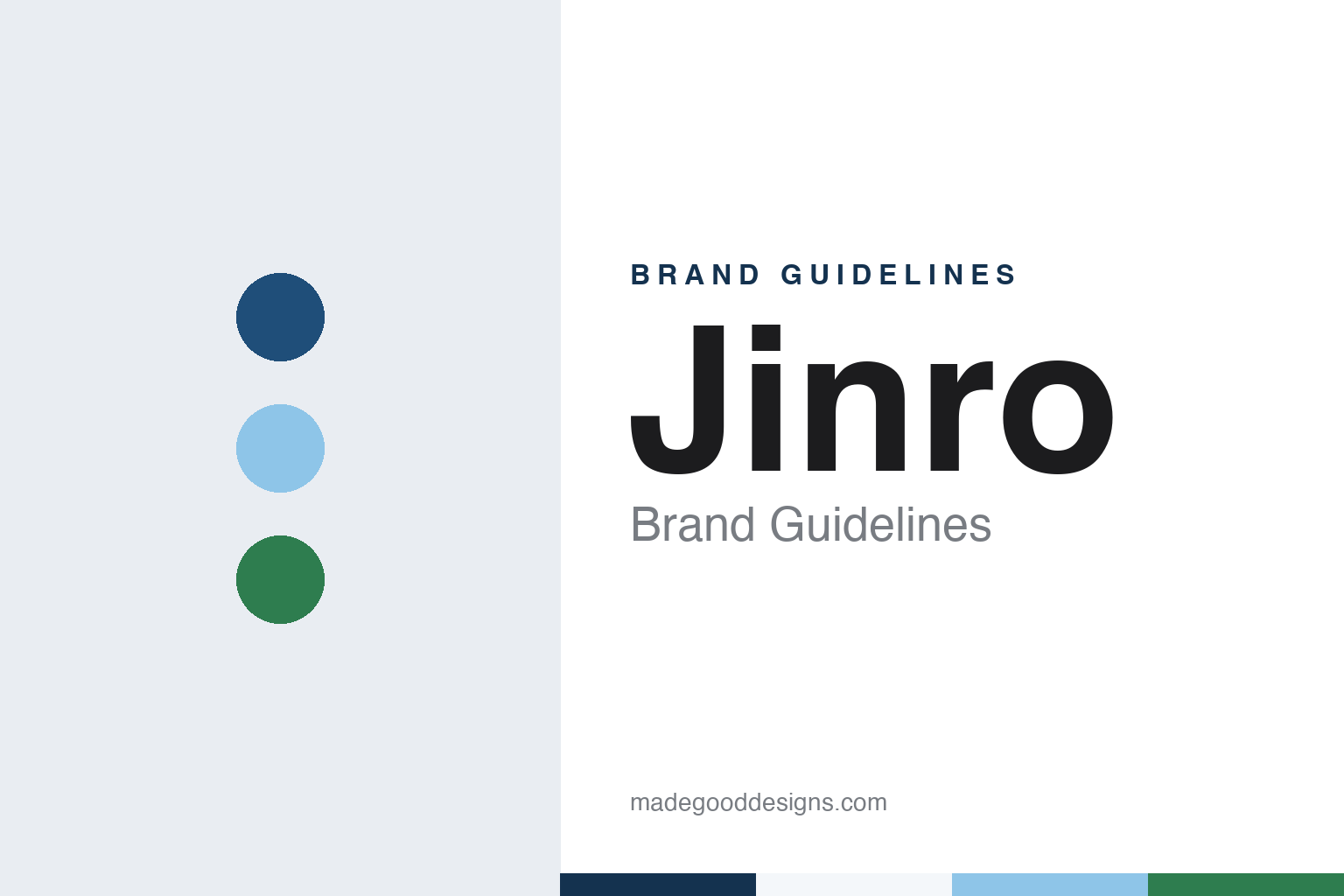
Jinro Brand Guidelines
A 1924 soju name, a toad and a pale-blue bottle.
Aa
Two constants: a deep blue, pale bottle blue and bottle green palette and a Korean serif register. Abstract homage — not a Jinro product or mark; no bottle, label, logo or toad is reproduced.
True dew
A 1924 brewery, a war and a new start in Seoul.
Jinro is the oldest name in Korean soju. Korean Wikipedia, citing a 2014 column in the Korea Economic Daily, says the business began in 1924 as Jincheon Brewing (진천양조상회), set up by Jang Hak-yeop in Yonggang County, South Pyongan, in the north of the peninsula. Sources differ on the exact day: English Wikipedia, citing the company’s own history page, gives 3 October 1924, while the infobox of Korean Wikipedia’s HiteJinro article gives 15 June 1924.
The name is written 眞露 in Chinese characters, and English Wikipedia glosses its best-known modern product, Chamisul, as “real dew.” Korean Wikipedia explains the link: Chamisul (참이슬) takes the native Korean readings of the two characters of Jinro, cham for “true” and iseul for “dew.” It credits the coinage to Son Hye-won of the branding agency CrossPoint, citing her 2006 book on brands and design, and says the name was chosen because dew seems to form on a bottle of soju as it is chilled.
War moved the company south. During the Korean War it relocated to Busan, where it made soju under other names, Korean Wikipedia says, citing a 2015 column in the Financial News; in 1954 it set up Seogwang Brewing in Singil-dong, in Seoul’s Yeongdeungpo district, and began making “Jinro soju” again. The firm became Jinro Brewing in 1966 and Jinro in 1975. By 1996 the Jinro group ranked 24th among South Korea’s business groups, with interests from retail to construction, and in 1992 it had formed a beer joint venture with the American brewer Coors.
Colour
A toad, a renamed soju and a blue bottle.
The most lasting part of the identity is an animal. The Jinro toad dates to 1954, The Korea Herald reported in December 2020, and HiteJinro told the paper the character has no official name. It has appeared in television commercials and on bottle labels, the Herald said, and in the Christmas season of 2020 Jinro sold a range of toad-inspired merchandise through the online retailer 11Street. The company described the mascot to the paper as “familiar, yet new”: a memory for drinkers in their 40s and 50s, and a fresh brand to younger ones.
The modern flagship arrived in the middle of a crisis. Chamisul was launched on 19 October 1998, Korean Wikipedia says, and its water is filtered through bamboo charcoal, a method the company patented. The label was redesigned in 2001, the logo and label changed again in December 2009, when the brand name was standardised as 참이슬, and a lighter variant called Chamisul Fresh launched in August 2006; in January 2012 the range was renamed Chamisul and Chamisul Classic.
Then Jinro looked back. In April 2019 HiteJinro launched Jinro Is Back, a new version of the old Jinro soju that the company said had taken four years to plan, The Korea Herald reported in January 2020. Instead of the standard green bottle that carried almost all Korean soju, it revived the clear, pale-blue bottle of past decades, printed with the toad, and drew on the Jinro made from 1975 to 1983. The Herald said more than 11 million bottles sold in the first 72 days and more than 100 million in seven months; The Korea Times reported in August 2020 that the non-standard bottle also caused a dispute with a rival over the industry’s shared bottle-recycling pact.
Typography
Design and documentation.
The seven brands in this group are all food and drink names from South Korea: Jinro, Paris Baguette, Chilsung Cider, Pulmuone, Dongwon, Sempio and Chung Jung One. Korean food and drink brands in general sit at many different points in the trade, from family firms that still carry a founder’s name to names that now belong to much larger food and drink groups, and a single brand can be sold everywhere from a corner shop to a supermarket shelf.
A food or drink brand’s identity is usually carried less by a single product than by a pack, a name and the meal, snack or drink it promises, because the company behind the name may have changed hands, moved its production or grown far beyond the place where it started. That makes the questions behind each name worth asking plainly: who started it, who owns it now, and where its products are actually made and packed.
Each guide separates what independent sources record from what the company says about itself — its founding story, its owners over time, where its products are made and how its packaging has changed — and marks plainly what rests only on the company’s own word.
Aa
A Korean serif for a name written “true dew.” (Specimen set in Gowun Batang, a serif STAND-IN; NOT the Jinro logo.)
Jinro
Collapse, a brewer’s rescue and the world market.
The Jinro group did not survive the late 1990s intact. On 21 April 1997, as the Asian financial crisis built, it became the first business group placed under the government’s bankruptcy-deferral agreement, and in September 1997 its companies sought court protection, Korean Wikipedia says, citing reports from Yonhap and KBS. In the years that followed the group sold its beer venture to OB in December 1999 and its whisky business, Jinro Ballantine’s, in February 2000, and Jinro was delisted from the Korea Exchange in January 2003.
A brewer bought the soju maker. After a court-approved reorganisation plan in April 2004, some ten bidders came forward, Korean Wikipedia says, and a consortium led by Hite Brewery, maker of the Hite beer, was chosen as preferred bidder in April 2005 and completed the acquisition in July 2005. On 1 September 2011 Jinro and Hite Brewery merged into a single company, HiteJinro, joining the country’s leading soju and beer makers. HiteJinro is listed on the Korea Exchange and is controlled by Hite Jinro Holdings, according to English and Korean Wikipedia, and has its head office in Gangnam, Seoul.
Abroad, the name has become a statistic. Drinks International’s Millionaires’ Club ranked Jinro the world’s top-selling spirit brand in 2016, English Wikipedia says, and in June 2021 HiteJinro said Jinro had been named the best-selling spirit brand for the 20th year in a row, with sales of more than 2.38 billion bottles in 2020, Chosun Ilbo reported; the company said it sold soju in some 80 countries. NPR reported in 2013 that Jinro’s American arm had worked with the singer PSY and with the Los Angeles Dodgers to put soju in front of American drinkers.
For a design guide, Jinro shows how a century-old name can be renewed by going back to its own archive: a toad, a pale-blue bottle and a pair of characters meaning “true dew.” Compare Chilsung Cider, from Lotte Chilsung, the rival Korean drinks maker, and Singha, the Thai beer that HiteJinro sells in Korea. For this guide we use a deep blue, a pale bottle blue and a bottle green with a Korean serif, an unofficial interpretation; no product or logo is reproduced.
Explore & save
Keep Jinro’s identity on hand — save it to a board in the Made Good inspiration library.
Jinro identity set
Pin the Jinro deep blue, pale bottle blue and bottle green palette and the Korean serif register to your own board.