Tapal Brand Guidelines
The Jodia Bazaar tea shop that became Pakistan’s biggest tea brand.
Aa
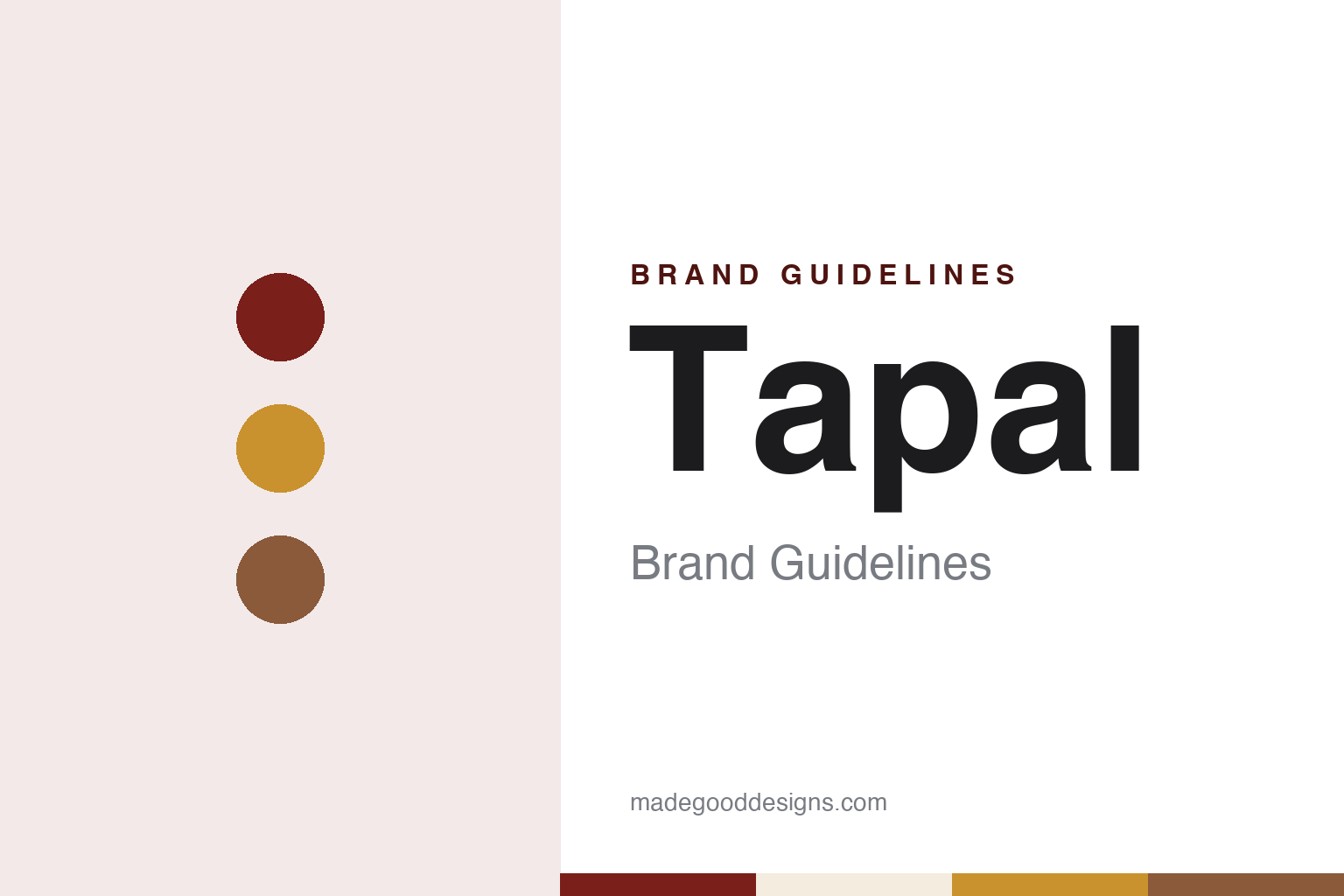
Two constants: a brewed red, Danedar gold and paper-bag brown palette and a warm bookish serif register. Abstract homage — not a Tapal product or mark; no pack, logo or tea is reproduced.
A shop in Jodia Bazaar
Ceylon tea, brown paper bags and Karachi’s cafés.
Tapal began as a tea shop in Jodia Bazaar, the old wholesale grocery market of Karachi. The company says it was founded in 1947 by Adam Ali Tapal as a retail outlet there, and that it started by importing tea from Sri Lanka, then Ceylon. Profit by Pakistan Today described the same beginning in 2021: shortly after Partition, the Tapal family imported tea from Sri Lanka and sold it wholesale in Karachi’s markets, a few miles from the port.
The shop’s first product of note was a blend. Writing in Aurora, the Dawn group’s marketing magazine, in its November–December 2017 issue, Ayesha Shaikh said Adam Ali Tapal developed Family Mixture, a blend of leaf and dust tea sold in brown paper bags, or thelis, with no branding or packaging to speak of. Its consistency and price made it popular with Karachi’s Iranian cafés, and café-goers who traced the tea back to its source became regular customers of the shop, Aurora said. The company dates Family Mixture to 1947 and calls it its first brand; Profit reported in 2018 that the founder introduced his leaf-and-dust blend in the 1960s.
For three decades the business stayed close to that shop. The change came with the founder’s grandson, Aftab Tapal, who joined after studying abroad — in 1975, according to Aurora and Profit in 2021, or in 1977, as Profit put it in 2018. Profit reported in 2018 that Aftab’s father, Faizullah Tapal, never ran the business. The company’s own timeline records a turnover of half a million kilograms of tea in 1977.
Colour
A sticker, a soft pack and a granular Kenyan tea.
Aftab Tapal’s first move was on the pack. He told Aurora that his time at an art institute had given him “a natural eye for aesthetics,” and that Tapal would never be seen as a brand while it sold good tea in paper bags. As a short-term fix a logo was screen-printed on the brown bags, Aurora said; Profit described it in 2018 as a sticker on the bags. Tapal’s first branded soft pack followed in the 1980s. In 1979 the business moved to its first factory and warehouses, on a two-acre plot in Korangi, an industrial district of Karachi, where Aurora said it still operated in 2017. The company says it mechanised blending in 1980 and imported its first packaging machine in 1982; Aurora said the machinery came from Germany.
The range then widened along regional lines. Chenak, a low-priced dust tea launched in 1984, was aimed at the Thar district and named after the metal containers used to pour tea at roadside dhabas, Aurora reported. In 1988 came Mezban, a premium dust tea for interior Sindh, and Danedar, a granular Kenyan tea named for its texture. Until then branded teas in Pakistan were Ceylon teas, Aurora said, and Danedar’s stronger, golden cup made it the flagship, sold with the campaign line “Daane Daane Pe Likha Hai Peene Wale Ka Naam.” The company calls it Pakistan’s first Danedar brand. Kenyan tea cost more than Ceylon tea at the time, and both Aurora and Profit reported that Tapal held its prices down and worked on narrow margins.
Distribution changed too. The company appointed its first distributor in 1985, and Aurora said company-owned vans gave way to a network of independent distributors in the mid-1980s.
Typography
Design and documentation.
The seven brands in this group are all food and drink names from Pakistan and Sri Lanka: Shan, National Foods, Rooh Afza, Olper’s, Tapal, Elephant House and Munchee. Pakistani and Sri Lankan food and drink brands in general sit at many different points in the trade, from family firms that still carry a founder’s name to names that now belong to much larger food and drink groups, and a single brand can be sold everywhere from a corner shop to a supermarket shelf.
A food or drink brand’s identity is usually carried less by a single product than by a pack, a name and the meal, snack or drink it promises, because the company behind the name may have changed hands, moved its production or grown far beyond the place where it started. That makes the questions behind each name worth asking plainly: who started it, who owns it now, and where its products are actually made and packed.
Each guide separates what independent sources record from what the company says about itself — its founding story, its owners over time, where its products are made and how its packaging has changed — and marks plainly what rests only on the company’s own word.
Aa
A warm bookish serif for a brand that started in a market shop. (Specimen set in Lora, a serif STAND-IN; NOT the Tapal logo.)
Tapal
A family business that overtook the multinationals.
Tapal grew up against two multinational rivals. Unilever’s Lipton led the branded market and Brooke Bond’s Supreme was second, Aurora reported, until Unilever bought Brooke Bond in the 1990s. Both Aurora and Profit say Tapal overtook them to become Pakistan’s largest-selling tea, though they date the moment differently: Profit put it at 2004–05 in its 2018 report, Aurora at 2008–09. In 2021 Profit estimated that about one in every three cups of tea drunk in Pakistan was Tapal.
The business is still private and family-owned, with its head office in Karachi. Profit wrote in 2021 that Tapal had shown no interest in listing on the Pakistan Stock Exchange. Its 2018 report said Aftab Tapal remained group chief executive while his daughter Mehvish Tapal, who joined in September 2006 and became a director in 2010, took most day-to-day decisions. English Wikipedia names Aftab Tapal as chairman.
Tapal’s tea is imported — Ceylon tea at first, Kenyan tea from the Danedar years — and blended and packed in Pakistan. The company names a head office and factory in Korangi Industrial Area, Karachi, and a second factory at Raiwind, near Lahore, where it set up a regional office in 1996. It says it launched a tea plantation at Shinkiari in 2000, the same year it brought out Tapal Green Tea, which it calls the country’s first range of flavoured teas; Tezdum followed in 2003. Exports began with Saudi Arabia, the company says — in 2004, according to the newspaper Business Recorder as cited by English Wikipedia — and it now claims a presence in more than 15 countries; Aurora put the figure at over 20 in 2017.
For a design guide, Tapal shows how a logo stamped on a brown paper bag can grow into a family of tea names, each pitched at a region. Compare Ketepa, the Kenyan tea packer, and Shan Foods, another Karachi brand. For this guide we use a brewed red, a Danedar gold and a paper-bag brown with a warm serif, an unofficial interpretation; no product or logo is reproduced.
Explore & save
Keep Tapal’s identity on hand — save it to a board in the Made Good inspiration library.
Tapal identity set
Pin the Tapal brewed red, Danedar gold and paper-bag brown palette and the warm bookish serif register to your own board.