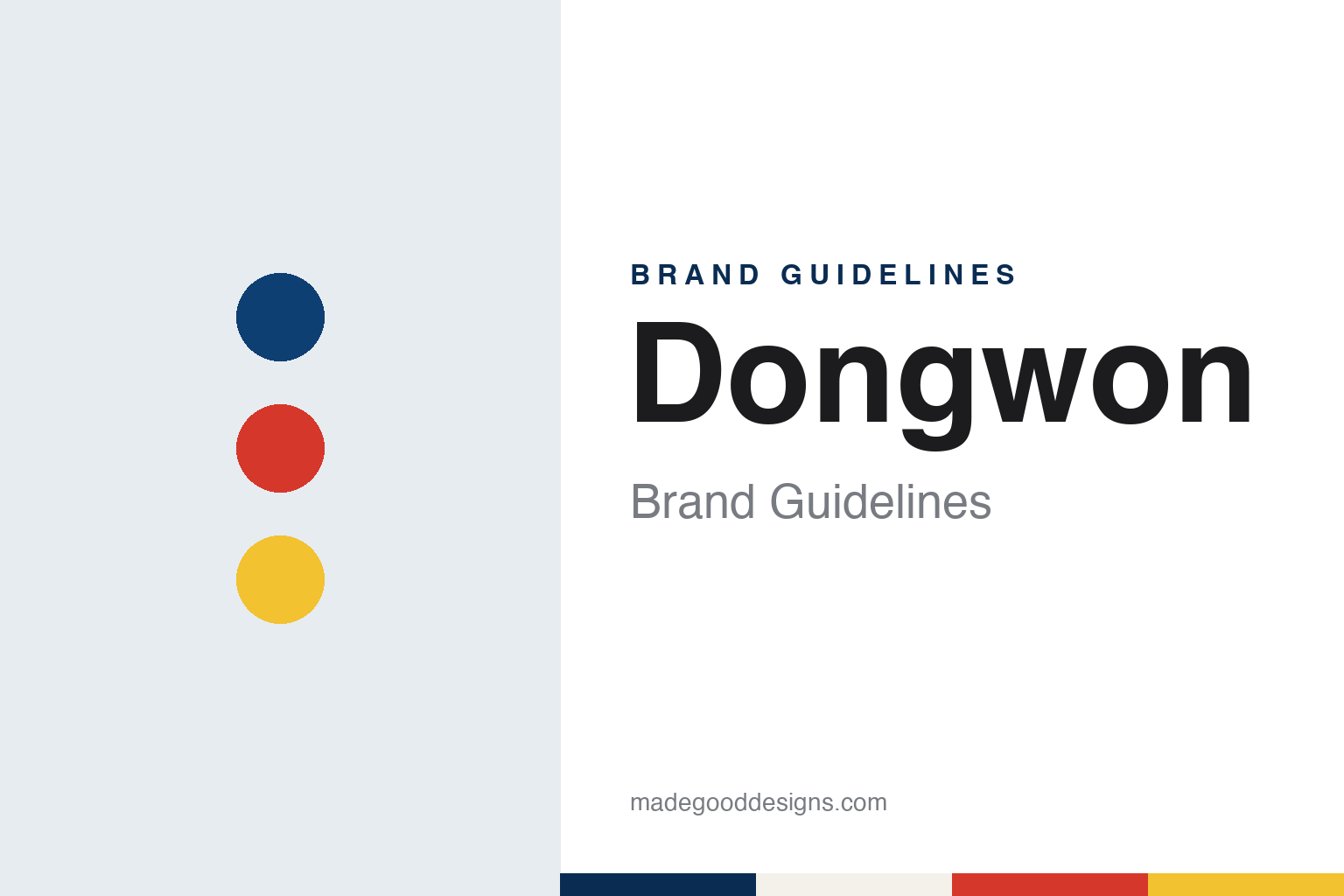
Dongwon Brand Guidelines
The 1969 tuna fleet that put tuna in Korean cans.
Aa
Two constants: a deep-sea navy, can red and yellowfin gold palette and a sturdy grotesque sans register. Abstract homage — not a Dongwon product or mark; no can, label or logo is reproduced.
A tuna fleet
A fisheries graduate, a long-liner and a base in Ghana.
Dongwon began at sea. Its founder, Kim Jae-chul, studied fishing at Busan Fisheries College, now Pukyong National University, and, according to Korean Wikipedia, worked as a fleet captain and then as a fisheries manager and director at Koryo Deep-Sea Fisheries in the 1960s. On 16 April 1969 he founded Dongwon Industries (동원산업) in Seoul, with a small office in the Myeong-dong district. English and Korean Wikipedia and the company’s own history all give 1969 as the founding year, and Kim as its founder.
The new company was a deep-sea fishing business. Korean Wikipedia’s company timeline says that in July 1969 it brought in the 31st Dongwon-ho, which it calls Korea’s first 500-tonne mothership-type tuna long-liner, and that in May 1973 it set up its first overseas base, at the port of Tema in Ghana. A cold-storage company followed in Busan in 1976, and in 1981 a separate food company, Dongwon Sikpum, was founded in Seongnam, south of Seoul. English Wikipedia calls Dongwon South Korea’s largest fishing company, and Korean Wikipedia lists purse seiners, tuna long-liners, trawlers and carriers in the fishing division of Dongwon Industries today.
Kim ran the business as president and then chairman for half a century. Korean Wikipedia lists him as chairman of the Dongwon Group from 1993 and as honorary chairman from 2019; he also chaired the Korea International Trade Association between 1999 and 2006. His son Kim Nam-jung is now chairman of the group, English Wikipedia says. Another son, Kim Nam-goo, runs Korea Investment Holdings, the financial business that grew out of Dongwon’s securities and asset-management arms and has since left the group.
Colour
Korea’s first canned tuna, and the slogans that sold it.
The brand most Koreans know is Dongwon Tuna (동원참치). The company’s history dates it to November 1982 and calls it the first canned tuna launched on the Korean market. The company says it presented canned tuna in the 1980s as a premium, developed-country food, and that in 1984 it became the first in the industry to sell tuna gift sets, the boxed assortments Koreans exchange at holidays. In December 1986 Dongwon opened a factory in Changwon, in South Gyeongsang province, to make tuna cans and pet food, the company says, and in 2002 it set up a canning company in Qingdao, China, according to Korean Wikipedia.
Advertising built the brand. Dongwon dates its first newspaper advertisement for the tuna to 1983 and its first television commercial to 1984, with the actor Baek Il-seob. Later lines have included “이건 맛의 대 참치” from 2019 to 2021 and “믿음의 한 캔” — “a can of trust” — from 2022. In 2025 the company ran a “Super Tuna” commercial with Jin of BTS. Earlier, in 1991, a Dongwon Industries corporate advertisement titled “A Sea with Dreams” won an excellence prize in the corporate category of the first SBS Advertising Awards, Korean Wikipedia says. In 1986 Dongwon was named an official supplier to the Seoul Asian Games and the 1988 Seoul Olympics for canned seafood, seasoned squid and seasoned laver.
The company keeps a running count of its cans. It says cumulative sales passed 1 billion in 1994, 5 billion in 2014 and 7 billion in 2022, and that by 2025 more than 7.9 billion cans had been sold. Dongwon’s food range now goes well beyond tuna: Korean Wikipedia lists Yangban seasoned laver, Dongwon Saemmul bottled water, Denmark milk, the Coolpis drink and Richam ham among its main products.
Typography
Design and documentation.
The seven brands in this group are all food and drink names from South Korea: Jinro, Paris Baguette, Chilsung Cider, Pulmuone, Dongwon, Sempio and Chung Jung One. Korean food and drink brands in general sit at many different points in the trade, from family firms that still carry a founder’s name to names that now belong to much larger food and drink groups, and a single brand can be sold everywhere from a corner shop to a supermarket shelf.
A food or drink brand’s identity is usually carried less by a single product than by a pack, a name and the meal, snack or drink it promises, because the company behind the name may have changed hands, moved its production or grown far beyond the place where it started. That makes the questions behind each name worth asking plainly: who started it, who owns it now, and where its products are actually made and packed.
Each guide separates what independent sources record from what the company says about itself — its founding story, its owners over time, where its products are made and how its packaging has changed — and marks plainly what rests only on the company’s own word.
Aa
A sturdy grotesque sans for a brand that grew out of a fishing fleet. (Specimen set in Archivo, a sans STAND-IN; NOT the Dongwon logo.)
Dongwon
A food spin-off, a holding company and an American tuna brand.
Dongwon became a group in stages. Dongwon Industries listed on the Korea Stock Exchange in March 1989, and Korean Wikipedia dates the official launch of the Dongwon Group to April 1996. On 1 November 2000 the food business was split off as Dongwon F&B, which listed separately that month; a holding company, Dongwon Enterprise, followed in 2001. In 2022 Dongwon Industries merged with Dongwon Enterprise and became the group’s holding company. In 2025 Dongwon F&B was taken private and turned into a wholly owned subsidiary of Dongwon Industries, the Dong-A Ilbo and Hankyung reported in April that year; Korean Wikipedia dates its delisting to 31 July 2025.
The group’s best-known purchase abroad is StarKist, the American tuna brand whose cartoon mascot, Charlie the Tuna, has appeared in its advertising since 1961, English Wikipedia says. The New York Times reported on 24 June 2008 that Del Monte Foods was selling its StarKist unit to Dongwon, and Korean Wikipedia’s company timeline records the acquisition as completed in October 2008. StarKist, previously based on Pittsburgh’s North Shore, moved its headquarters to Reston, Virginia, in 2022. In October 2018 StarKist agreed to plead guilty to a federal price-fixing charge in a US Justice Department investigation of the canned-tuna industry, USA Today reported.
Dongwon has also grown into packaging and logistics. Korean Wikipedia lists Dongwon Systems, which makes packaging, and Dongwon Home Food among the group’s companies, and dates the purchase of Dongbu Express, now Dongwon LOEX, to 2017. Dongwon F&B’s factories include Seongnam for fish-cake products from 1986, Gwangju for drinks from 1995 and Jincheon for processed meat and kimchi from 1996, the company says.
For a design guide, Dongwon shows how a fishing company turned its own catch into a household can and a brand that runs from Korean supermarkets to American pantries. Compare Century Tuna, the Manila canner, and CJ CheilJedang, another Korean food group. For this guide we use deep-sea navy, a can red and a yellowfin gold with a grotesque sans, an unofficial interpretation; no product or logo is reproduced.
Explore & save
Keep Dongwon’s identity on hand — save it to a board in the Made Good inspiration library.
Dongwon identity set
Pin the Dongwon deep-sea navy, can red and yellowfin gold palette and the sturdy grotesque sans register to your own board.