Singha Brand Guidelines
Thailand’s first brewery and its lion.
Aa
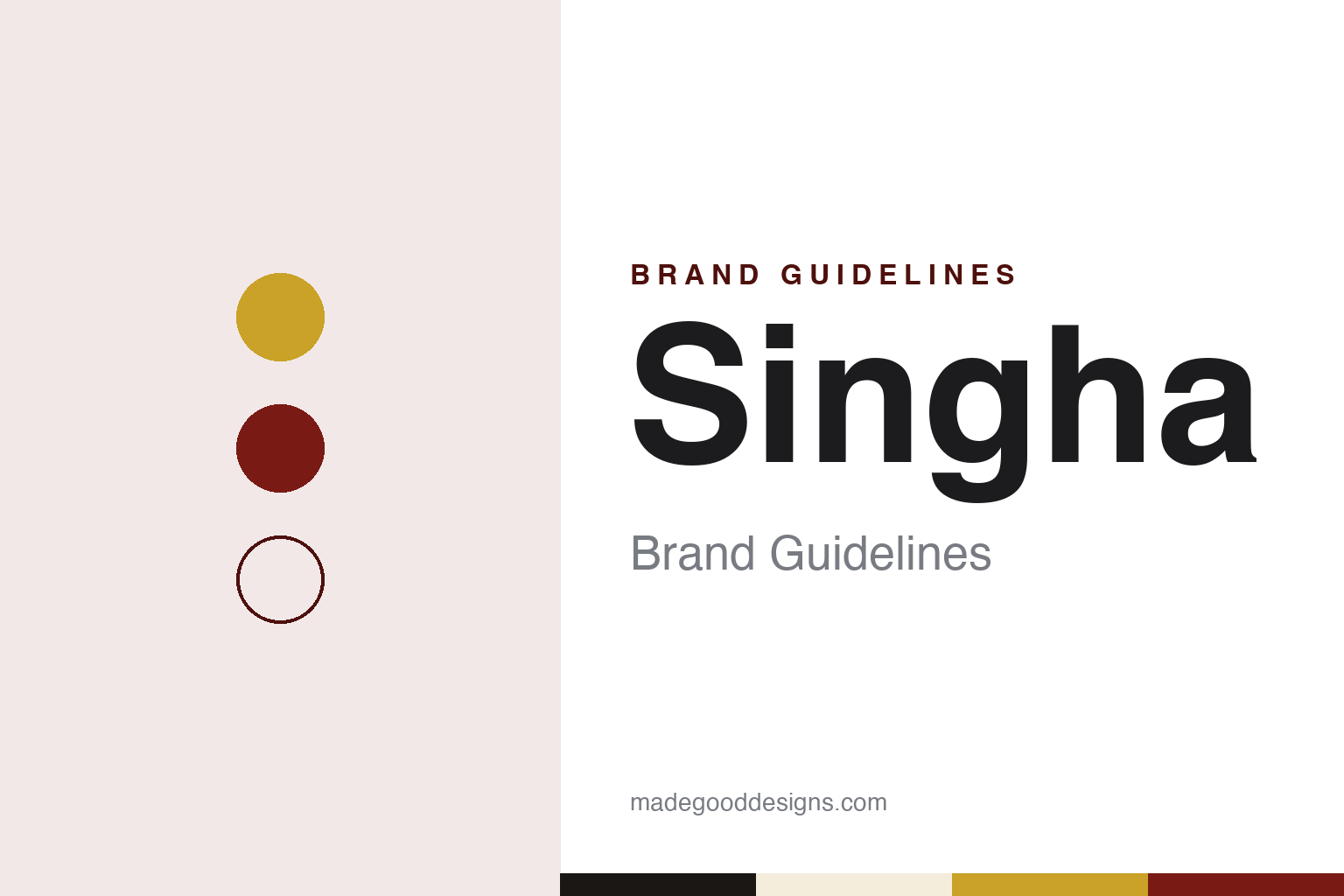
Two constants: a lion gold, lacquer red and rice cream palette and a classical capital serif register. Abstract homage — not a Singha product or mark; no bottle, label, lion or Garuda is reproduced.
Thailand’s first brewery
A nobleman, a Bangkok brewery and a beer that won out.
Singha is the beer of Boon Rawd Brewery, which English Wikipedia describes as the first brewery to open in Thailand. Thai Wikipedia dates the company’s founding to 4 August 1933 and names its founder as Phraya Bhirom Bhakdi, a nobleman whose birth name, English Wikipedia says, was Boonrawd Sreshthaputra; the company still carries that name. Phraya Bhirom Bhakdi was the title he held, and his descendants took Bhirombhakdi as their family name.
The early dates differ between sources. English Wikipedia says the brewery was built in 1933 and that its first bottles came off the line in 1934. Thai Wikipedia’s article on the brewery says that in 1934 Singha was well received at an event held at a civic club in Bangkok, which brought in special orders. Its article on the beer itself gives 1 June 1936 as the date Singha was first put on sale. Both articles agree that Singha was the brand that set the company’s course.
That choice was not obvious at the start. Thai Wikipedia says Boon Rawd first brewed several beers under different labels, and that the Singha mark proved more popular than the others; the company then dropped the other labels and concentrated on Singha. The beer became the company’s flagship and, in time, the name most people outside Thailand know the brewery by.
Today the business is run through two names. Boon Rawd Brewery is the brewer, and Singha Corporation, set up in 2001, is the holding company that manages the group’s brands and their development, Thai Wikipedia says; English Wikipedia describes Singha Corporation as the subsidiary that sells the beer.
Colour
A mythical lion and a royal bird.
The name and the emblem are the same thing. A singha is a lion from Hindu and Thai mythology, and English Wikipedia says the founder picked it as an easily recognisable symbol for his beer.
The second emblem is the Garuda, the mythical bird that is the royal symbol of Thailand. Singha bottles carry a Garuda at the neck as a mark of royal approval. Both English and Thai Wikipedia date the royal warrant that allows it to 25 October 1939, and English Wikipedia says Boon Rawd is the only brewery in Thailand to have received that right.
The beer is a pale lager. English Wikipedia gives the standard Singha at 5% alcohol by volume, with a light version at 3.8%, sold in bottles, cans and on tap; it describes the beer as brewed with all-barley malt and European hops, and says it is available in more than 50 countries. Boon Rawd also makes other beers, among them Leo and U Beer, as well as soda water and drinking water under the Singha name.
Sport has carried the lion abroad. English Wikipedia lists Singha as a partner of Chelsea from 2010 to 2022, a three-year deal with Leicester City from 2015, official beer of the MotoGP world championship from 2014 and a personal sponsor of the Formula One driver Kimi Räikkönen from 2015; Thai Wikipedia adds Manchester United, from 2010, and Oxford United. English Wikipedia also names Thai snooker players among the brand’s sponsored athletes, including Mink Nutcharut.
Typography
Design and documentation.
The seven brands in this group are all drinks, and all of them come from Thailand: Singha, Chang, Leo, M-150, Krating Daeng, est and Carabao. Thai drink brands in general sit at many different points in the trade, from family firms that still carry a founder’s name to names that now belong to much larger listed groups, and a single brand can be sold everywhere from a roadside shop to a supermarket shelf.
A drink brand’s identity is usually carried less by a single product than by a bottle or can, a name and the moment it promises, because the company behind the name may have changed hands, moved its production or grown far beyond the place where it started. That makes the questions behind each name worth asking plainly: who started it, who owns it now, and where its drinks are actually made and packed.
Each guide separates what independent sources record from what the company says about itself — its founding story, its owners over time, where its drinks are made and how its packaging and advertising have changed — and marks plainly what rests only on the company’s own word.
Aa
A classical capital serif for a beer that carries a royal warrant. (Specimen set in Cinzel, a serif STAND-IN; NOT the Singha logo.)
Singha
A family brewer that brews at home.
Boon Rawd has stayed in the founding family for more than ninety years. English Wikipedia says the founder’s elder son, Prachuab Bhirombhakdi, became Thailand’s first brewmaster and succeeded his father at the head of the company. Later generations followed: Santi Bhirombhakdi, a grandson of the founder, is described as the head of the family, and his sons Bhurit and Piti work in the business, with Bhurit Bhirombhakdi named as president and chief executive.
The brewing is done in Thailand. English Wikipedia says the company has about 3,500 employees and nine factories, in Bangkok, Chiang Mai, Singburi, Khon Kaen, Ayutthaya, Pathum Thani and Surat Thani, with a capacity of about one billion litres a year, and that around 10% of production is exported. There was one experiment with brewing abroad: in 1994 Boon Rawd bought breweries in Hartmannsdorf and Mittweida, in the German state of Saxony, which made a Singha Gold for the European market until 2001. Since then, English Wikipedia says, all Singha brands have been made only in Thailand.
The group has also grown beyond beer. Alongside Leo and U Beer, English Wikipedia lists Snowy and a licensed Asahi among the brands made by the company, and the Singha name appears on soda water and on drinking water, which Thai Wikipedia names among the company’s products, together with an Isaan beer. English Wikipedia’s article on Singha adds MY BEER and Kopper among related beers. One branch of the family has moved into wine: Piya Bhirombhakdi, a brother of Santi, founded the PB Valley Khao Yai winery, English Wikipedia says.
For a design guide, Singha shows how a mythical lion and a royal warrant can carry a national beer from a single Bangkok brewery to football shirts and racetracks. Compare Chang, its biggest Thai rival, and Leo, the other lager from Boon Rawd. For this guide we use lion gold, a lacquer red and a rice cream with a classical serif, an unofficial interpretation; no product or logo is reproduced.
Explore & save
Keep Singha’s identity on hand — save it to a board in the Made Good inspiration library.
Singha identity set
Pin the Singha lion gold, lacquer red and rice cream palette and the classical capital serif register to your own board.