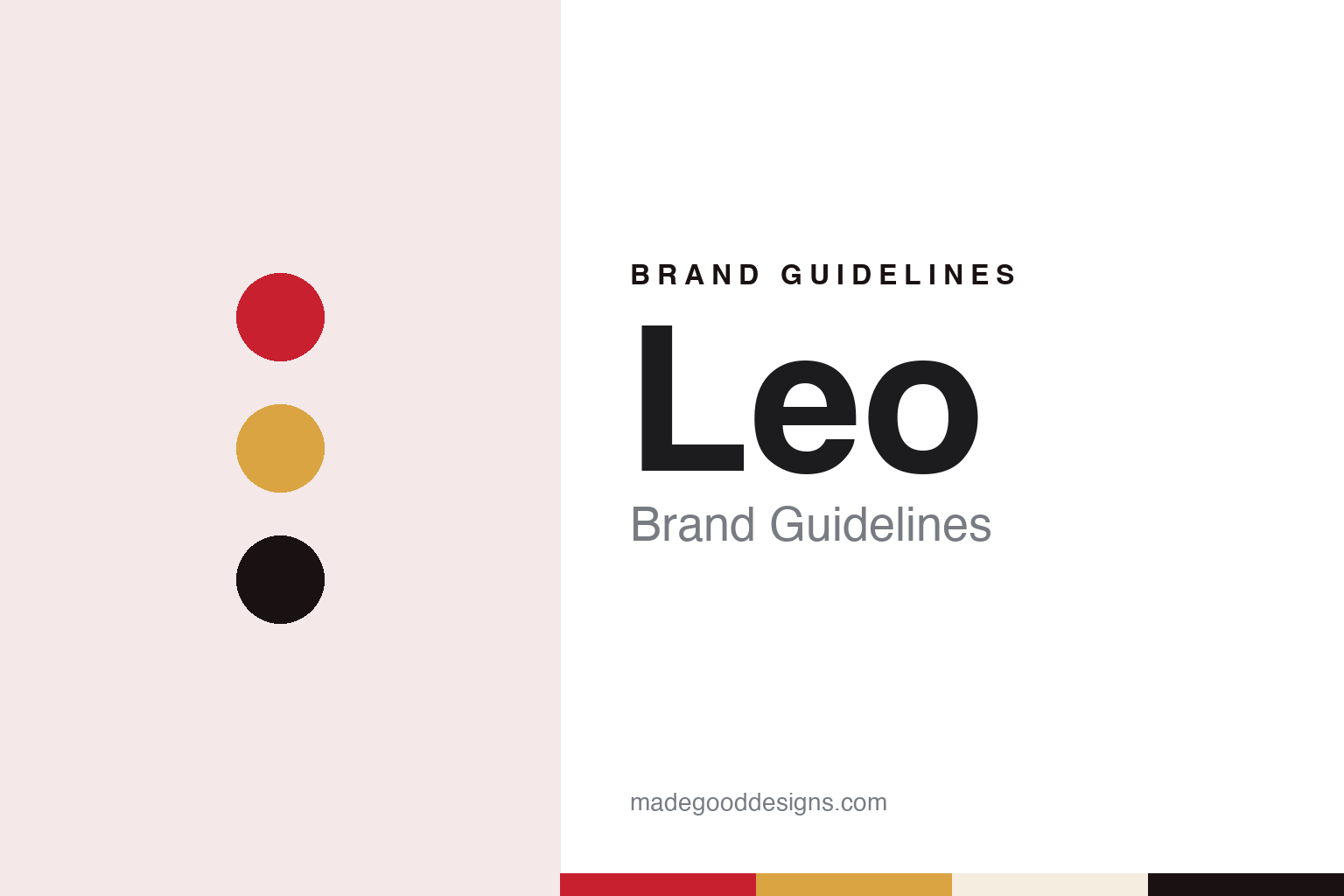
Leo Brand Guidelines
Boon Rawd’s second lager, named for a leopard on an office wall.
Aa
Two constants: a red, gold and cream palette and a condensed poster sans register. Abstract homage — not a Leo product or mark; no label, bottle or leopard emblem is reproduced.
A second beer
A brewery under pressure, and a painting on the wall.
Leo is a lager made by Boon Rawd Brewery, the Bangkok company that also brews Singha. Boon Rawd was founded in 1933 by Phraya Bhirom Bhakdi, born Boonrawd Sreshthaputra, and Thai Wikipedia dates the company to 4 August 1933; English Wikipedia calls it Thailand’s first brewery and says it is still run by his descendants, the Bhirombhakdi family. In Thailand the beer is distributed by Boon Rawd Trading, Thai Wikipedia says.
Leo was born of competition. Thai Wikipedia, citing the business site BrandCase (2022), says that after Charoen Sirivadhanabhakdi’s Chang beer arrived in 1995 and was sold to shops together with his spirits, Singha’s share of the Thai beer market fell sharply, and the Asian financial crisis of 1997 pushed drinkers towards cheaper beer. Rather than cut Singha’s price, Boon Rawd chose to build a second beer of its own, priced below Singha and aimed at a different group of drinkers.
The name and the emblem came from one room. In a 2015 interview published on the Thai blog Geranun.com, Chatchai Wiratyosin, then an assistant managing director at Boon Rawd and one of the beer’s creators, recalled that a series of proposed names had been turned down. In the office of the managing director, Santi Bhirombhakdi, hung a painting of a leopard. A leopard, the thinking went, belongs beside a lion, the Singha. “Leopard” was too long, so it was cut to “LEO.” with a full stop, which, Chatchai said, also nodded to the lion. The full stop was later dropped, and the painted leopard became the emblem on the label.
Colour
Khon Kaen, June 1998.
Leo was given its own brewery. Thai Wikipedia says Boon Rawd set up the Khon Kaen Brewery company in November 1994 to run a plant in Khon Kaen, in northeastern Thailand, and the weekly Matichon Sutsapda reported in 2019 that construction began in 1995 and took two years. Leo, “the newest beer,” went on sale in June 1998, the same report says. In a December 2016 press release Bhurit Bhirombhakdi, chief executive of Boon Rawd Trading, also dated the brand’s first launch to 1998.
The launch began away from Bangkok. Thai Wikipedia says the company chose the Northeast, where Singha sold less, so that the two brands would not be compared side by side, and that the first lot of 800,000 cases sold out in two months rather than the six that had been planned. The advertising drew attention of its own: the first Leo commercial featured a lead character who resembled a provincial governor, which brought protests from governors and gave the beer the press nickname “the governor’s beer,” Thai Wikipedia says. Chatchai Wiratyosin told Geranun.com that the brand later leaned on what he called “sexy marketing” against a rival’s music-led campaigns.
Not every move worked, he said. A green “Super LEO” did not lift sales, while two further beers, Thai Beer and Isan Beer, helped Leo grow, he said. Matichon Sutsapda wrote in 2019 that Leo created a new market for Boon Rawd and became the best-selling beer brand in the country, and Thai Wikipedia says the company regained first place in the Thai beer market from 2005.
Typography
Design and documentation.
The seven brands in this group are all drinks, and all of them come from Thailand: Singha, Chang, Leo, M-150, Krating Daeng, est and Carabao. Thai drink brands in general sit at many different points in the trade, from family firms that still carry a founder’s name to names that now belong to much larger listed groups, and a single brand can be sold everywhere from a roadside shop to a supermarket shelf.
A drink brand’s identity is usually carried less by a single product than by a bottle or can, a name and the moment it promises, because the company behind the name may have changed hands, moved its production or grown far beyond the place where it started. That makes the questions behind each name worth asking plainly: who started it, who owns it now, and where its drinks are actually made and packed.
Each guide separates what independent sources record from what the company says about itself — its founding story, its owners over time, where its drinks are made and how its packaging and advertising have changed — and marks plainly what rests only on the company’s own word.
Aa
A tall condensed sans for a beer sold on its emblem. (Specimen set in Oswald, a sans STAND-IN from Google Fonts — NOT the Leo logo lettering, which is a custom mark.)
Leo today
A new label, a soda and a brewery in the Northeast.
The biggest documented change to Leo’s look came in November 2016. Boon Rawd Trading announced new labels and neck labels for the large and small bottles, a slimmer small bottle, redesigned cans to match, and new caps and cartons, with the new packs in shops across the country from mid-November, Marketing Oops! published in December 2016. Visiting the Khon Kaen brewery soon afterwards, Brand Inside described the new label as carrying more red, and reported staff saying the recipe was unchanged and only the label had moved; old and new labels sat side by side in shops because the change was made one production line at a time.
The same Brand Inside report, published in January 2017, described the Khon Kaen site as the home of Leo. A monument to Phraya Bhirom Bhakdi stands at the entrance, and staff said the plant had once also brewed Singha, Super Leo, Thai Beer, Isan Beer and Mittweida but now made Leo, soda and drinking water. Staff named the ingredients as barley malt bought from Europe, the Americas, Australia and China, Thai rice, European hops and a yeast strain used only within the Boon Rawd group. Thai Wikipedia adds that breweries in Pathum Thani and Nakhon Pathom use the same recipe.
The name has also moved beyond beer. In November 2016, close to the relabelling, Boon Rawd launched Leo soda, a soda water aimed at younger drinkers who mix their drinks, the trade site Brand Buffet reported. Thai Wikipedia, citing BrandAge (2021), notes that a soft drink under the Leo name could be marketed more freely after Thailand banned advertising for alcoholic drinks. Since 2001 Boon Rawd’s businesses have sat under a holding company, Singha Corporation, which Thai Wikipedia says also oversees the design and management of the group’s brands.
For a design guide, Leo shows how a second brand can borrow a family resemblance without copying its parent: a leopard beside a lion, a short name cut from a longer word, and a label refreshed after almost twenty years. Compare Singha, Boon Rawd’s lion-badged flagship, and Chang, the rival whose arrival prompted Leo. For this guide we use a Leo red, a leopard gold and a cream with a condensed sans, an unofficial interpretation; no product or logo is reproduced.
Explore & save
Keep Leo’s identity on hand — save it to a board in the Made Good inspiration library.
Leo identity set
Pin the Leo red, leopard gold and cream palette and the condensed poster sans register to your own board.