Saigon Brand Guidelines
The 1875 brewery brand now owned through ThaiBev.
Aa
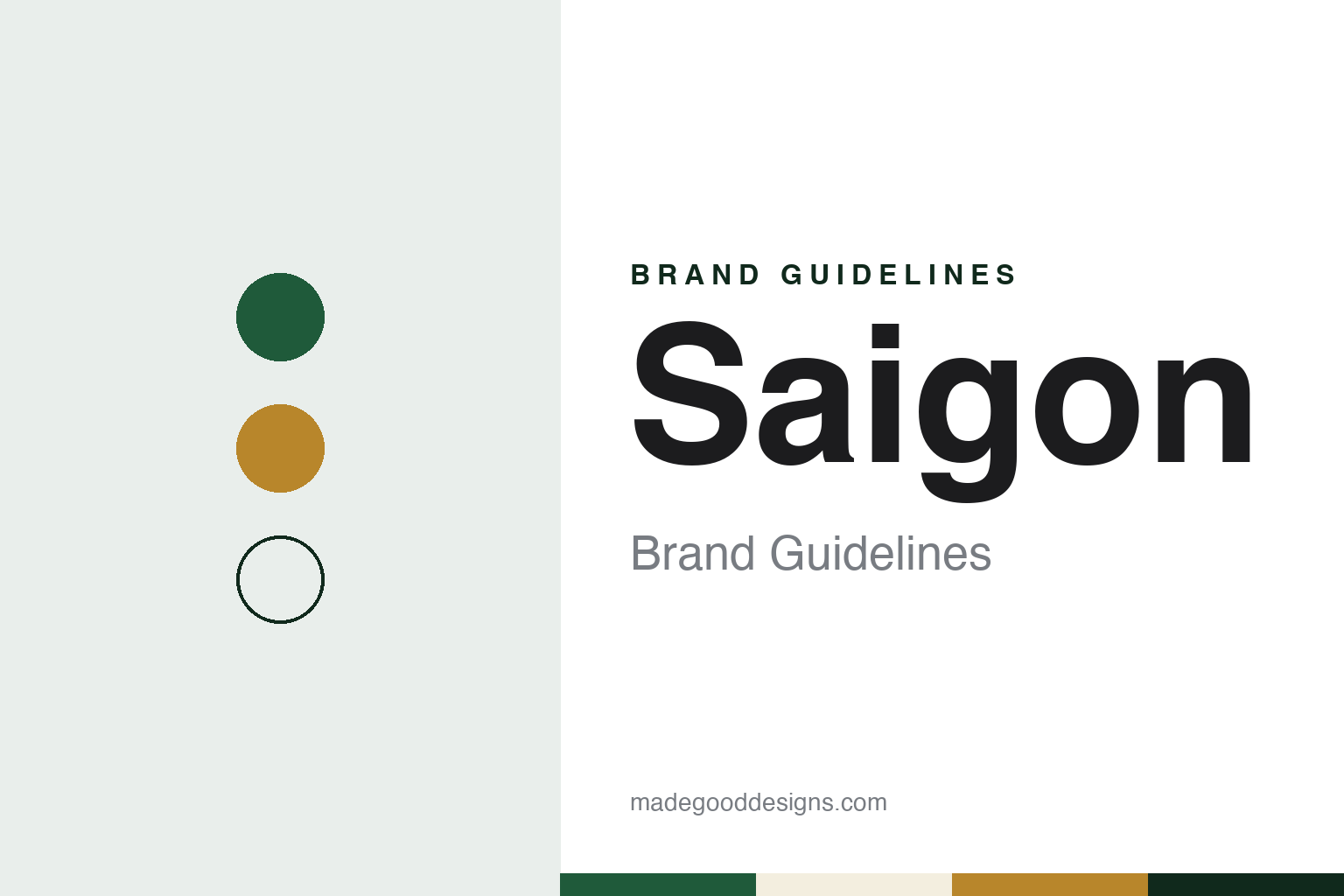
Two constants: a Saigon green, gold and cream palette and a heritage serif register. Abstract homage — not a Bia Saigon product or mark; no bottle, can, logo or label is reproduced.
Victor Larue’s brewery
From a colonial workshop to a state brewery.
Bia Saigon — Saigon Beer — is the main brand of Sabeco, the Saigon Beer-Alcohol-Beverage Corporation of Ho Chi Minh City. The company traces its origins to 1875, when, it says, a small brewery was set up in Saigon by Victor Larue, a Frenchman; English and Vietnamese Wikipedia both name Larue as founder. By 1910, the company says, the workshop had become a full factory making beer, soft drinks and ice, and in September 1927 it was merged into the French brewing group BGI.
The company also dates the legal basis of the brewery that still stands in District 5 to the colonial period: an application filed in 1908 and approval from the Governor-General of Indochina for a beer and ice factory at Chợ Lớn, under a decree of 24 March 1909. That site, the company says, is where its brewery on Nguyễn Chí Thanh street stands today.
After reunification the brewery passed to the state. On 17 May 1977, the company says, a decision of the Minister of Food handed all of BGI’s plant to the state’s Southern Alcohol company, and from 1 June 1977 it was renamed Nhà máy Bia Sài Gòn, the Saigon Brewery. Vietnamese Wikipedia describes the next years as those of a state enterprise under central planning, before the brewery became the Saigon Beer Company in 1993 and the core of the Sabeco corporation formed in July 2003.
Colour
Cans, bottles and a green glass.
The products that carry the brand today took shape in the decades that followed. The company dates the 333 Export can, in a 330 ml size, to October 1989. In February 1992, it says, the brewery installed a new bottling line, replaced wooden crates with plastic ones and introduced a 450 ml bottle in place of the 500 ml one, describing the new shape as more attractive and stronger under pressure.
The beers now on its website followed. Saigon Export arrived in June 1996, the company says — first intended for export, but sold at home because of demand. Saigon Special followed in July 2000, in what the company calls a distinctive green glass bottle of 330 ml, aimed at higher-income drinkers. Saigon Gold, a limited premium can, came in 2016; the company also lists Saigon Lager, Saigon Chill, Lạc Việt and two 333 beers, including a 333 Pilsner launched in 2024.
The brand has also been redesigned. The company says it relaunched Bia Saigon — Special, Lager and Export — in August 2019 and the 333 can in December 2019. For its 145th anniversary in 2020 it launched Lạc Việt and Saigon Chill and a new design for Saigon Gold, and in 2021 it released a “Bản sắc Việt,” or Vietnamese identity, collection with limited-edition Saigon Lager cans.
Production grew with the brand. In 2000, Vietnamese Wikipedia says, the Saigon Beer Company became the first Vietnamese brewer to pass 200 million litres a year, and in 2008 Sabeco opened a large brewery at Củ Chi, outside the city, which the company describes as among the most modern in Southeast Asia at the time.
Typography
Vietnam’s food and drink brands.
The seven brands in this group all make food or drink, and all of them come from Vietnam: Kinh Đô, Bibica, TH true MILK, Saigon, Bia Hà Nội, Vissan and Cholimex. Vietnamese food and drink brands in general sit at many different points in the trade, from businesses that began as state enterprises to names that now belong to much larger groups, and a single brand can be sold everywhere from a street-side stall to a supermarket shelf.
A food or drink brand’s identity is usually carried less by a single product than by a pack, a name and the meal or moment it promises, because the company behind the name may have changed hands, moved its factory or grown far beyond the city where it started. That makes the questions behind each name worth asking plainly: who started it, who owns it now, and where its products are actually made and packed.
Each guide separates what independent sources record from what the company says about itself — its founding story, its owners over time, where its products are made and how its packaging has changed — and marks plainly what rests only on the company’s own word.
Aa
A heritage serif for a brewery that dates itself to 1875. (Specimen set in Playfair Display, a serif STAND-IN; NOT the Bia Saigon logo.)
Saigon
From the ministry to ThaiBev.
Sabeco’s ownership changed in stages. The corporation was converted into a joint-stock company in 2008, Vietnamese Wikipedia says, though the state kept control: English Wikipedia, citing the Vietnamese financial site Gafin, says the Ministry of Industry and Trade owned about 89.6 per cent in September 2012, when foreign brewers including Heineken, SABMiller, Kirin and Asahi had shown interest. Sabeco’s shares were listed on the Ho Chi Minh City Stock Exchange, under the code SAB, on 6 December 2016, Vietnamese Wikipedia says, citing the broadcaster VTV.
The decisive sale came a year later. In December 2017 the ministry sold its 53.59 per cent stake to Vietnam Beverage Company Limited, a Hanoi company set up that October, the newspaper Tiền Phong reported on 17 December 2017; the company says the ministry kept 36 per cent. Vietnamese Wikipedia traces Vietnam Beverage through F&B Alliance Vietnam and BeerCo Limited to Thai Beverage, the Bangkok drinks group controlled by Charoen Sirivadhanabhakdi, and English Wikipedia lists ThaiBev as Sabeco’s owner. English Wikipedia, citing Nikkei Asia, says Sabeco’s share of the Vietnamese beer market had fallen below 40 per cent at the time of the takeover, having been about 51 per cent in 2010.
The founder’s name travelled separately. English Wikipedia notes that Vietnam Brewery Limited, a joint venture of Singapore’s Asia Pacific Breweries and Saigon Trading Group and one of Sabeco’s main rivals, sells a beer called Bière Larue. Sabeco marked its 150th anniversary in 2025, and its website still opens its history with Victor Larue’s brewery of 1875.
For a design guide, Saigon shows how a city name can carry a beer through colonial, state and foreign ownership. Compare Bia Hà Nội, the beer brand of Hanoi, and Trung Nguyên, another Vietnamese drinks brand. For this guide we use a bottle green, lager gold and cream with a serif, an unofficial interpretation; no product or logo is reproduced.
Explore & save
Keep Saigon’s identity on hand — save it to a board in the Made Good inspiration library.
Saigon identity set
Pin the Saigon green, gold and cream palette and the heritage serif register to your own board.