Chivita Brand Guidelines
The Lagos juice brand that grew out of a Capri-Sonne franchise.
Aa
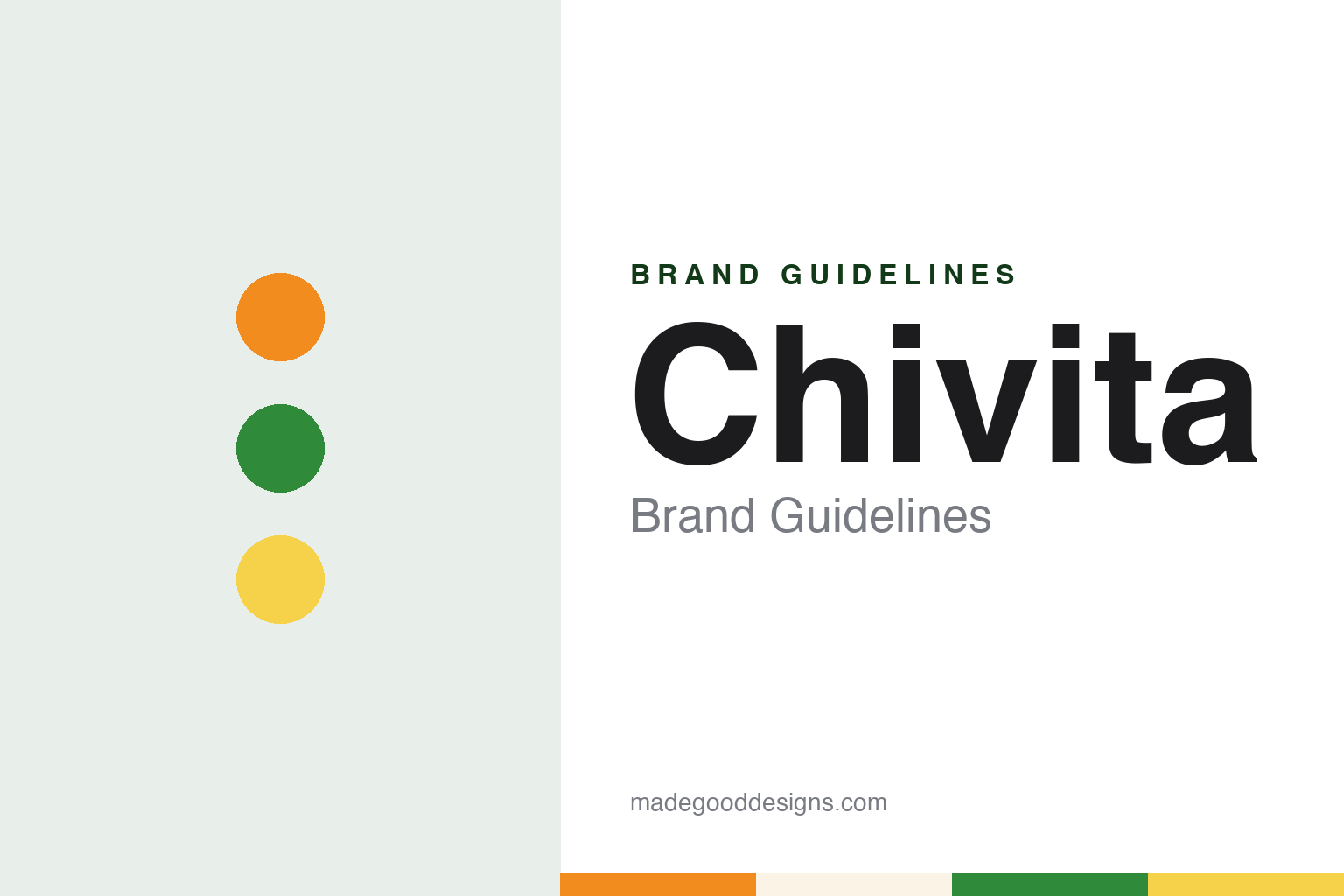
Two constants: an orange, leaf green and pineapple yellow palette and a rounded bold sans register. Abstract homage — not a Chivita product or mark; no pack, logo or carton is reproduced.
A franchise first
A Lagos company that made someone else’s drink before its own.
Chivita is the juice brand of CHI Limited, a food and drinks company in Lagos, Nigeria. The Coca-Cola Company, in a 2019 press release, said CHI was founded in Lagos in 1980, and the company’s own timeline gives the same year for the incorporation of what it styles “C.H.I Limited.” Today it trades as Chivita|Hollandia, joining the names of its two biggest brands, and gives its corporate office as Ajao Estate in Lagos.
Its first big product was not its own. The company’s timeline says it launched Capri-Sonne, the German pouch drink later renamed Capri-Sun, in Nigeria in 1982 in four flavours. Deepanjan Roy, then CHI’s managing director, told BusinessDay in a March 2021 interview that Capri-Sonne arrived in 1981 under a franchise arrangement, so the two sources differ by a year. The company says Nigeria grew to become the second-largest Capri-Sonne market in the world; Roy put it as the third-largest Capri-Sonne franchise globally by 2011. CHI still makes and distributes Capri-Sun in Nigeria, the company says.
Chivita came later. ThisDay reported in July 2013 that Chivita Premium Fruit Juice was first introduced in Nigeria in 1996, at a time when many shoppers preferred imported goods and saw them as higher quality. The company’s timeline also dates the creation and launch of “its own juice brand, Chivita” to 1996, while English Wikipedia’s article on the company gives 1997, and Roy, in his 2021 interview, dated Chivita 100% Orange in a one-litre aseptic carton to 1997.
Packaging came next. The company says it installed its first Tetra Pak line in 1998 and put Chivita into one-litre aseptic packs, then widened the range of flavours. Roy said that by 2009 CHI had become the largest Tetra Pak partner in sub-Saharan Africa. ThisDay added a policy turn: in 2002, it reported, the federal government banned imports of certain goods, juice among them, and a number of foreign brands began to be produced in Nigeria instead. In that market, the newspaper wrote, Chivita still had to persuade shoppers that a locally made juice would match imported quality.
Colour
A tagline, film actors and a football club.
Chivita’s advertising has leaned on the claim in its name. In July 2013 ThisDay reported on a new campaign built around the brand’s tagline, “100% fruit juice content,” and named its main rivals at the time as 5Alive, from Coca-Cola, along with Funman, Don Simon and more than 15 smaller brands. The same article recalled an earlier campaign that sold Chivita as a Nigerian product with the slogan “Be Nigerian, Buy Nigerian,” and said the brand had used the actors Jide Kosoko, Ini Edo and Nkiru Sylvanus in its marketing.
The name itself changed in step. English Wikipedia says Chivita Premium Fruit Juice was renamed Chivita 100% in 2014 in a rebranding meant to signal the product’s composition. In October 2014 Manchester United announced a partnership with CHI Limited, on its own website, that made Chivita 100% the club’s official beverage partner in Nigeria and allowed CHI to use the club’s brand elements on its products in the Nigerian market. The Nation reported in September 2015 that CHI had launched a “Chivita 100% or nothing” campaign; English Wikipedia, citing that report, says the promotion featured Manchester United players.
The range has spread well beyond orange juice in a carton. The company dates a Chivita Ice Tea, Chivita Active and Chivita Happy Hour to 2009 and 2010. It began putting Chivita drinks into cans in 2020, introduced a Chivita Smart Malt Drink in 2022, carried out what it calls a portfolio revitalisation of the Chivita and Hollandia brands in 2023, and moved Chivita into PET bottles in 2025. The juices have a website of their own, chivitajuices.com, alongside the company site.
The brand has collected trade awards along the way. English Wikipedia lists Most Preferred Juice Brand at the 2013 Generation Next awards, run with BusinessDay and HDI Youth Marketers; Africa’s Best Quality Juice Brand in 2014 from the Africa Quality Institute; and Outstanding Juice Brand in Nigeria at the 2016 Marketing Edge Brands and Advertising Excellence awards.
Typography
Design and documentation.
The seven brands in this group all make food or drink, and all of them come from Ghana, Ethiopia or Nigeria: Nkulenu, Kasapreko, Dashen, Star, Hollandia, Chivita and Gala. Food and drink brands in general sit at many different points in the trade, from family firms that still carry a founder’s surname to names that now belong to much larger groups, and a single brand can be sold everywhere from a roadside kiosk to a supermarket shelf.
A food or drink brand’s identity is usually carried less by a single product than by a pack, a name and the meal or moment it promises, because the company behind the name may have changed hands, moved its factory or grown far beyond the town where it started. That makes the questions behind each name worth asking plainly: who started it, who owns it now, and where its products are actually made and packed.
Each guide separates what independent sources record from what the company says about itself — its founding story, its owners over time, where its products are made and how its packaging has changed — and marks plainly what rests only on the company’s own word.
Aa
A rounded bold sans for a bright carton-shelf juice. (Specimen set in Baloo 2, a sans STAND-IN; NOT the Chivita logo.)
CHI Limited
A Nigerian holding company, Coca-Cola, then UAC.
For most of its history CHI belonged to a Nigerian group. When The Coca-Cola Company announced its first investment, on 30 January 2016, it described Tropical General Investments Group (TGI Group) as the holding company of Chi Ltd and called CHI Nigeria’s leading dairy and juice company. Under a binding agreement Coca-Cola took an initial 40% stake and said it intended to raise that to 100% within three years, subject to regulatory approval.
It did so on schedule. On 30 January 2019 Coca-Cola announced from Atlanta that it had completed its acquisition of Chi and now owned all of it, naming Chivita for juice and Hollandia for value-added dairy among the company’s products. Peter Njonjo, then president of Coca-Cola’s West Africa business unit, said in the release that Chi’s range complemented Coca-Cola’s own and would help it grow in new categories in Africa. Roy, speaking to BusinessDay in 2021, dated the two steps to February 2016 and February 2019.
Six years later CHI changed hands again. BusinessDay reported on 4 October 2025 that UAC of Nigeria Plc had agreed to buy CHI from Coca-Cola, in a deal announced on 30 July 2025, and that Nigeria’s Federal Competition and Consumer Protection Commission had approved it. TheCable reported on 3 October 2025 that UAC had completed the acquisition, quoting CHI’s managing director, Eelco Weber, and UAC’s group managing director, Fola Aiyesimoju. UAC began in 1931 as Nigerian Motors, a subsidiary of Unilever’s United Africa Company, English Wikipedia says; it now calls itself a holding company, with businesses ranging from paints and animal feed to packaged food and drinks.
CHI describes its products as locally made in Nigeria. It says it runs the largest production site with aseptic beverage packaging in sub-Saharan Africa and holds ISO 22000 certification. Its brands today are Chivita, Hollandia, Capri-Sun and the SuperBite Beefie snack; Roy dated the Beefie sausage roll to 1997.
For a design guide, Chivita shows how a Lagos juice company turned a one-litre carton and a “100%” promise into a national brand through three changes of owner. Compare Hollandia, the dairy brand from the same company, and Jumex, the Mexican juice maker. For this guide we use orange, leaf green and pineapple yellow with a rounded sans, an unofficial interpretation; no product or logo is reproduced.
Explore & save
Keep Chivita’s identity on hand — save it to a board in the Made Good inspiration library.
Chivita identity set
Pin the Chivita orange, leaf green and pineapple yellow palette and the rounded bold sans register to your own board.