Rani Brand Guidelines
The Gulf juice drink with pieces of fruit in the can.
Aa
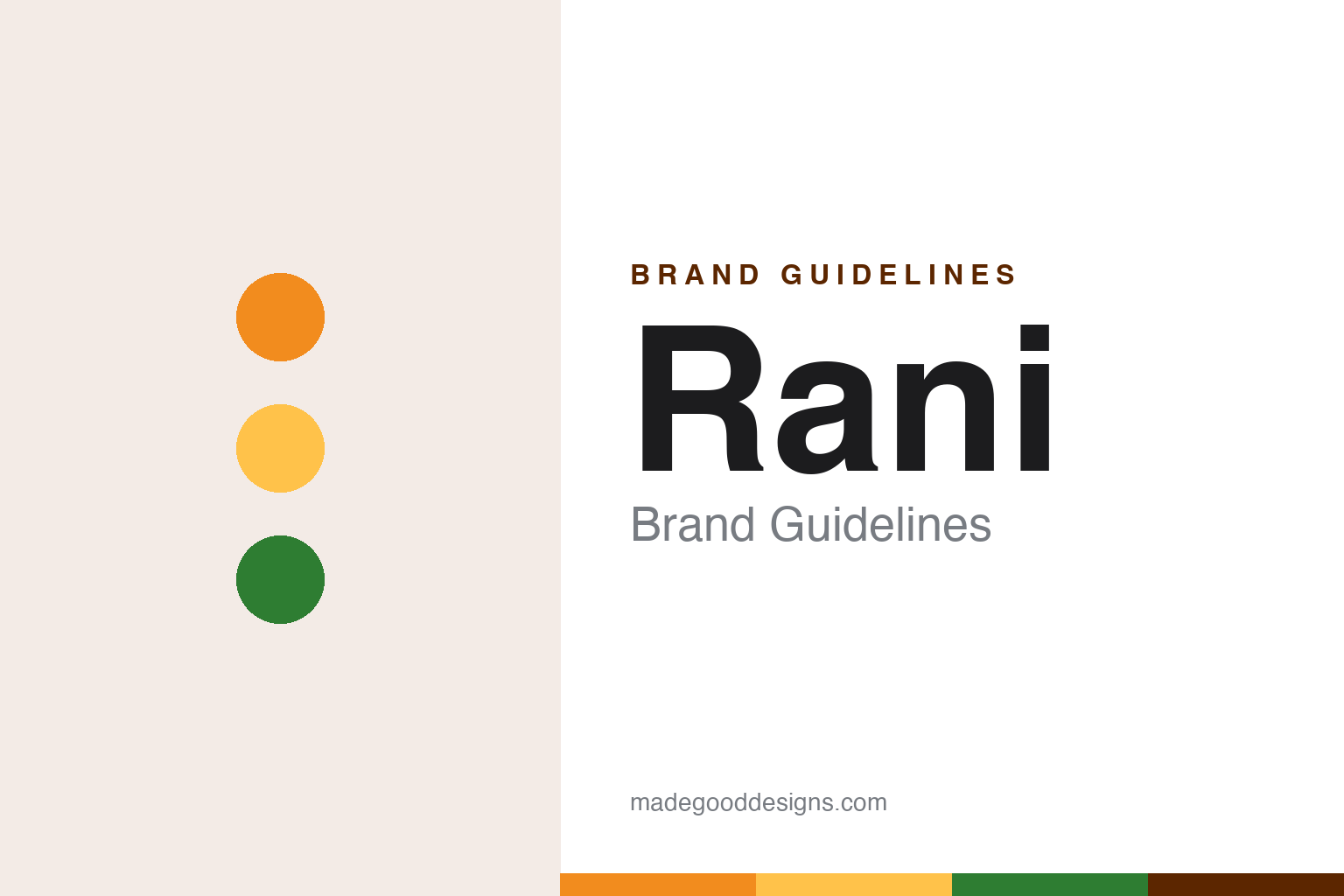
Two constants: a Rani orange, gold and green palette and a rounded sans register. Abstract homage — not a Rani product or mark; no can, logo or label is reproduced.
Rani Orange Float
A Bahraini trading house and its first drink of its own.
Rani is a younger brand than the company behind it. Its maker, the Aujan family business, traces itself to 1905, when Abdulla Aujan & Brothers was founded in Bahrain by Abdulla Aujan and three of his brothers, English Wikipedia says, citing Bloomberg and the company. The firm began by trading goods such as tobacco and rice, and it came to drinks through another company’s brand: in the late 1920s it secured the right to distribute Vimto, the Manchester cordial, in the Middle East. Aujan dates that agreement with Nichols to 1927; Wikipedia, citing Bloomberg, gives 1928. The group is now headquartered in Dammam, in Saudi Arabia’s Eastern Province.
Aujan opened its first beverage plant in Dammam in 1979, according to the company’s own timeline, and three years later it launched a drink of its own. Aujan calls Rani, launched in 1982, its “first homegrown beverage brand.” The first product was Rani Orange Float, Wikipedia says, and Bloomberg reported in January 2013 that it was inspired by a mandarin drink that Adel Aujan, the family member who later chaired Aujan Industries, had tasted on a trip to Japan. Adel Aujan had joined the company in 1968 after studying at Fort Lewis College in Colorado, Wikipedia says, and is credited there with taking the group’s drinks distribution beyond Saudi Arabia.
The drink became the core of the business. Bloomberg’s 2013 report, as summarised on Wikipedia, put Rani at 84 per cent of Aujan’s sales in 2011, the year Aujan agreed to sell a stake in its drinks business.
Colour
Float, cans and a billion of them.
Rani is sold as a fruit juice drink, and its best-known line is the one it started with. BeverageDaily described the brand in February 2015 as two lines: a smooth drink sold simply as Rani, and Rani Float, which contains pieces of fruit. Wikipedia lists three ranges, Rani Float, Rani Fruit Drink and Rani Refreshing, and says the drinks are sold in cans, glass bottles, plastic bottles and cartons.
The scale of production is recorded in one milestone. In March 2013, Coca-Cola and Aujan held a ceremony in Dubai to mark the one billionth can of Rani made by their joint bottling company, Wikipedia says, citing a regional news report. By 2015, BeverageDaily reported, Rani was sold in 56 countries; the company’s own list of markets begins with Saudi Arabia, Kuwait, Bahrain, Qatar, the UAE and Oman and runs on through Iraq, Jordan, Yemen and Egypt, with a further presence it describes in North Africa, the Levant, East Africa and Southeast Asia.
Rani’s home plant is in Saudi Arabia, and a second followed in the UAE. Aujan’s timeline records a second beverage plant in Dubai, which it now dates to 2002 while Wikipedia, citing an earlier version of the company’s history, gives 2005. The company names its plants as Dammam, Dubai and Beirut, the last added through the purchase of Lebanon’s National Beverage Company, and it says it has since opened beverage plants in Egypt and Iraq.
Typography
Gulf food and drink brands.
The seven brands in this group all make food and drink, and they come from the United Arab Emirates, Saudi Arabia and Oman: Al Kabeer, Sunbulah, Al Rawabi, Mazoon, Lacnor, Al Ain and Rani. Gulf food and drink brands in general sit at many different points in the trade, from family firms that still carry a founder’s name to names that now belong to much larger food groups, and a single brand can be sold everywhere from a corner grocery to a hypermarket aisle.
A food or drink brand’s identity is usually carried less by a single product than by a pack, a name and the meal or refreshment it promises, because the company behind the name may have changed hands, moved its factory or grown far beyond the town where it started. That makes the questions behind each name worth asking plainly: who started it, who owns it now, and where its products are actually made and packed.
Each guide separates what independent sources record from what the company says about itself — its founding story, its owners over time, where its products are made and how its packaging has changed — and marks plainly what rests only on the company’s own word.
Aa
A rounded, friendly sans — for a fruit drink sold in cans. (Specimen set in Poppins, a sans STAND-IN; NOT the Rani logo.)
Rani
A homegrown brand inside a Coca-Cola partnership.
In December 2011, The Coca-Cola Company agreed to buy into Aujan’s beverage business, and the deal was completed in September 2012, according to Coca-Cola’s announcements as cited on Wikipedia. Two companies came out of it. Rani Refreshments, which Aujan describes as the trademark owner of Rani and of the malt drink Barbican, holds the brands; Aujan Coca-Cola Beverages Company, known as ACCBC, is the authorised manufacturer and distributor of their products and also makes Vimto under licence in the region, the company says. Sources give different figures for the size of Coca-Cola’s share: Wikipedia says half of the beverage business, while BeverageDaily reported in 2015 that it was 45 per cent.
Rani’s packaging is described mostly in the company’s own words. In an undated press release headed “RANI® Float, time for a whole Rejuvenation!”, Aujan announced that Float was returning “after several years of silence” with a complete inside-and-outside makeover: a new range labelled as fruit juice with no added sugar, and what it called a “younger and trendsetting iconic look of its can,” backed by what it described as a 360-degree campaign in its key markets starting in June. The release names no design agency.
Rani also sits beside a second brand Aujan built up. Barbican, the malt drink now held by Rani Refreshments, began as a British import: Wikipedia, citing Bloomberg, says Aujan started importing it from Bass in 1983 and took full control in 2010, while Aujan’s own timeline dates the launch to 1984 and its trademark rights to 2000. In January 2015, BeverageDaily reported, ACCBC bought 80 per cent of Lebanon’s National Beverage Company, with chief executive Nicolaas Nusmeier describing the aim as moving from a single category into a multi-country drinks business.
For a design guide, Rani shows how a regional drink can build its identity on one product idea, a fruit drink with pieces of fruit in it, and keep that name for four decades while its ownership changes around it. Compare it with Vimto, the British cordial whose Gulf distribution started Aujan in drinks, and with Almarai, the Saudi dairy and juice company. For this guide we use orange, mandarin gold and leaf green with a rounded sans, an unofficial interpretation; no product or logo is reproduced.
Explore & save
Keep Rani’s identity on hand — save it to a board in the Made Good inspiration library.
Rani identity set
Pin the Rani orange, gold and green palette and the rounded sans register to your own board.