La Moderna Brand Guidelines
The 1920 pasta factory that became a Toluca food group.
Aa
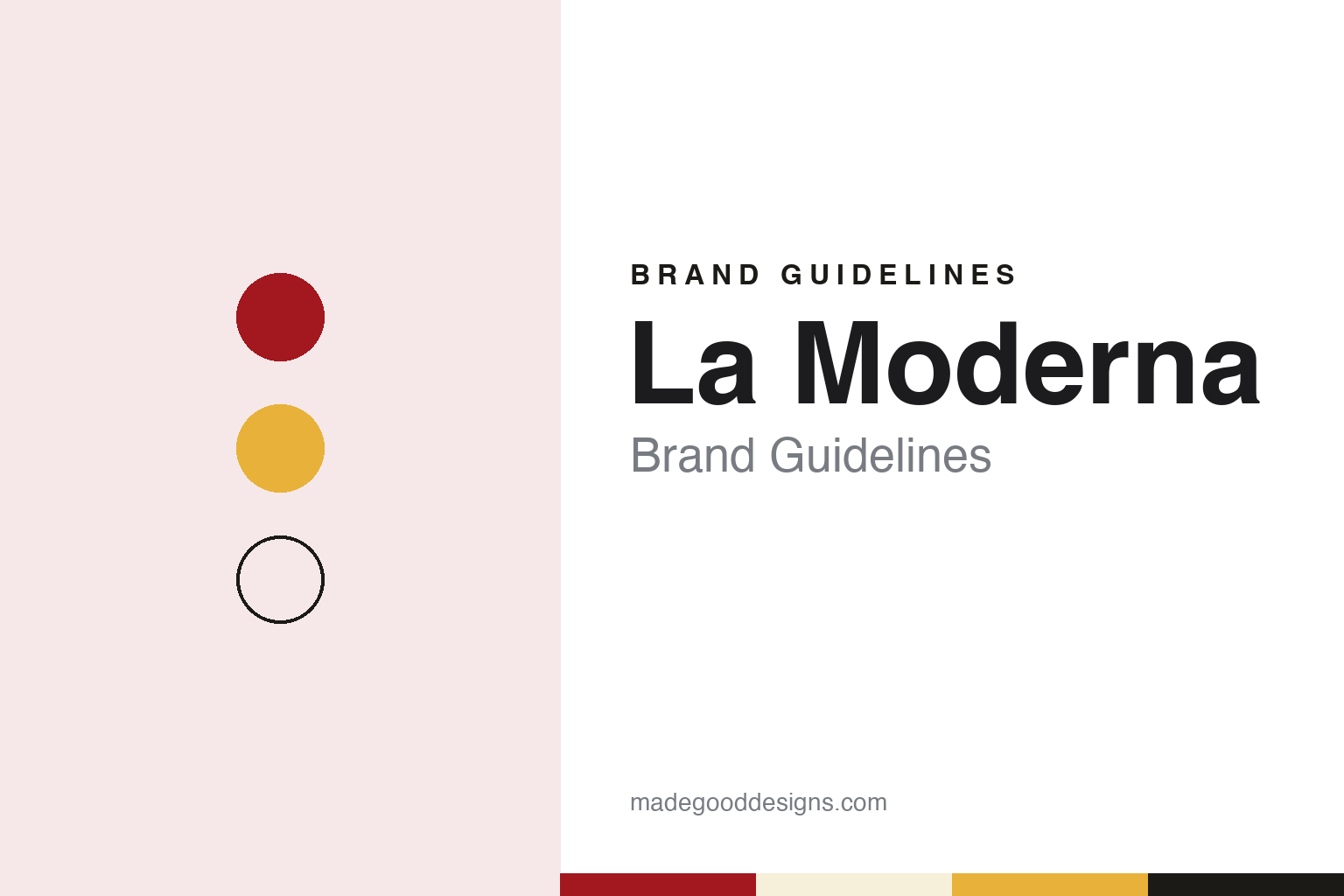
Two constants: a tomato red, durum gold and cream palette and a sturdy grotesque register. Abstract homage — not a La Moderna product or mark; no pack, logo or wordmark is reproduced.
A factory with five owners
Spanish brothers, a son-in-law and a buyer who stayed.
La Moderna is one of Mexico’s best-known pasta brands, and its history is a chain of owners. Grupo La Moderna, the company that owns it today, says the Fábrica de Pastas Alimenticias La Moderna was founded in 1920, when the Spanish-born Vendrel brothers went into partnership with Alberto A. Henkel to start a small pasta factory.
The business soon changed hands. The company says the founders were obliged to cede it to Rafael Costa, who ran it with his son-in-law Javier Reverter until 1927, when Costa retired to Spain and left the management to Reverter. In 1955 Reverter sold the factory to Esteban Abascal Saldamando, who, the company says, modernised it, moved it to its present site and bought the best machinery of the day.
The owner who shaped the modern brand arrived four years later. On 1 June 1959, the company says, the factory was bought in partnership by Luis Dosal, Carlos Scougall and Eduardo Monroy Cárdenas, who became director general. Scougall later sold his share to Monroy, who at 33 took full control. Grupo La Moderna calls Monroy its founder: the founder of the group, rather than of the 1920 factory, and it says the two histories are inseparable.
Under Monroy, the company says, La Moderna won markets in the state of Hidalgo and the Bajío region and expanded across the State of Mexico, using the slogan “Excelencia de Sabor y Garantía de Calidad” (excellence of flavour and a guarantee of quality). It says it made a policy of staying at the technological front, renewing machinery and taking advice from the pasta specialist Luigi Geremia Zanon.
Colour
Mills, biscuits, packaging and a stock-market listing.
From the 1970s Monroy built a vertically integrated group around the pasta. In 1970, the company says, he bought his first mill, the Compañía Nacional de Harinas in Toluca, today Molinos del Sudeste, which became the main supplier of raw material to the pasta factory. A biscuit company, Fábrica de Galletas La Moderna, was constituted in Toluca on 30 December 1972 and began operating in August 1974 in the city’s industrial zone.
On 17 October 1978 the holding company Táblex was formed; the company says its letters stood for the virtues of a good businessman: trabajo (work), administración, buena fe (good faith) and lealtad (loyalty), with the last two letters alluding to excellence and success. Táblex founded Películas Plásticas at the end of 1980 to print flexible packaging for the pasta factory, moving it to Atlacomulco in 1992, and later added Papeles Corrugados, a corrugated-box maker in Metepec. On 3 September 1987 the family company listed on the Mexican Stock Exchange under the ticker Táblex, which later became GModern, the company says.
Wheat came next. In the 1990s, the company says, the Toluca mills were converted to grind durum wheat into semolina, so that La Moderna pasta would be made from the same kind of wheat used by the leading pasta countries. In 1988 it founded the flour mill Harinera Los Pirineos; in 1997 it formed Táblex-Miller (TAMISA) with Miller Milling Co. of Minneapolis to make durum semolina in southern Sonora; and in 1999 it bought Molinos del Fénix in Saltillo. In 2000 Táblex changed its name to Grupo La Moderna, so that all its companies would carry the brand.
The pasta is made in Mexico and Guatemala. The group lists pasta plants at its Toluca base and in Saltillo, Gómez Palacio, Guadalajara, Mexicali and Mérida, plus one at Villa Canales in Guatemala; its range covers pasta, packaged soups, wheat flour, sauces and wheat-flour pellets for frying.
Typography
Design and documentation.
The seven brands in this group all make food, and all of them come from Peru or Mexico: Gloria, D’Onofrio, San Jorge, La Moderna, Lala, Alpura and Bachoco. Food brands from these two countries in general sit at many different points in the trade, from family firms that still carry a founder’s surname to names that now belong to much larger food groups, and a single brand can be sold everywhere from a neighbourhood shop to a supermarket shelf.
A food brand’s identity is usually carried less by a single product than by a pack, a name and the meal or snack it promises, because the company behind the name may have changed hands, moved its factory or grown far beyond the town where it started. That makes the questions behind each name worth asking plainly: who started it, who owns it now, and where its food is actually made and packed.
Each guide separates what independent sources record from what the company says about itself — its founding story, its owners over time, where its food is made and how its packaging has changed — and marks plainly what rests only on the company’s own word.
Aa
A sturdy, confident grotesque for a brand whose name means “the modern one.” (Specimen set in Archivo, a sans STAND-IN; NOT the La Moderna logo.)
La Moderna
Tres Estrellas, Bimbo and the road north.
La Moderna grew by buying brands as well as mills. In 2001, the company says, it acquired the Tres Estrellas brand, which it describes as a leader in Mexico for more than 75 years, and installed a rice mill in Toluca and a flour-mix plant in Salamanca, Guanajuato, to make its products. The same year it bought Pastas Cora and formed a commercial alliance with Pastas Capri of Guatemala, which it went on to acquire in 2005, opening Guatemala and Central America to La Moderna products.
Its biscuit company now has a partner. The company says that in December 2007, after complex negotiations, it signed an agreement under which Grupo Bimbo bought 50% of Fábrica de Galletas La Moderna, with management and operation remaining with Grupo La Moderna. English Wikipedia’s article on Grupo Bimbo lists Galletas La Moderna among Bimbo’s brands.
The United States has been a target since the late 1980s. The company says it set up Interamerican Foods Corporation in Texas in 1988 to open that market, began exporting its own La Moderna-branded products there in 1992, after earlier co-packing for other companies’ brands, and opened a distribution centre in Texas in 1996. Its list of companies today gives an address for Interamerican Foods in Calexico, California, on the border with Mexicali. The group also lists Finagil, a financing business, among its companies, and it has marked the factory’s centenary with a book, 100 Años La Moderna: Tradición, Calidad y Sabor.
For a design guide, La Moderna shows how a plain, confident name — “the modern one” — can outlast a century of owners, from Spanish founders to a Toluca industrial group that makes its own semolina and its own packaging. Compare it with Mexican partners and neighbours Bimbo, co-owner of its biscuit company, and the Monterrey biscuit maker Gamesa. For this guide we use tomato red, durum gold and semolina cream with a sans, an unofficial interpretation; no product or logo is reproduced.
Explore & save
Keep La Moderna’s identity on hand — save it to a board in the Made Good inspiration library.
Save the La Moderna palette
Tomato red, durum gold and semolina cream, with a sturdy grotesque — an unofficial La Moderna-inspired set for pantry and packaging moodboards.