Vissan Brand Guidelines
Saigon’s 1970 meat company and its three golden flowers.
Aa
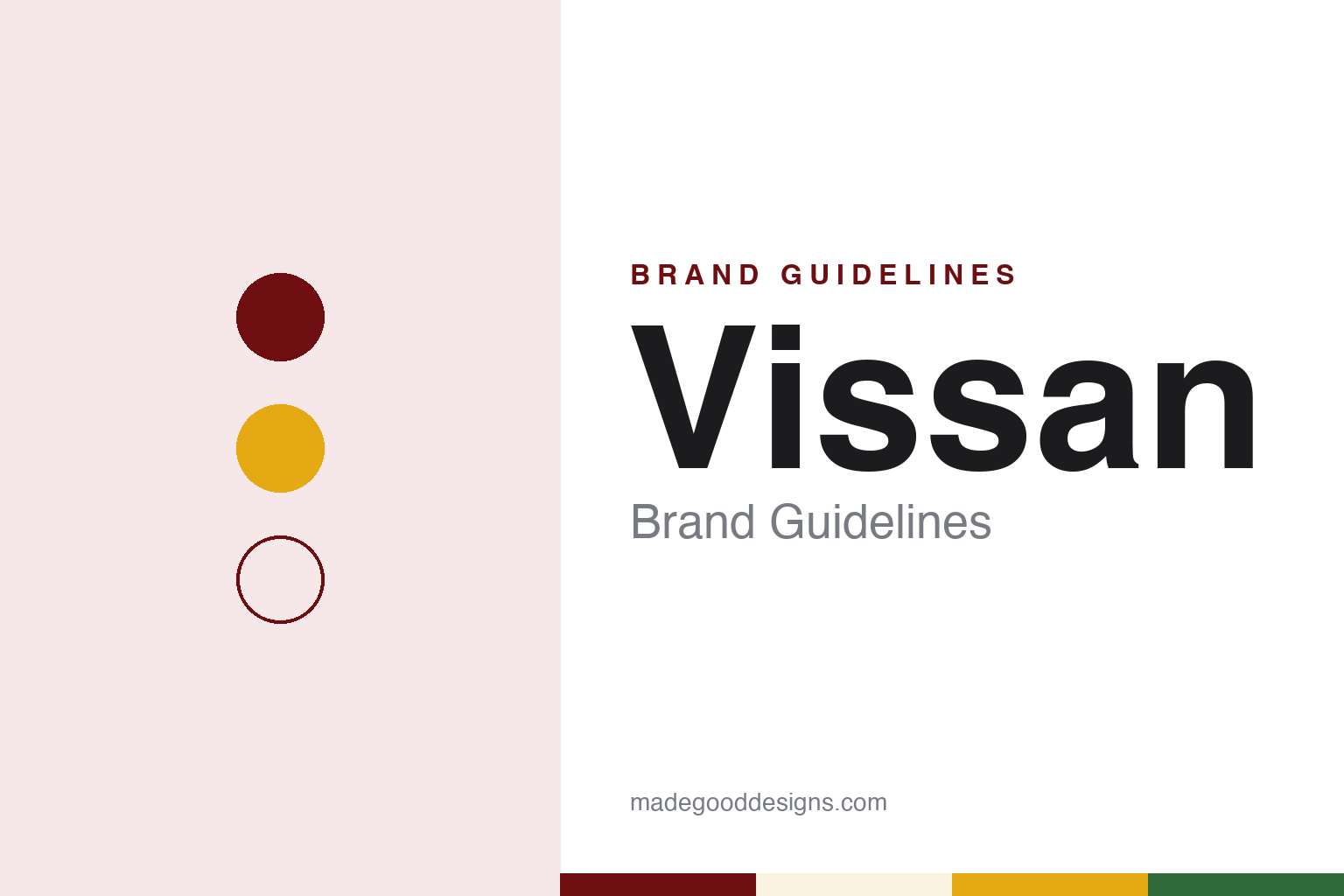
Two constants: a Vissan red, oxblood and golden-flower yellow palette and a sturdy Vietnamese sans register. Abstract homage — not a Vissan product or mark; no pack, logo or product is reproduced.
A Saigon slaughterhouse
German plans, Danish lines and a 1974 opening.
Vissan’s name is a contraction of its Vietnamese company name, Việt Nam Kỹ nghệ Súc sản, roughly “Vietnam Livestock Industries,” and the company dates itself to 20 November 1970. That day, the company says, construction began in Saigon on the Tân Tiến Đô Thành slaughterhouse, a plant designed in West Germany and fitted with slaughter lines from Denmark and Germany. Vissan calls it the first foundation of a modern meat slaughtering and processing industry in Vietnam. Vietnamese Wikipedia gives the same founding date.
The plant opened on 18 May 1974, in the last year of the Republic of Vietnam, as the Vietnam Livestock Industries company, Vissan, with three pork lines and two beef lines and modern chilling and freezing rooms, the company says. The company’s head office is still in Ho Chi Minh City.
A year later the political setting changed completely. After 30 April 1975, Vissan says, the company came under state management, and on 16 March 1976 it was reorganised as Food Company I (Công ty Thực phẩm I), with the job of slaughtering livestock and supplying fresh meat to the city’s residents. Vietnamese Wikipedia says that in this period the company also exported frozen meat to the Soviet Union and Eastern Europe. The company kept the anniversary of the original groundbreaking: it marked its 55th year in November 2025 under the line “55 năm – Tự hào thương hiệu Việt,” “55 years – proud of a Vietnamese brand.”
Colour
A name restored, and a sausage that keeps.
The Vissan brand as shoppers know it took shape at the end of the 1980s. On 16 November 1989, the company says, it took back its original name together with its “three golden flowers” logo, which it calls iconic, and in March of the same year it set up a food processing unit. Vietnamese Wikipedia says the company turned towards the domestic market in the late 1980s, widening its range, building distribution and pricing its goods for local incomes.
Processed foods followed in steps. A first processing workshop opened on 20 May 1994 to make cooked meat products for the domestic market using French technology, the company says. In 1997 it launched sterilised sausages, which Vissan describes as a breakthrough that took it from fresh meat into packaged foods; the same year it opened a branch in Hanoi. The company now sells more than 300 processed products, it says, among them sterilised sausages, lạp xưởng (Chinese-style dried sausage), canned meats and cold cuts, alongside more than 100 lines of fresh pork and beef, including pork farmed to the VietGAP standard and Australian beef.
Vissan presents itself as a farm-to-table business. It says it was a pioneer of a “3F” model, Feed, Farm and Food, with a meat traceability system, and that it sells through more than 130,000 points of sale across Vietnam as well as its own shops. In 2020 it added a telephone ordering line, social-media sales and its own online store, vissanmart.com. Its mission line is “Sức sống mỗi ngày,” “vitality every day.”
Typography
Design and documentation.
The seven brands in this group all make food or drink, and all of them come from Vietnam: Kinh Đô, Bibica, TH true MILK, Saigon, Bia Hà Nội, Vissan and Cholimex. Vietnamese food and drink brands in general sit at many different points in the trade, from businesses that began as state enterprises to names that now belong to much larger groups, and a single brand can be sold everywhere from a street-side stall to a supermarket shelf.
A food or drink brand’s identity is usually carried less by a single product than by a pack, a name and the meal or moment it promises, because the company behind the name may have changed hands, moved its factory or grown far beyond the city where it started. That makes the questions behind each name worth asking plainly: who started it, who owns it now, and where its products are actually made and packed.
Each guide separates what independent sources record from what the company says about itself — its founding story, its owners over time, where its products are made and how its packaging has changed — and marks plainly what rests only on the company’s own word.
Aa
A sturdy sans with full Vietnamese diacritics, for a name made from Vietnamese words. (Specimen set in Be Vietnam Pro, a sans STAND-IN; NOT the Vissan logo.)
Vissan today
A state trading group, new company forms and two factories.
Vissan has spent most of its life inside Ho Chi Minh City’s state trading sector. Vietnamese Wikipedia describes it as a state enterprise belonging to the Saigon Trading Group (Satra) and names Satra as its parent company, and the company’s own report of its 55th anniversary in 2025 notes an award presented by Satra’s representatives. Its legal form has changed twice in two decades. On 21 September 2006, the company says, it became a single-member limited company, and on 28 May 2016 it was converted into a joint-stock company, now Công ty Cổ phần Việt Nam Kỹ nghệ Súc sản.
Where Vissan’s food is made is set out on its own site. The company says it runs two processing factories, one in Ho Chi Minh City and one in Bắc Ninh province in the north, and two livestock farms, in Bình Thuận and Bình Dương. The Bắc Ninh plant began operating in November 2003 and was reopened in expanded form in June 2015, the year the Bình Thuận farm started work, Vissan says; the company also opened a branch in Đà Nẵng in 2003. At its 2025 shareholders’ meeting it reported plans to expand its Bình Dương pig farm. Vietnamese Wikipedia says the company exports processed and frozen products to markets including North America, Australia, South Korea, Taiwan, Singapore, Germany and Russia.
The company has gathered domestic awards over the years. It says it has held the Hàng Việt Nam chất lượng cao (high-quality Vietnamese goods) title across the thirty years from 1996, and it received a certificate of merit from the Ho Chi Minh City People’s Committee at its 2025 anniversary.
For a design guide, Vissan shows how a company name made from Vietnamese words, and a logo of three golden flowers, can carry a business from a 1970s slaughterhouse to a supermarket sausage. Compare Cholimex, another Ho Chi Minh City food maker, and Vinamilk, a Vietnamese dairy brand with state roots. For this guide we use Vissan red, oxblood and a golden-flower yellow with a sturdy sans, an unofficial interpretation; no product or logo is reproduced.
Explore & save
Keep Vissan’s identity on hand — save it to a board in the Made Good inspiration library.
Vissan identity set
Pin the Vissan red, oxblood and golden-flower yellow palette and the sturdy Vietnamese sans register to your own board.