Massimo Brand Guidelines
The flour miller’s bread in Italian green, white and red.
Aa
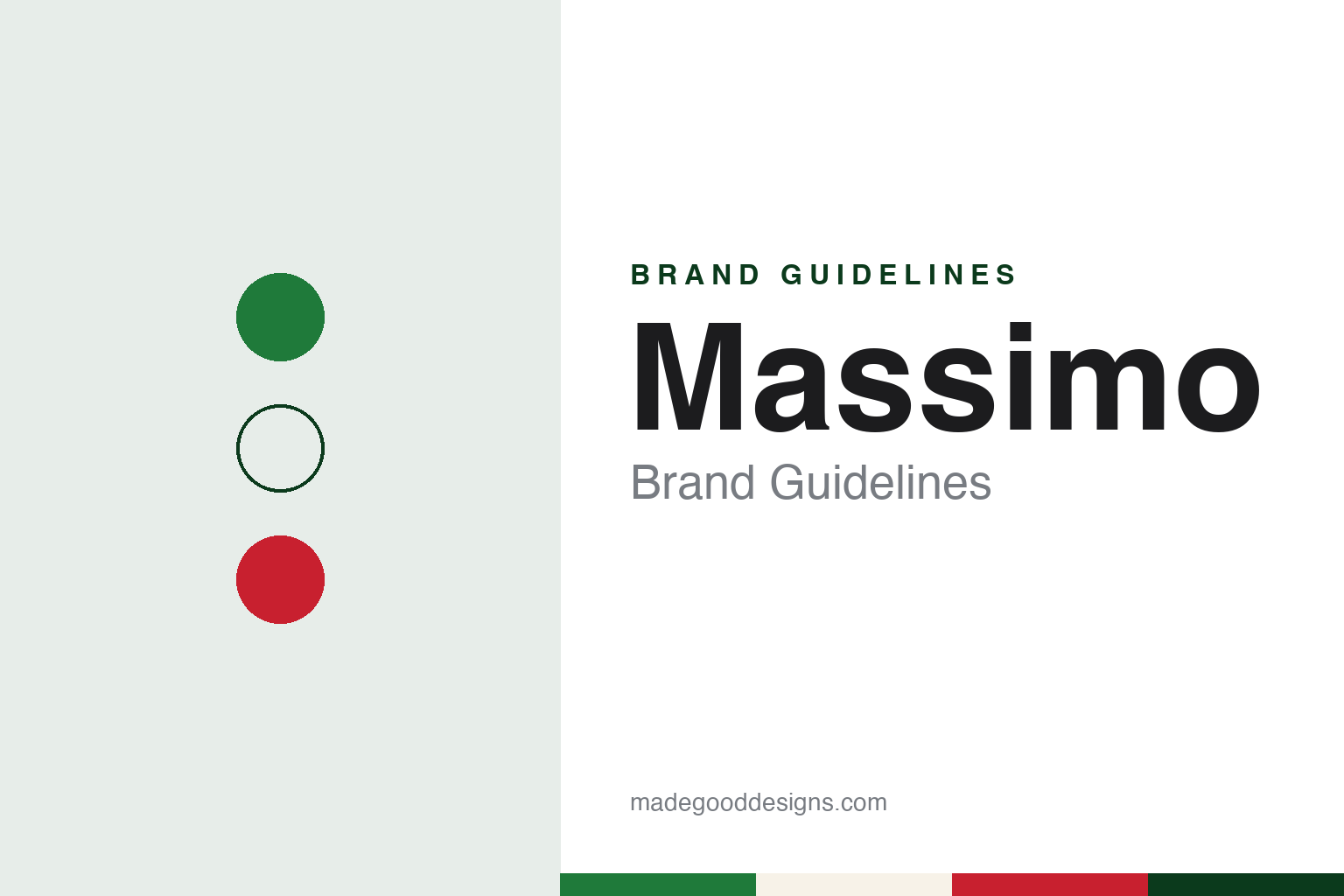
Two constants: a basil green, flour white and tomato red palette and an Italianate serif register. Abstract homage — not a Massimo product or mark; no pack, logo or loaf is reproduced.
A miller’s bakery
A new loaf, a new plant and a flour mill next door.
Massimo is a young brand by the standards of Malaysian supermarket shelves. It was launched in 2011 by The Italian Baker Sdn Bhd, which the company describes as a wholly owned subsidiary of FFM Berhad, the flour-milling business better known as Federal Flour Mills. English Wikipedia, which treats The Italian Baker as a bakery company trading as Massimo, gives the same founding year and places the business in Sungai Buloh, Selangor, where the company still has its marketing office.
The launch was reported in The Star on 27 September 2011 under the headline “New bread brand on the block.” The paper described the first product, a sandwich loaf with wheat germ, as a “homegrown” loaf that had recently entered the bread market, and said buns and breads under the Massimo name were already doing well in the Klang Valley. It quoted Jimmy Chang, The Italian Baker’s general manager and director, who said the company had decided to “adopt the Italian approach” because Italians take great pride in food and in fresh ingredients. Chang also told the paper that rising costs of basic staples such as bread had been part of the thinking behind the new brand.
The bakery itself was built at Pulau Indah, near Port Klang, where Federal Flour Mills is located, which The Star said gave easy access to the raw ingredients. According to the paper, machinery from the United States and Europe was brought in and installed in phases, with a local team working alongside overseas experts. The company still gives Pulau Indah as its production address. A company newspaper advertisement in theSun, cited by English Wikipedia, put the plant’s output at 16,000 loaves and 24,000 buns a day, delivered across Peninsular Malaysia.
Colour
Green, white and red.
Massimo’s look is built on one borrowed idea: Italy. The name is the Italian word for “greatest,” as the company itself points out, and The Star reported in 2011 that the brand name was meant to suggest luxury and prestige, and described the bread as joining a traditional style to modern design, with Italian baking habits married to present-day techniques. The packs carry green, white and red, the colours of the Italian flag; the 2011 report noted the match, and English Wikipedia, citing that article, says the bread is packed in those three colours. The company returns to the point in its own words, saying that, true to the green, white and red of its packaging, Massimo breads “fly the flag” of Italian standards.
The Italian theme runs through the product names as much as the packs. Alongside plain sandwich loaves and the original wheat-germ loaf, the company’s current range includes a Massimo Maxima sandwich loaf, Ricco Chocolato and Chiffon in a Cup, as well as cream rolls and a whole-wheat loaf. The company says it pairs flour from Federal Flour Mills with traditional techniques, modern machinery and strict quality control, and that its products are halal certified.
The pack has also been used to make a promise about the bread inside. Massimo says it introduced what it calls Malaysia’s first tamper-evident packaging across all its loaves, with a laser-sealed seal that shoppers are asked to check before buying, and a reusable Kwik Lock tag to close the bag once the seal is broken. It promotes the idea with the hashtags #SealedForSafety and #CheckTheSeal.
Typography
Design and documentation.
The seven brands in this group all make food or drink, and all of them come from Malaysia: Ayamas, Adabi, Aik Cheong, Apollo, Cintan, Dutch Lady and Massimo. Malaysian food and drink brands in general sit at many different points in the trade, from family firms that still carry a founder’s name to names that now belong to much larger food groups, and a single brand can be sold everywhere from a neighbourhood sundry shop to a supermarket shelf.
A food or drink brand’s identity is usually carried less by a single product than by a pack, a name and the meal or snack it promises, because the company behind the name may have changed hands, moved its factory or grown far beyond the town where it started. That makes the questions behind each name worth asking plainly: who started it, who owns it now, and where its products are actually made and packed.
Each guide separates what independent sources record from what the company says about itself — its founding story, its owners over time, where its products are made and how its packaging has changed — and marks plainly what rests only on the company’s own word.
Aa
An Italianate serif for a Malaysian loaf with an Italian name. (Specimen set in Playfair Display, a serif STAND-IN; NOT the Massimo logo.)
Massimo
A Kuok-founded miller, a factory and a community campaign.
Behind Massimo is a flour miller with a long history. English Wikipedia’s article on PPB Group says Kuok Brothers, the family business of Robert Kuok, set up Federal Flour Mills in 1962, and that PPB Group, which Kuok founded in 1968 as Perlis Plantations, added the flour miller to its group in 1987. The same article calls FFM the largest flour miller in Malaysia and, citing PPB’s 2014 annual report, describes FFM Berhad as an 80 percent subsidiary of the group, which the Kuok family controls. The article gives the group’s main business today as supplying flour to downstream food producers.
Outside the bakery, Massimo’s public face includes a community campaign under the hashtag #HatiBaik, Malay for “good heart.” The company says the campaign has included visits to flood victims in Hulu Langat and Banting, work with Hospital Sungai Buloh and an old folks’ home, and food distribution around Hari Raya, including a 2021 drive it ran under the hashtag #projekprihatinmassimo; it also runs consumer contests on its website.
On 3 April 2025, Bernama and the Malay Mail reported that The Italian Baker had announced a temporary disruption to production because a gas pipeline fire in Putra Heights, Selangor, had affected the LNG supply to its factory, and that its bakery products might be limited in stores from the following day until further notice.
For a design guide, Massimo shows how a national flag’s three colours and a single Italian word can give a Malaysian sandwich loaf a clear identity on a crowded bread shelf. Compare Gardenia, the sliced-bread brand with roots in Singapore and Malaysia, and Warburtons, the British family baker. For this guide we use a basil green, a flour white and a tomato red with a serif, an unofficial interpretation; no product or logo is reproduced.
Explore & save
Keep Massimo’s identity on hand — save it to a board in the Made Good inspiration library.
Massimo identity set
Pin the Massimo basil green, flour white and tomato red palette and the Italianate serif register to your own board.