Bia Hà Nội Brand Guidelines
Hanoi beer from the 1890 Hommel brewery to Habeco.
Aa
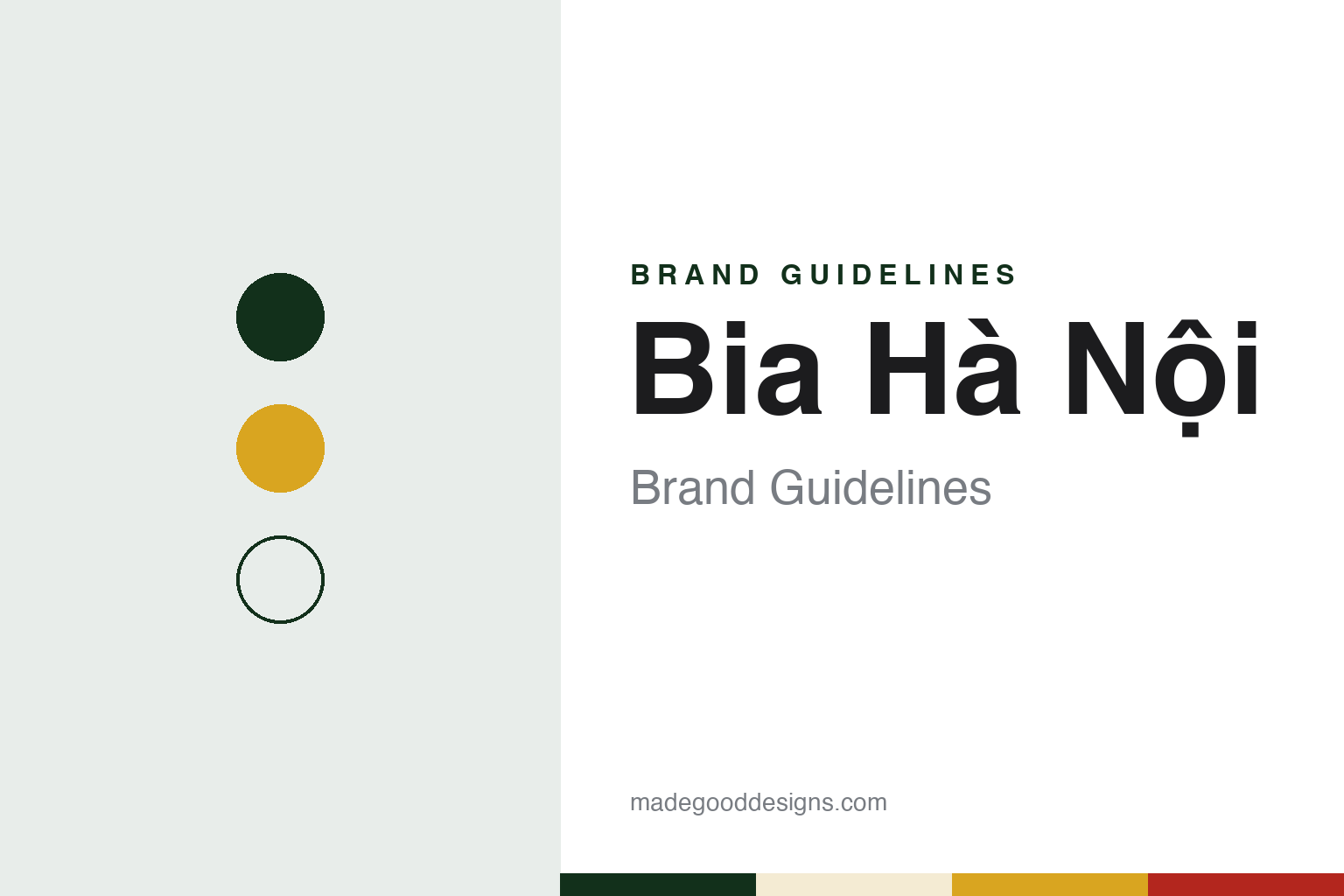
Two constants: a brewhouse green, lager gold and lantern red palette and a heritage serif register. Abstract homage — not a Bia Hà Nội product or mark; no can, bottle, label or logo is reproduced.
The Hommel brewery
A colonial brewery, a restoration and a first bottle.
Bia Hà Nội, “Hanoi Beer,” is the main beer brand of Habeco, the Hanoi Beer Alcohol and Beverage Joint Stock Corporation, and the company traces its story back to 1890. That year, Habeco says, the French built the Hommel brewery in Hanoi, a small operation with about 30 workers set up to supply the French colonial army. Vietnamese Wikipedia, which also names the brewery after a Frenchman called Hommel, puts its early output at around 150 litres a day and says it served the French and the Vietnamese officials working for them in the larger northern towns.
The break came with the end of French rule in the north in 1954. Habeco says that before they withdrew, the French dismantled and damaged the brewery’s machinery and burned its technical documents. In 1957, under the government’s economic recovery policy, the plant was restored and renamed the Hanoi Brewery, the company says; Vietnamese Wikipedia dates the change of name to 1954.
The modern brand dates its own birthday from the year after. On 1 May 1958, Habeco says, the first trial brew was made by Vũ Văn Bộc, a skilled worker from the old Hommel brewery, with help from brewing specialists from Czechoslovakia. On 15 August 1958 the brewery filled what the company calls the first bottle of Vietnamese beer, under the Trúc Bạch label. Habeco still marks 15 August each year as the tradition day of Bia Hà Nội, and it celebrated sixty years of rebuilding and growth in 2018.
Colour
Draught, cans and a growing brewery.
The range widened slowly in the planned economy. In 1960, Habeco says, the brewery launched a beer called Hữu Nghị, meaning “friendship,” together with bia hơi, its draught beer. Vietnamese Wikipedia says output reached 15 million litres a year in 1960 and 20 million in 1970. In 1978, it adds, East Germany helped rebuild the brewhouse, and a new combined brewhouse came into use in 1983, raising capacity to 30 million litres.
The company became Công ty Bia Hà Nội, the Hanoi Beer Company, in a reorganisation that Habeco dates to 1993 and Vietnamese Wikipedia to 1983. Canned beer arrived in 1991, the company says, and the business pushed capacity to 50 million litres a year in the 1990s. On 6 May 2003 the Ministry of Industry created the Hanoi Beer Alcohol and Beverage Corporation, Habeco, around the Hanoi Beer Company, and in 2008 it was converted from a state corporation into a joint-stock company.
Habeco’s products today carry the city’s name in several forms. The company names Bia hơi Hà Nội, Bia lon Hà Nội (the canned beer), Bia Trúc Bạch and Hanoi Beer Premium among its best-known lines, and Vietnamese Wikipedia also lists a bottled Bia Hà Nội and a Bia Hà Nội “xanh,” or green. English Wikipedia, citing a Habeco product page, says Hanoi Beer was first introduced in 1890, and the company sells a bottled beer under the name Bia Hà Nội 1890. Trúc Bạch, the 1958 label, was revived in 2010, Habeco says, and given a new identity in 2018.
Typography
Design and documentation.
The seven brands in this group all make food or drink, and all of them come from Vietnam: Kinh Đô, Bibica, TH true MILK, Saigon, Bia Hà Nội, Vissan and Cholimex. Vietnamese food and drink brands in general sit at many different points in the trade, from businesses that began as state enterprises to names that now belong to much larger groups, and a single brand can be sold everywhere from a street-side stall to a supermarket shelf.
A food or drink brand’s identity is usually carried less by a single product than by a pack, a name and the meal or moment it promises, because the company behind the name may have changed hands, moved its factory or grown far beyond the city where it started. That makes the questions behind each name worth asking plainly: who started it, who owns it now, and where its products are actually made and packed.
Each guide separates what independent sources record from what the company says about itself — its founding story, its owners over time, where its products are made and how its packaging has changed — and marks plainly what rests only on the company’s own word.
Aa
A heritage serif for a brand that dates itself to 1890. (Specimen set in Playfair Display, a serif STAND-IN; NOT the Bia Hà Nội or Habeco logo.)
Habeco
A state brewer, a Danish partner and a new identity.
Habeco remains largely in state hands, with a foreign brewer as a partner. The company says it signed a strategic cooperation agreement with the Danish Carlsberg group in 2007. Carlsberg bought shares in Habeco’s initial public offering in March 2008, MarketWatch reported in November 2012, when Vietnam’s Ministry of Industry and Trade held 83% of the company and had asked it to sell a further 13% to Carlsberg. The Vietnamese financial site gafin put Carlsberg’s holding at 15.8% in 2012. In 2010, gafin reported, Habeco had 13.9% of the Vietnamese beer market, behind the Ho Chi Minh City brewer Sabeco and the Heineken joint venture Vietnam Brewery.
The brand is brewed well beyond its original site. In 2010, Habeco says, it completed a brewery with a capacity of 200 million litres a year at Mê Linh, on the edge of Hanoi, taking the group to almost 400 million litres; a canning line followed there in 2015, and a further plant, Bia Hà Nội – Hoàng Hoa Thám, was set up in 2017. Among its member companies Habeco lists regional breweries carrying the Bia Hà Nội name in Hải Phòng, Nam Định, Thái Bình, Nghệ An and other provinces. The company says its beers are sold abroad in markets including Taiwan, South Korea, Britain, Germany, the United States and Australia.
The corporate identity was redrawn in May 2019, when Habeco launched a new visual identity with a bold HABECO wordmark and the slogan “Sức bật Việt Nam,” roughly “Vietnam’s bounce.” Vietnamese Wikipedia says the company tied each letter of the new wordmark to one of its core values, from integration to ambition.
For a design guide, Bia Hà Nội shows how a city’s name, a founding date and a lakeside label can carry a beer from a colonial brewery to a joint-stock company. Compare Saigon Beer, the southern rival, and Vinamilk, another Vietnamese state-founded consumer brand. For this guide we use brewhouse green, lager gold and lantern red with a heritage serif, an unofficial interpretation; no product or logo is reproduced.
Explore & save
Keep Bia Hà Nội’s identity on hand — save it to a board in the Made Good inspiration library.
Bia Hà Nội identity set
Pin the Bia Hà Nội brewhouse green, lager gold and lantern red palette and the heritage serif register to your own board.