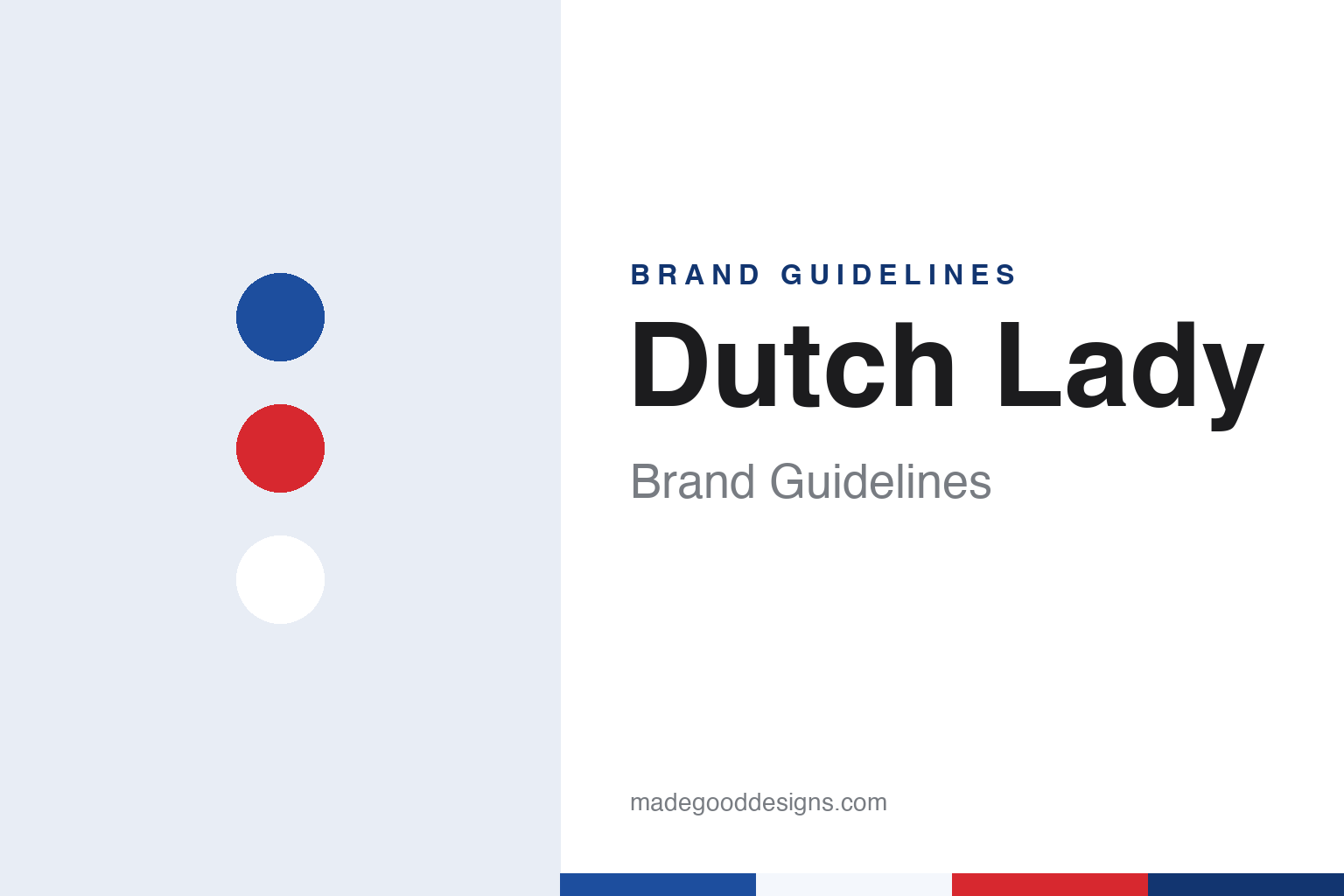
Dutch Lady Brand Guidelines
The Petaling Jaya dairy born in 1963 as Pacific Milk.
Aa
Two constants: a Delft blue, tulip red and milk white palette and a soft Dutch serif register. Abstract homage — not a Dutch Lady product or mark; no pack, logo or figure is reproduced.
Pacific Milk
A condensed-milk plant and a Dutch co-operative.
Dutch Lady began in Malaysia in 1963, under another name. The company’s own milestone list, in its 2024 integrated annual report, opens that year with a sweetened condensed milk plant and the formation of Pacific Milk Industries; English Wikipedia gives the full name as Pacific Milk Industries (Malaya) and dates the company to May 1963, in Petaling Jaya, Selangor. Its first product was sweetened condensed milk. The Petaling Jaya factory was, according to English Wikipedia citing FrieslandCampina, the Dutch dairy group’s first production site outside the Netherlands. In its 2024 report the company dates that first factory to 1966, so the plant and the company carry slightly different founding years in its own telling.
The business grew fast and went public early. In 1968 it became, in the company’s words, the first milk company to be listed on the local stock exchange; English Wikipedia says it listed in Kuala Lumpur and Singapore in September that year. In 1975 it started making UHT milk and baby food, and changed its name to Dutch Baby Milk Industries. The Dutch Lady name came later: the company’s milestone list records that in 1984 the Dutch Baby brand name was changed to Dutch Lady, and English Wikipedia says the company itself took the name Dutch Lady Milk Industries Berhad in 2000.
Behind it, throughout, stands a Dutch dairy co-operative. Dutch Lady Malaysia was part of Royal Friesland Foods, and since the merger of Friesland Foods and Campina in December 2008 it has been a listed subsidiary of FrieslandCampina, the group whose other brands include Peak, Frisian Flag and Friso. FrieslandCampina’s own brand page, archived in 2017, described Dutch Lady as a family dairy range stretching from powdered and full-fat milk to yoghurt drinks and sweetened condensed milk, sold in Malaysia and Vietnam and known in Hong Kong for its UHT milk and instant milk powder.
Colour
Bottles, cartons, schools and a cow named Daisy.
Dutch Lady’s milestone list reads as a history of Malaysian milk formats. The company says it partnered the Ministry of Education on the country’s inaugural School Milk Programme in 1983, and English Wikipedia adds that sterilised milk began to be made locally and sold in plastic bottles that year. Pasteurised milk followed in 1986, according to the company, and Wikipedia dates the start of chilled products to the same year and fruit yoghurt and growing-up milk to 1988. Later entries add drinking yoghurt and ready-to-eat yoghurt, a chocolate drink in 2010, and the introduction of the company’s own corporate logo in 2008.
Packaging machinery shows up in the list as a point of pride. In 2013, the year it marked its 50th anniversary, Dutch Lady says it was the first company in Malaysia to install a particular SIG Combibloc aseptic carton filling machine, and it later bought a faster one-litre filler from the same supplier. In 2014 it says it worked with the Ministry of Education to hold Malaysia’s first World School Milk Day. The schools link continues: in 2025, the company says, it distributed some 14.4 million packs of milk to about 74,000 students in Sarawak under a programme with the ministry and Yayasan Didik Negara.
The old factory itself became a landmark. In its 2024 report the company said goodbye to DLMI@PJ, its first factory, and described it as a familiar sight to passers-by in Petaling Jaya, with Daisy and Maya cow figurines and a replica Dutch windmill outside. The same report lists 2020 as a year of refreshed pack designs, and the 2022 launch of a “Signature Dutch Lady Can”. In 2023, it says, milk powder products began to be sourced from Frisian Flag Indonesia and elsewhere in the FrieslandCampina network, as Malaysian production concentrated on liquid milk.
Typography
Design and documentation.
The seven brands in this group all make food or drink, and all of them come from Malaysia: Ayamas, Adabi, Aik Cheong, Apollo, Cintan, Dutch Lady and Massimo. Malaysian food and drink brands in general sit at many different points in the trade, from family firms that still carry a founder’s name to names that now belong to much larger food groups, and a single brand can be sold everywhere from a neighbourhood sundry shop to a supermarket shelf.
A food or drink brand’s identity is usually carried less by a single product than by a pack, a name and the meal or snack it promises, because the company behind the name may have changed hands, moved its factory or grown far beyond the town where it started. That makes the questions behind each name worth asking plainly: who started it, who owns it now, and where its products are actually made and packed.
Each guide separates what independent sources record from what the company says about itself — its founding story, its owners over time, where its products are made and how its packaging has changed — and marks plainly what rests only on the company’s own word.
Aa
A soft Dutch serif for a brand that has always worn its Netherlands parentage on the pack. (Specimen set in Fraunces, a serif STAND-IN; NOT the Dutch Lady logo.)
Dutch Lady
From Petaling Jaya to Bandar Enstek.
The biggest change in Dutch Lady’s recent history is where its milk is made. In 2020, the company says, it bought 32.59 acres of industrial land in Bandar Enstek, Negeri Sembilan, and in 2022 it appointed Seremban Engineering as main contractor for the new plant. The factory, called DLMI@Enstek, was inaugurated on 30 May 2024 by the Yang di-Pertuan Besar of Negeri Sembilan, Tuanku Muhriz, with FrieslandCampina’s chief executive, Jan Derck van Karnebeek, in attendance; the company chose the date to mark the 61st anniversary of its incorporation. It describes the 13-hectare site as three times the land area of the Petaling Jaya plant, with twice the capacity, Industry 4.0 automation and Halal certification.
The move was gradual. Dutch Lady says it completed the transition from Petaling Jaya to Bandar Enstek in the third quarter of 2024, and that the switch briefly affected some products for trade customers but not its core range. In February 2026 its managing director, Veronika Utami, called the transition to the Bandar Enstek factory and its distribution centre “a transformational step” for the business. The company’s press releases are still datelined Petaling Jaya, where its head office is, and Dutch Lady Milk Industries Berhad remains listed on Bursa Malaysia, with FrieslandCampina as its parent.
The Dutch Lady name reaches beyond Malaysia. English Wikipedia lists the brand in Brunei, Hong Kong, Japan, the Philippines, Singapore and Vietnam, where it is known as Cô Gái Hà Lan, and English Wikipedia’s FrieslandCampina article notes that in those markets the group’s adult dairy range is sold under the Dutch Lady brand. In Malaysia the company describes its products as Halal-certified and its current range as covering every stage of life, from growing-up milks to ready-to-drink UHT milk and a professional range for cafés and caterers.
For a design guide, Dutch Lady shows a European dairy name turned into a Malaysian household brand over six decades, kept consistent through name changes, a factory move and a long schools programme. Compare Peak, FrieslandCampina’s evaporated milk in Nigeria, and Vinamilk, Vietnam’s dairy founded in 1976. For this guide we use Delft blue, tulip red and milk white with a serif, an unofficial interpretation; no product or logo is reproduced.
Explore & save
Keep Dutch Lady’s identity on hand — save it to a board in the Made Good inspiration library.
Dutch Lady identity set
Pin the Dutch Lady Delft blue, tulip red and milk white palette and the soft Dutch serif register to your own board.