M-150 Brand Guidelines
A 150 ml bottle, a magnum name and a sheriff’s badge.
Aa
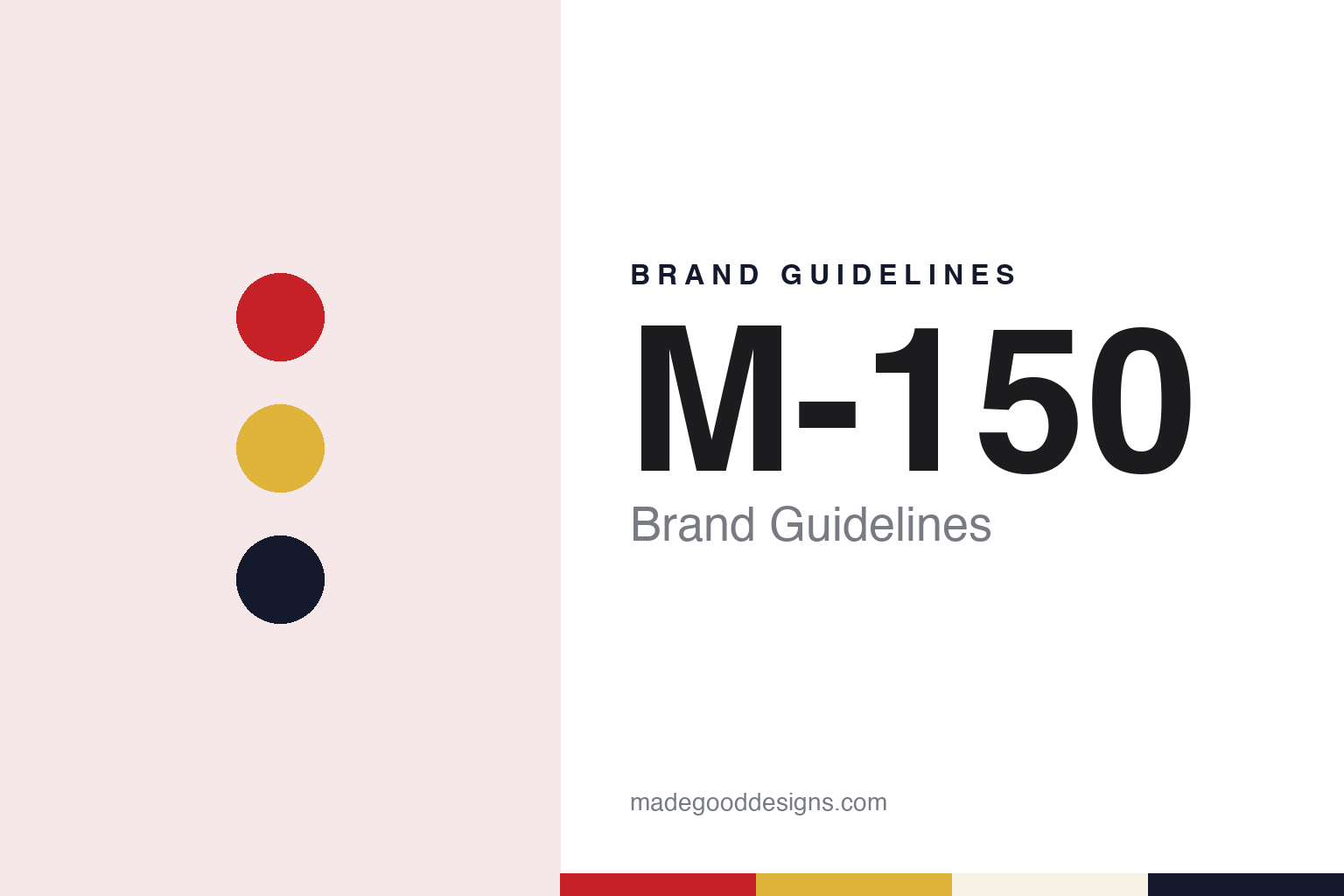
Two constants: a red, gold and navy palette and a heavy display sans register. Abstract homage — not an M-150 product or mark; no bottle, label or badge is reproduced.
Teck Heng Yoo
A Sampeng shop that became a drinks company.
M-150 belongs to Osotspa, one of Thailand’s oldest consumer-goods companies. The company says its story begins in 1891 with Teck Heng Yoo, a small shop in the Sampeng area of Bangkok’s Chinatown founded by a man the company calls Mr. Pae. Its best-known early product was a remedy sold as Krisnaklan, under the Kilane brand that Osotspa still uses, which the company says was supplied to King Vajiravudh’s Wild Tiger Corps during exercises in Nakhon Pathom. The king later gave the family the surname Osathanugrah, which English Wikipedia translates as “provider of medicine.”
The business grew in steps that the company dates on its own history page. In 1932 the shop moved to Charoenkrung Road and took a new name; in 1949 it opened a factory on Soi Lang Suan and was registered on 23 May as Osotspa (Teck Heng Yoo) Company Limited; on 13 October 1959 King Bhumibol Adulyadej granted it the Royal Garuda emblem; and in 1974 its office and factory moved to a site on Ramkhamhaeng Road in Bangkok’s Bang Kapi district, where the company is still based. It took the name Osotspa Company Limited in 1995.
The route into drinks ran through Japan. In 1965, Forbes Asia reported in 2019, Surat Osathanugrah licensed the tonic drink Lipovitan-D from Japan’s Taisho Pharmaceutical; English Wikipedia says Osotspa first imported it and began making it under licence in 1969. Thai Wikipedia, citing the company’s 2018 filings, lists a joint venture with Taisho that still distributes medicines and drinks in Thailand.
Colour
Magnum, 150 and a badge.
M-150 was Osotspa’s own answer to the licensed drink. In 1985, Forbes Asia reported in 2019, Surat Osathanugrah launched his own version: the “M” stood for magnum revolver cartridges and the 150 for its 150 ml bottle, and the label carried a sheriff’s badge. Osotspa now describes M-150 as Thailand’s leading energy drink “for over 40 years.” English and Thai Wikipedia both describe it as a non-carbonated drink sold in Thailand in 150 ml glass bottles.
The name was matched by tough-sounding advertising. Writing for GlobalPost in September 2010, Patrick Winn described M-150 as courting Thailand’s male working class, quoted its slogan in English as “Devotion! Courage! Sacrifice!”, and reported that it controlled more than 65 percent of the Thai energy-drink market, a figure he attributed to the consultancy Food Industry Thailand. Thai Wikipedia, citing FinanceAsia (2014), gives the same 65 percent share for 2010 and says it had fallen to 46 percent by 2014. Winn also reported that M-150 had been introduced in the United States, mostly through Asian supermarkets, and that in a 2008 interview the company’s president had set the goal of making it Southeast Asia’s top-selling energy drink by 2014. Forbes Asia still called it the No. 1 energy drink in Thailand by sales in 2019.
Today Osotspa presents the brand under the Thai slogan “Powering the Fight” and a strategy it calls “Right Spot, Right Time.” The range still centres on the 150 ml bottle, in several recipes including a honey version and a black ginger with honey version, and now also includes an M-150 Sparkling Energy Drink in a can, the company’s site shows.
Typography
Design and documentation.
The seven brands in this group are all drinks, and all of them come from Thailand: Singha, Chang, Leo, M-150, Krating Daeng, est and Carabao. Thai drink brands in general sit at many different points in the trade, from family firms that still carry a founder’s name to names that now belong to much larger listed groups, and a single brand can be sold everywhere from a roadside shop to a supermarket shelf.
A drink brand’s identity is usually carried less by a single product than by a bottle or can, a name and the moment it promises, because the company behind the name may have changed hands, moved its production or grown far beyond the place where it started. That makes the questions behind each name worth asking plainly: who started it, who owns it now, and where its drinks are actually made and packed.
Each guide separates what independent sources record from what the company says about itself — its founding story, its owners over time, where its drinks are made and how its packaging and advertising have changed — and marks plainly what rests only on the company’s own word.
Aa
A heavy, tightly spaced sans for a name built from a number. (Specimen set in Anton, a sans STAND-IN from Google Fonts — NOT the M-150 logo lettering, which is a custom mark.)
Osotspa today
A listed company, its own glassworks and markets next door.
Osotspa is still controlled by the Osathanugrah family but has been a listed company since 17 October 2018, when its shares began trading on the Stock Exchange of Thailand, the company says. Forbes Asia reported in 2019 that Petch Osathanugrah, a former rock singer and advertising executive who took charge of the company in 2015, had reorganised it around energy drinks such as M-150, recruited managers from multinational firms and set out to grow abroad. The company’s current chief executive is Wannipa Bhakdibutr, according to its website. Thai Wikipedia says Osotspa has registered 27 main trademarks with Thailand’s Department of Intellectual Property, among them M-150 and Shark.
On where the drink is made, Forbes Asia wrote in 2019 that Osotspa supplied its export markets from ten plants in Thailand and planned its first overseas factory, in Yangon, to make M-150 and other drinks for Myanmar. Thai Wikipedia, listing the group’s subsidiaries at the end of 2018 from company filings, includes two glass-bottle makers, Siam Glass Industry and Siam Glass Ayutthaya, a manufacturing company in Myanmar and an importer, PT M-150 Indonesia. The same list includes joint ventures with Japanese partners, among them Calpis Osotspa, which makes and sells products of the Calpis cultured-milk brand in Thailand, and House Osotspa Foods. Thai Wikipedia says that in 2018 Thailand accounted for 83.7 percent of sales, with Myanmar, Laos, Cambodia and Indonesia the main markets abroad.
For a design guide, M-150 shows how a product name can double as a specification: a letter and a number that tell you the bottle size, wrapped in a badge borrowed from a western. Compare Krating Daeng, the Thai energy drink that went global as Red Bull, and Carabao, another Thai energy drink. For this guide we use a signal red, a badge gold and a night navy with a heavy display sans, an unofficial interpretation; no product or logo is reproduced.
Explore & save
Keep M-150’s identity on hand — save it to a board in the Made Good inspiration library.
M-150 identity set
Pin the M-150 signal red, badge gold and night navy palette and the heavy display sans register to your own board.