Krating Daeng Brand Guidelines
The Thai red gaur drink behind Red Bull.
Aa
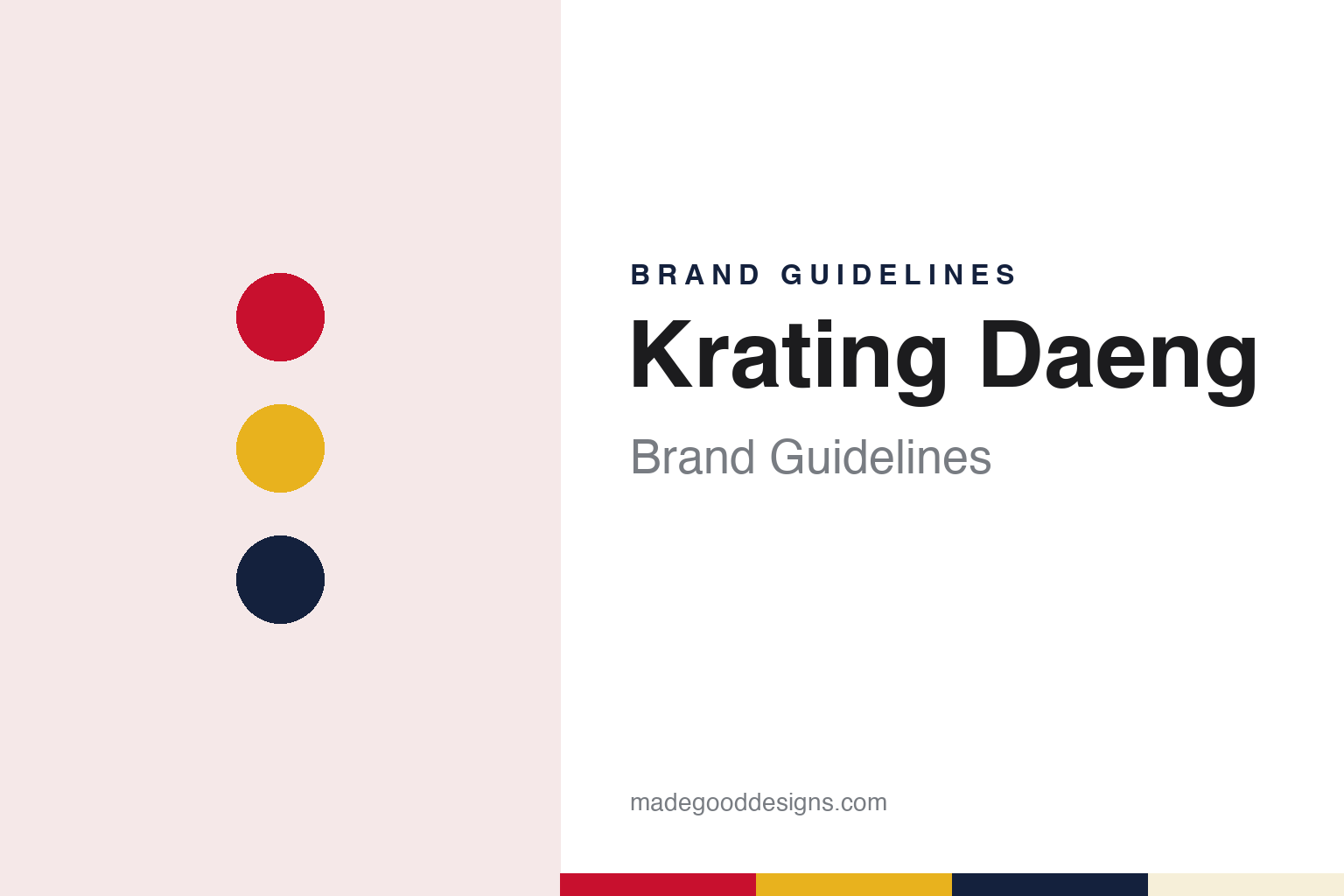
Two constants: a gaur red, sun gold and deep navy palette and a heavy grotesque sans register. Abstract homage — not a Krating Daeng product or mark; no can, bottle, logo or emblem is reproduced.
Red gaur
A medicine salesman, a syrup and two charging bulls.
Krating Daeng is the Thai drink from which Red Bull grew. Its maker traces back to Chaleo Yoovidhya, who, the company says, began as a salesman of pharmaceutical supplies and founded T.C. Pharmaceutical Ltd. in Bangkok on 27 March 1956, in a rented office on an alley off Khaosan Road. Obituaries in The Telegraph and The Independent in 2012 describe him as a former antibiotics salesman who set up his own small drug company; English Wikipedia, citing them and the company, places that in the early 1960s, so the company’s date and the press account differ.
According to TCP’s own history, its first medicines were formulated in-house and made under contract in Germany, before Chaleo opened a Bangkok plant under the T.C. Mycin name. That brand was advertised in cinemas, on the radio and, the company says, on the first lightboxes ever fitted to Bangkok taxis. In its second decade the firm moved production to Ekachai Road in Bang Bon, on the edge of the city, added a cosmetics line called Tattoo, and turned to ready-to-drink tonics. TCP says a syrup called Theoplex-D carried a trademark of two red bulls colliding, which earned it the nickname “Red Bull” and led to the launch of a 150cc drink under that name, sold through a campaign of price cuts and branded giveaways in exchange for used bottle caps — an approach the company describes as a first in Thai marketing.
English Wikipedia, citing the Bangkok Post in 2015, says the drink was devised in 1975 and introduced in Thailand in 1976. Its Thai name, กระทิงแดง, means “red gaur”: the krathing is the gaur, a large wild bovine of Southeast Asia, not domestic cattle. In that 2015 report the chief executive, Saravoot Yoovidhya, told the paper that “at first it was not very popular,” and that Chaleo focused first on upcountry markets rather than the cities where competitors were concentrated. English Wikipedia describes the early customers as rural workers, truck drivers and labourers.
Colour
The partner who took it to Europe.
The bridge to Red Bull was Dietrich Mateschitz, an Austrian then working as international marketing director for the German toothpaste maker Blendax. The Economist reported in 2002 that he visited Thailand in 1982 and came across Krating Daeng there. He met Chaleo, and in 1984 the two co-founded Red Bull GmbH in Austria, English Wikipedia says. Forbes reported in 2005 that each partner took 49 per cent, with the remaining 2 per cent going to Chaleo’s son Chalerm Yoovidhya, and that Mateschitz would run the company; TCP’s own history describes the split as 51 per cent for Chaleo’s family and 49 per cent for Mateschitz. The formula was adapted for Western tastes, the brand strategist Martin Roll wrote in Asian Brand Strategy (2005), and Red Bull went on sale in Austria on 1 April 1987, according to Red Bull’s company page.
The two businesses remain separate companies. TCP makes and sells Krating Daeng, chiefly in Asia, while Red Bull GmbH owns the trademark for its drink in Europe and the United States; the Bangkok Post reported in 2015 that the Yoovidhya family controls 51 per cent of the Austrian company. The overlap of names is real. TCP’s product pages show the classic Thai 250 mL can carrying both “Red Bull” and the one-word wordmark “KRATINGDAENG,” and several TCP products for other Asian markets carrying “Red Bull” alone, so the English words on a can do not by themselves show which company made it.
TCP set up T.C. Pharmaceutical Industries Co., Ltd. on 28 August 1978 to manufacture and export the brand, with Singapore as its first export market, the company says. A sales and marketing company, Red Bull Beverage Co., Ltd., followed in 1988, a vending business in 1996 and the distributor Durbell in 2002. The company says production later moved from Bangkok to a 2,000-rai site in Ban Sang District, Prachinburi province; Thai Wikipedia, citing Manager Online, adds plants in Vietnam, China and Indonesia. In China the gold can was made under licence by Reignwood Group from 1995 as “红牛 Red Bull”; since the licence term ended in 2016 the two sides have contested the Chinese trademark in court, Chinese financial press reported in 2018 and 2023.
Typography
Design and documentation.
The seven brands in this group are all drinks, and all of them come from Thailand: Singha, Chang, Leo, M-150, Krating Daeng, est and Carabao. Thai drink brands in general sit at many different points in the trade, from family firms that still carry a founder’s name to names that now belong to much larger listed groups, and a single brand can be sold everywhere from a roadside shop to a supermarket shelf.
A drink brand’s identity is usually carried less by a single product than by a bottle or can, a name and the moment it promises, because the company behind the name may have changed hands, moved its production or grown far beyond the place where it started. That makes the questions behind each name worth asking plainly: who started it, who owns it now, and where its drinks are actually made and packed.
Each guide separates what independent sources record from what the company says about itself — its founding story, its owners over time, where its drinks are made and how its packaging and advertising have changed — and marks plainly what rests only on the company’s own word.
Aa
A heavy, compact grotesque for a brand built on one blunt emblem. (Specimen set in Archivo, a sans STAND-IN; NOT the Krating Daeng logo or wordmark.)
Krating Daeng
A family group and a crowded home market.
Chaleo Yoovidhya died in Bangkok on 17 March 2012, The Telegraph and the BBC reported. The business has stayed with his family: Saravoot Yoovidhya was chief executive when the Bangkok Post interviewed him in 2015, and in 2017 the companies were consolidated as TCP Group, which the company says brought four subsidiaries together and opened its first overseas office, in Ho Chi Minh City, followed by offices in Myanmar and China. In 2022 the group adopted the purpose statement “Energizing a Better World for All.”
At home the brand has lost ground to newer rivals. FinanceAsia reported in 2014 that Krating Daeng had fallen behind M-150 to third place in Thailand’s energy-drink market, with a share it put at possibly 7 per cent, in a report on Carabao’s planned stock-market listing. TCP’s product pages today list small bottles of Kratingdaeng for Thailand, Laos and Mongolia and separate lines for Indonesia, where the brand’s sponsorships include the Proliga volleyball league and football clubs, English Wikipedia says.
The brand’s visual core is its mark: two red gaurs charging head-on, set against a sun, which the Bangkok Post described in 2015 as the basis of the drink’s branding. TCP traces that pair of bulls to the trademark on its Theoplex-D syrup, and the English name to the nickname customers gave it, so the picture came before the words.
For a design guide, Krating Daeng shows how one literal emblem — two animals in collision — can hold a brand together across scripts and markets, with the Thai name, the English nickname and the one-word wordmark all sitting under the same picture. Compare it with M-150 and Carabao, its Thai rivals. For this guide we use gaur red, sun gold and deep navy with a heavy grotesque sans, an unofficial interpretation; no product or logo is reproduced.
Explore & save
Keep Krating Daeng’s identity on hand — save it to a board in the Made Good inspiration library.
Krating Daeng identity set
Pin the Krating Daeng gaur red, sun gold and deep navy palette and the heavy grotesque sans register to your own board.