Carabao Brand Guidelines
The Thai energy drink named after a rock band.
Aa
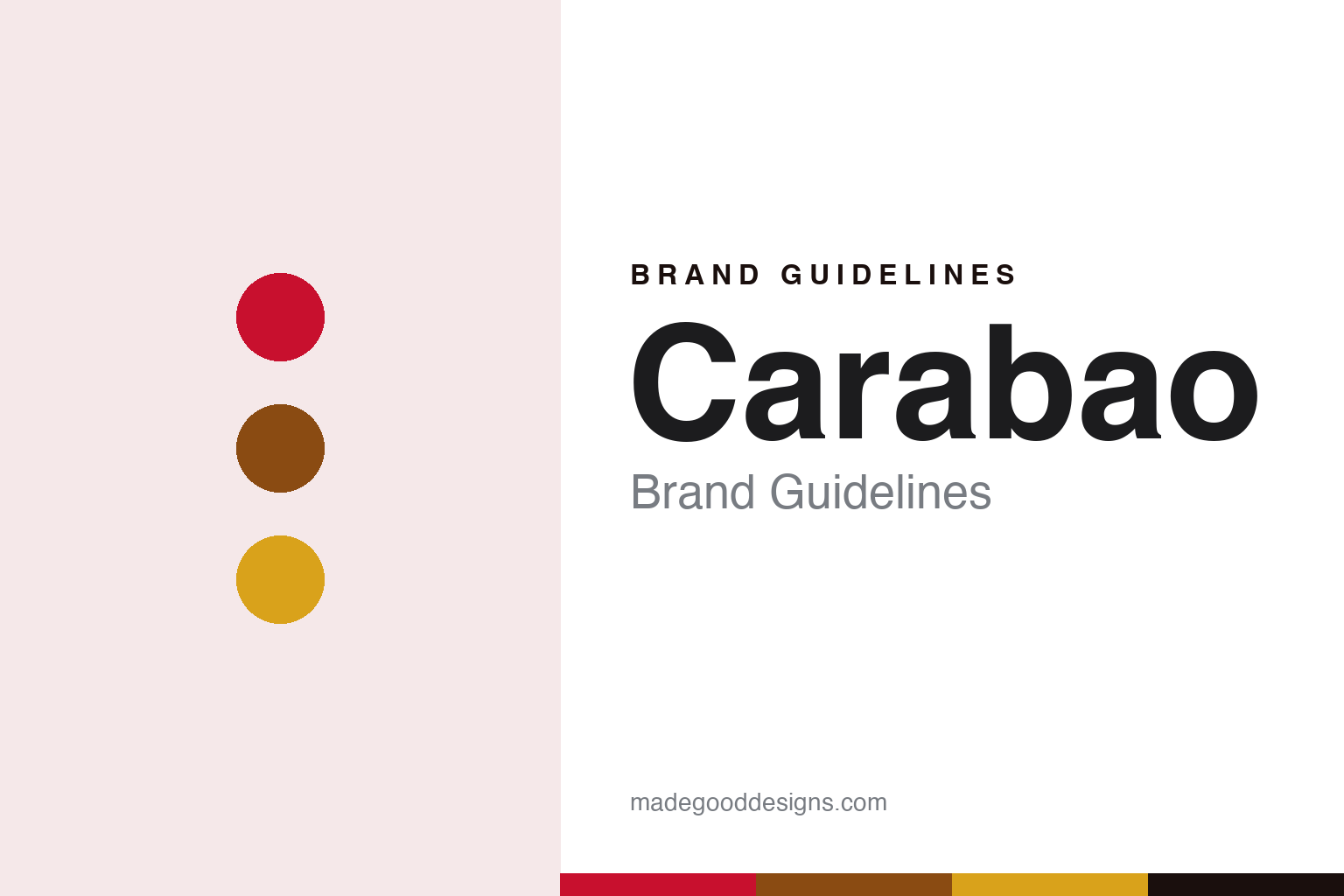
Two constants: a Carabao red, amber and gold palette and a condensed sans register. Abstract homage — not a Carabao product or mark; no bottle, can, logo or label is reproduced.
Red buffalo
A rock singer and a Bangkok brewery restaurant.
Carabao the drink takes its name from Carabao the band. The group was formed in 1980 by Yuenyong Opakul, known as Aed Carabao, with Kirati Promsaka Na Sakon Nakhon and Sanit Limsila, students who met at the Mapúa Institute of Technology in the Philippines, English Wikipedia says, which adds that carabao means “buffalo” and that the band is known for Thai phleng phuea chiwit, or “songs for life.”
The drinks company came two decades later. Carabao Group says Carabao Tawandang Co., Ltd. was incorporated on 22 August 2001 as a joint venture with the Tawandang German Brewery restaurant, and names its major shareholders as Sathien Setthasit, Nutchamai Thanombooncharoen and Yuenyong Opakul, the band’s founder and lead singer. Thai Wikipedia, citing Forbes Thailand in 2019, describes the brand as a collaboration between the singer and the brewery restaurant’s executives.
The product’s name joins the two halves of that partnership. In Thai it is Carabao Dang — “red buffalo” — and the company says the name comes from the band combined with the Tawandang restaurant; English Wikipedia gives the same explanation. The company dates the launch of the energy drink under the Carabao Dang trademark to 28 October 2002, and markets it with the slogan “Carabao Dang: The Fighting Spirit.”
Colour
Thai heroes, a new album and free concerts.
The launch was built around advertising. Thai Wikipedia says the first commercial aired on 23 October 2002 on Channel 7, under a slogan that translates as “honouring the great fighters,” and retold episodes from Thai history — the villagers of Bang Rachan, Thao Suranari and the naval battle off Ko Chang — on a film-like scale. It ran alongside a new Carabao album of the same name and free concerts, the marketing magazine Positioning reported. English Wikipedia, citing The Nation, says the campaign featured the company’s founders, including Sathien Setthasit and Aed Carabao.
The campaign drew attention of more than one kind. The Nation reported in November 2002 that the Office of the Consumer Protection Board had examined the advertisements as too violent; in September 2003 the same paper reported that the campaign had won gold and silver at Media & Marketing magazine’s Asian Brand Marketing Effectiveness Awards. Thai Wikipedia adds that some critics questioned the use of historical events in marketing, and a songs-for-life band’s move into commerce.
On the ground, Thai Wikipedia says, the company used teams of promotional staff known as the “Bao Daeng girls” at shops and events around the country. The founders set up the Carabao Foundation in 2004, which has run an essay competition for schoolchildren and, with the broadcaster Workpoint, a televised band contest, Bao Young Blood, from 2014.
The brand grew into a range. Thai Wikipedia lists a short-lived Carabao XO in 2005, a sports drink launched as Start Plus in 2014 and renamed Carabao Sport in 2018, which the company describes as a “One Brand Strategy”; bottled water and coffee under the Carabao name in 2016; and a carbonated Green Apple energy drink in cans in 2018. The company says it later cut the domestic Green Apple can from 330 to 180 millilitres to reach younger drinkers and refresh the brand image.
Typography
Thai drink brands.
The seven brands in this group are all drinks, and all of them come from Thailand: Singha, Chang, Leo, M-150, Krating Daeng, est and Carabao. Thai drink brands in general sit at many different points in the trade, from family firms that still carry a founder’s name to names that now belong to much larger listed groups, and a single brand can be sold everywhere from a roadside shop to a supermarket shelf.
A drink brand’s identity is usually carried less by a single product than by a bottle or can, a name and the moment it promises, because the company behind the name may have changed hands, moved its production or grown far beyond the place where it started. That makes the questions behind each name worth asking plainly: who started it, who owns it now, and where its drinks are actually made and packed.
Each guide separates what independent sources record from what the company says about itself — its founding story, its owners over time, where its drinks are made and how its packaging and advertising have changed — and marks plainly what rests only on the company’s own word.
Aa
A condensed sans for a brand built on a fighting slogan. (Specimen set in Oswald, a sans STAND-IN; NOT the Carabao logo.)
Carabao
Bang Pakong, the stock exchange and the Carabao Cup.
The business was reorganised around a listed holding company. Carabao Group says Carabao Group Public Company Limited was registered in August 2013, became a public company in July 2014 and listed on the Stock Exchange of Thailand on 21 November 2014. Thai Wikipedia says the group ended its distribution arrangement with Serm Suk in 2012 and set up its own distributor, Tawandang DCM, with a fleet of cash vans serving shops across the country.
Production is in Thailand. Carabao Dang is made by Carabao Tawandang at Bang Pakong, in Chachoengsao province, at a site that, according to Thai and English Wikipedia, also makes glass bottles and aluminium cans. The company says its subsidiary Asia Pacific Glass makes the amber glass bottles used for Carabao Dang and expanded that plant in December 2017, and that its can-making company, Asia Can Manufacturing, began production there in November 2018. The German machinery maker Krones, in a customer reference cited by English Wikipedia, says eight of its lines run at Bang Pakong and that the site supplies more than 40 export markets.
Exports began early. English Wikipedia, citing the Bangkok Post, says the drink was introduced to Europe and the United States in 2004, and to China and India from 2007. In Britain the brand chose football. The Nation reported that Carabao became shirt sponsor of Reading for the 2015–16 season and then a principal partner of Chelsea from 2016–17. On 4 November 2016 BBC Sport reported that the EFL Cup would be known as the Carabao Cup from the 2017–18 season, in a three-year deal with “the Thai energy drinks brand,” succeeding Capital One; the company says the agreement was later extended. English Wikipedia, citing the English Football League, says a renewal announced in March 2026 runs to the end of the 2028–29 season.
For a design guide, Carabao shows how a borrowed identity — a band’s name, a buffalo and a fighting slogan — can carry a drink from Thai shop counters to the name of an English cup competition. Compare Krating Daeng, the Thai energy drink it competes with at home, and M-150. For this guide we use red, amber and gold with a condensed sans, an unofficial interpretation; no product or logo is reproduced.
Explore & save
Keep Carabao’s identity on hand — save it to a board in the Made Good inspiration library.
Carabao identity set
Pin the Carabao red, amber and gold palette and the condensed sans register to your own board.