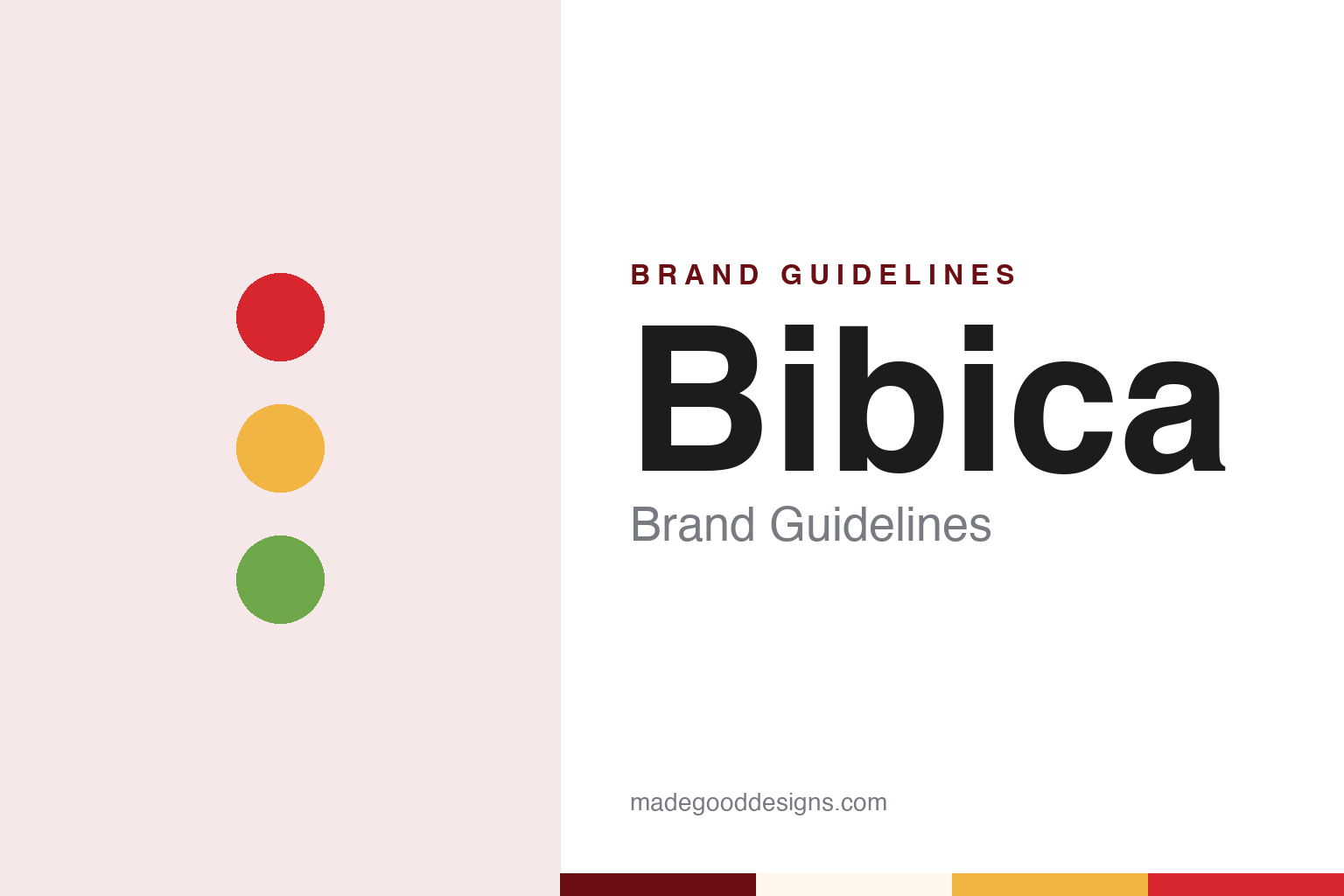
Bibica Brand Guidelines
The Biên Hòa confectioner fought over by Lotte and PAN.
Aa
Two constants: a candy red, caramel and pandan green palette and a rounded friendly sans register. Abstract homage — not a Bibica product or mark; no pack, logo or sweet is reproduced.
A sugar factory’s candy shop
Biên Hòa, soft candy and an acronym.
Bibica comes from Biên Hòa, the industrial city in Đồng Nai province just north-east of Ho Chi Minh City. The company says it grew out of a candy workshop at the Biên Hòa sugar factory, which became the Biên Hòa Confectionery Joint Stock Company and later Bibica Corporation. The company’s own history begins with sweets: in 1993, it says, its first soft-candy production line went into operation, the step it treats as the start of its confectionery business.
The range widened quickly. The company’s timeline records a hard-candy line and a biscuit line in 1994, with the soft-candy line upgraded to make more, and cookies and malt products between 1996 and 1998. In 1997, the company says, it adopted the name BIBICA as its brand — an acronym of Biên Hòa Biscuit Candy — and introduced a red logo.
In 1999 the business was reorganised as a joint-stock company, Công ty Cổ phần Bánh kẹo Biên Hòa (Biên Hòa Confectionery Joint Stock Company), with Bibica as its trading name, and in 2000, the company says, it raised its charter capital and gained ISO 9001 certification. Its shares were registered for trading on Vietnam’s stock exchange in December 2001 under the ticker BBC, Vietnamese Wikipedia’s list of listed companies shows. Today the company presents itself as a Vietnamese confectionery brand with more than three decades of experience, a history that runs from a single soft-candy line to a national network of factories.
Colour
Hura, Goody and three new factories.
Bibica’s best-known product line is Hura, its layer and sponge cakes. The company says it invested in a Hura sponge-cake line in 2001, alongside lines for filled cookies and other cakes, and Hura has since grown into a family that also covers sandwich bread. Its other brands, as the company lists them, include Goody biscuits and gift sets, Zoo jelly sweets, Michoco coconut candies, and the herbal candies aHHa and Migita, with seasonal ranges for Tết, the lunar new year, and for the Mid-Autumn Festival. VnExpress International has described the company as a maker of pies, sponge cakes, mooncakes and biscuits.
The company moved beyond its home province in stages. It opened Bibica Hà Nội, a factory in the Sài Đồng B industrial zone in Hanoi’s Long Biên district, in 2002, to serve the north; a factory called Bibica Miền Đông (Bibica East) in the Mỹ Phước 3 industrial zone in Bình Dương province followed in 2006. In 2008 its head office moved to Lý Thường Kiệt street in Ho Chi Minh City, where it remains. In 2017, the company says, it installed a new soft-candy line with European equipment, and in 2019 it opened Bibica Miền Tây (Bibica West), a 50,000-square-metre plant in the Vĩnh Lộc 2 industrial zone in Long An, with lines for crackers and wafers. The company says it supplies around 20,000 tonnes of confectionery a year to customers in Vietnam and abroad, and lists HACCP, ISO 22000 and halal certification for its production, along with compliance with the requirements of the United States Food and Drug Administration for exports.
Typography
Design and documentation.
The seven brands in this group all make food or drink, and all of them come from Vietnam: Kinh Đô, Bibica, TH true MILK, Saigon, Bia Hà Nội, Vissan and Cholimex. Vietnamese food and drink brands in general sit at many different points in the trade, from businesses that began as state enterprises to names that now belong to much larger groups, and a single brand can be sold everywhere from a street-side stall to a supermarket shelf.
A food or drink brand’s identity is usually carried less by a single product than by a pack, a name and the meal or moment it promises, because the company behind the name may have changed hands, moved its factory or grown far beyond the city where it started. That makes the questions behind each name worth asking plainly: who started it, who owns it now, and where its products are actually made and packed.
Each guide separates what independent sources record from what the company says about itself — its founding story, its owners over time, where its products are made and how its packaging has changed — and marks plainly what rests only on the company’s own word.
Aa
A rounded friendly sans for a brand named after biscuits and candy. (Specimen set in Nunito, a sans STAND-IN; NOT the Bibica logo.)
Bibica
A long contest for control.
For more than a decade Bibica’s ownership was contested. The South Korean group Lotte first took a 30% stake in 2007, VnExpress International reported in December 2020. In the early 2010s Lotte and the brokerage Saigon Securities Incorporation (SSI), Bibica’s two largest shareholders, began a race to raise their holdings; the paper dated the start of that race to 2012 in one report and the disputes to 2013 in another. By August 2013 Lotte held 38.6%.
A third party broke the deadlock. In early 2015 PAN Food, part of the Vietnamese food and agriculture company PAN Group, bought SSI’s stake and became a major shareholder with 42.3%, and in February 2017 it raised its holding to 50.07%, overtaking Lotte, VnExpress International reported. Disagreements continued: the paper reported that at the 2018 annual meeting Lotte, by then holding 44.03%, vetoed the company’s business plans. In July 2019 PAN Group made an offer for the shares it did not own, an offer the paper later described as rejected.
The contest ended with Lotte’s exit. In December 2020 Lotte registered to sell its entire 44.03% stake, VnExpress International reported. By March 2022 PAN held 58.94% through PAN Food, and in May 2022 it bought a further 39.9%, taking its ownership to 98.3%; the paper reported that PAN’s management described Bibica as key to its food business and to its “feed-farm-food” strategy. Bibica Corporation, as the company now calls itself, therefore belongs almost entirely to PAN Group.
For a design guide, Bibica shows how a factory town and a product list can become a brand name. Compare Kinh Đô, the Ho Chi Minh City mooncake maker now owned by Mondelez, and Vinamilk, the Vietnamese dairy founded in 1976. For this guide we use a candy red, a caramel and a pandan green with a rounded sans, an unofficial interpretation; no product or logo is reproduced.
Explore & save
Keep Bibica’s identity on hand — save it to a board in the Made Good inspiration library.
Bibica identity set
Pin the Bibica candy red, caramel and pandan green palette and the rounded friendly sans register to your own board.