14 Hands Brand Guidelines
Ste. Michelle’s wild-horse wine from Washington, debuted 2005.
Aa
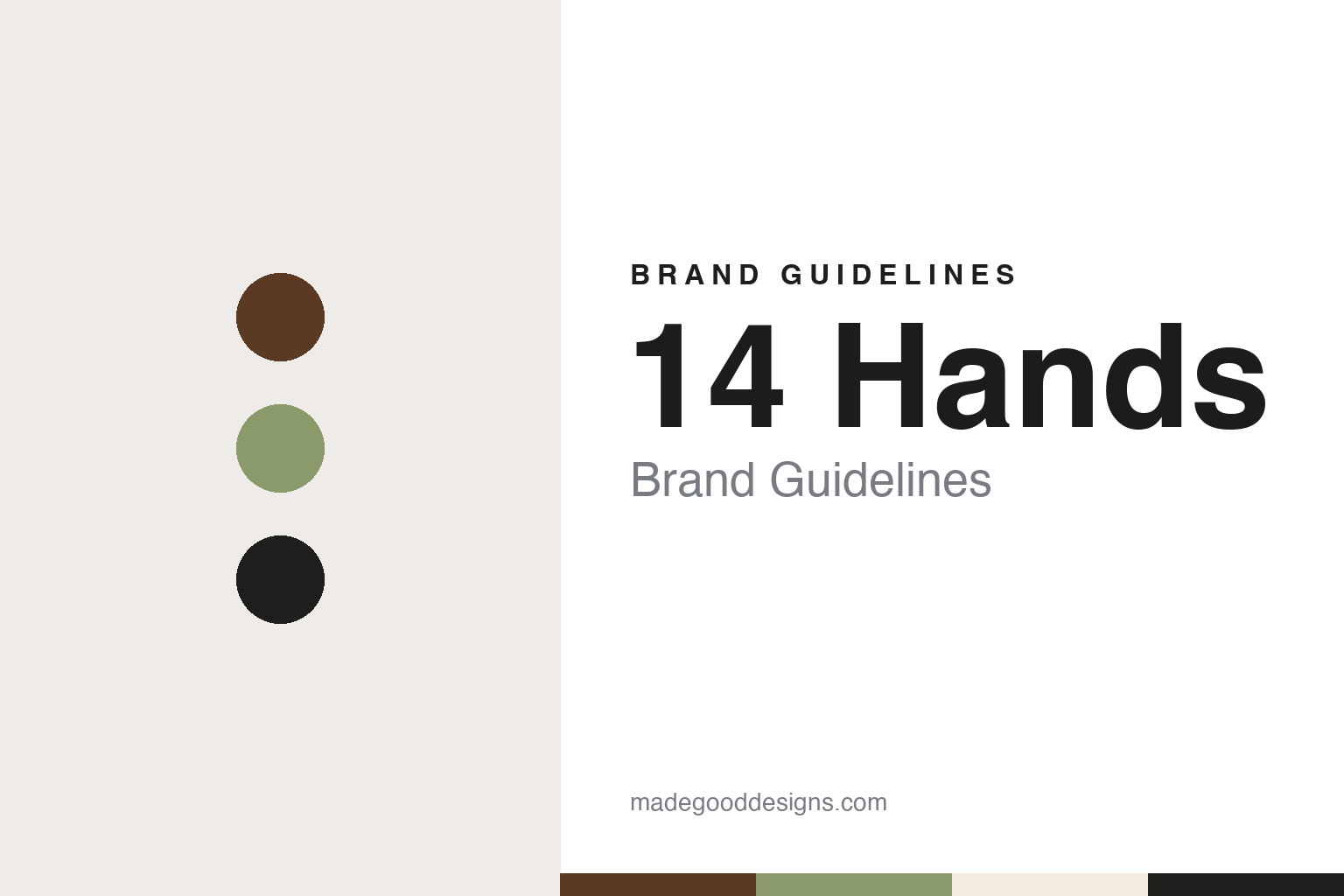
Two constants: a saddle brown, sagebrush and basalt black palette and a sturdy slab serif register. Abstract homage — not a 14 Hands product or mark; no label, logo or bottle is reproduced.
A restaurant label from Washington
From fine-dining wine lists to a national brand.
14 Hands is a Washington State wine brand owned by Ste. Michelle Wine Estates, the company behind Chateau Ste. Michelle and Columbia Crest. Ste. Michelle said in an April 2015 press release that 14 Hands debuted in 2005 in fine-dining restaurants. Great Northwest Wine reported in May 2015 that it began as a restaurant-only label and that demand grew strong enough for the company, then based in Woodinville, to turn it into a national retail brand.
The growth was fast. The same Great Northwest Wine report said 14 Hands made nearly 1.7 million cases in 2014, which it said made it the second-largest winery in the Northwest. Ste. Michelle said in 2015 that the brand had been named an Impact “Hot Brand” for seven years in a row, from 2008 to 2014, and that it was the only honoree from outside California in 2014. The company also said 14 Hands was sold nationally and exported to 24 countries, and, citing AC Nielsen data, that it had been the best-selling wine in Seattle and Portland since mid-2011.
The wine was made under a long-serving winemaker. Great Northwest Wine named Keith Kenison as head winemaker in 2015, noting that he had joined Ste. Michelle in 1992 and also made white wines for Columbia Crest. Wine Industry Advisor reported in May 2024 that Zach Richardson, who had worked on 14 Hands wines for nine years, had been named the brand’s winemaker.
For about a decade the brand had a home of its own. The former Snoqualmie Vineyards winery in Prosser, Washington, was renamed 14 Hands Winery and held its grand opening on 10 April 2014, Great Northwest Wine reported. Ste. Michelle described the tasting room as sitting at the gateway to the Horse Heaven Hills, with a large tasting bar and a working barrel room. In 2014 the brand also introduced a limited range called The Reserve and a wine club, Cellar 14, the company said.
Colour
A legend of small horses, and a unit of measure.
The name is a horse’s height. A hand is the traditional unit used to measure horses, equal to four inches, so a horse “14 hands” tall stands about 56 inches at the shoulder. Ste. Michelle says the brand is named for the wild horses that once roamed eastern Washington, small animals that stood about 14 hands tall. Great Northwest Wine placed those horses in the Horse Heaven Hills, the area south of Prosser that also gives its name to a wine-growing region.
The horse theme runs through the brand’s marketing. Ste. Michelle said in 2015 that 14 Hands had sponsored the Kentucky Derby for the previous three years, and Great Northwest Wine described the brand’s links to horse racing in the same year. The company’s story ties the wine to the endurance of those wild horses and to the dry, open landscape of the Columbia Valley.
No designer of the original label is named in published sources, and the brand has not issued an official colour code. The palette here borrows from the brand’s own setting rather than from any label: the brown of a saddle, the grey-green of sagebrush on the eastern Washington hills, and the dark basalt of the Columbia River country.
Typography
Design and documentation.
The seven brands in this group are all wine names: Chateau Ste. Michelle, Bogle, 14 Hands, Dark Horse, Cupcake, Ménage à Trois and Chandon. Wine brands in general sit at many different points in the trade, from family houses that still carry a founder’s name to labels that now belong to much larger drinks groups, and a single brand can be sold everywhere from a corner shop to a restaurant list.
A wine brand’s identity is usually carried less by a single bottle than by a label, a name and the place it promises, because the company behind the name may have changed hands, moved its production or grown far beyond the place where it started. That makes the questions behind each name worth asking plainly: who started it, who owns it now, and where its wine is actually made and bottled.
Each guide separates what independent sources record from what the company says about itself — its founding story, its owners over time, where its wine is made and how its labels have changed — and marks plainly what rests only on the company’s own word.
Aa
A sturdy slab serif for a brand built on horses and open country. (Specimen set in Zilla Slab, a slab-serif STAND-IN; NOT the 14 Hands logo.)
14 Hands
A brand that outlived its own winery.
The brand’s address has since changed twice. In May 2024 the Tri-City Herald, as republished by the Bellingham Herald, reported that Ste. Michelle had agreed to sell the Prosser winery to the Andrews family, owners of Horse Heaven Wine Co., in a sale and leaseback, and that 14 Hands production was moving to the company’s Columbia Crest winery near Paterson. Good Fruit Grower reported in November 2024 that the production facility had closed in 2023, that Horse Heaven Wine Co. had crushed grapes there in 2024, and that Ste. Michelle had decided to close both the 14 Hands tasting room in Prosser and the Columbia Crest tasting room. A company spokeswoman told the magazine it was focusing on winemaking and national distribution.
The brand’s owner changed hands too. English Wikipedia says Ste. Michelle Wine Estates was long owned by Altria, the company formerly known as Philip Morris, and was sold in 2021 to the private equity firm Sycamore Partners. In December 2025 Wine Spectator reported that the Wyckoff family, a Washington farming family based in the Yakima Valley, had bought Ste. Michelle’s Washington wine brands, facilities and vineyards, and listed 14 Hands among them; the magazine said Sycamore kept the company’s Oregon brands. KIRO 7 reported that the deal returned the company to Washington ownership for the first time in more than 50 years. Through each change 14 Hands has stayed part of the Ste. Michelle portfolio rather than being sold on its own.
The name needs a little care online. Many stables, riding schools and horse businesses use “14 hands” in their names; the wine brand’s own site is 14hands.com.
For a design guide, 14 Hands shows how a single number and a regional legend can carry a high-volume wine brand from restaurant lists to national shelves, and keep it recognisable after the winery that bore its name was sold. Compare Chateau Ste. Michelle, its Woodinville sister brand, and Dark Horse, another American wine named for a horse. For this guide we use saddle brown, sagebrush and basalt black with a slab serif, an unofficial interpretation; no product or logo is reproduced.
Explore & save
Keep 14 Hands’s identity on hand — save it to a board in the Made Good inspiration library.
14 Hands identity set
Pin the 14 Hands saddle brown, sagebrush and basalt black palette and the sturdy slab serif register to your own board.