Ozeki Brand Guidelines
The Nishinomiya sake house of 1711 and One Cup.
Aa
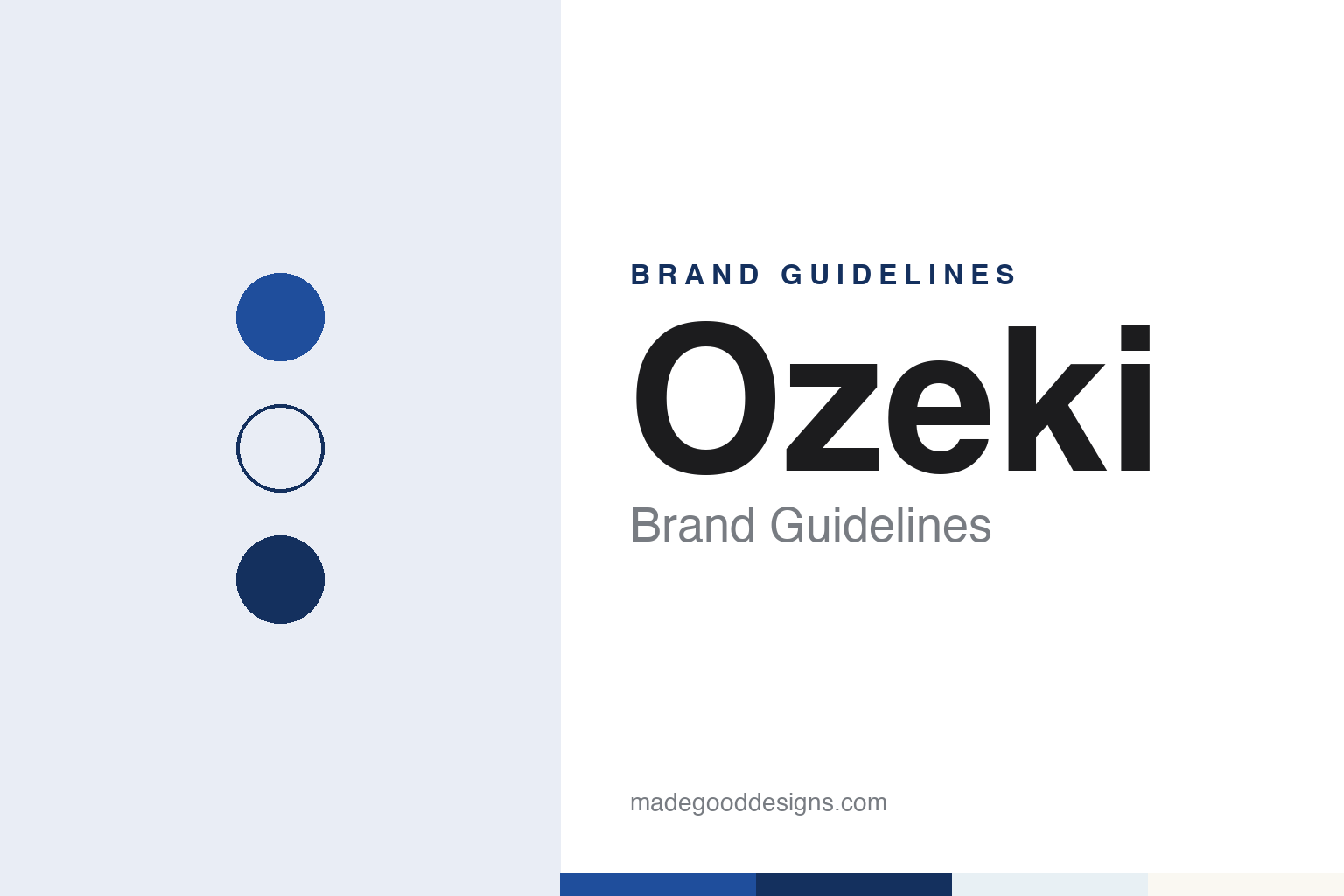
Two constants: a One Cup blue, Nada navy and cup glass palette and a plain gothic sans register. Abstract homage — not an Ozeki product or mark; no label, logo or cup is reproduced.
Osakaya of Imazu
A Nada brewer that named its sake after a sumo rank.
Ozeki traces its history to 1711. The company says the business began that year in the village of Imazu, in Settsu Province, as a shop called Osakaya, run by the first Osakaya Chōbei of the Osabe family, and that its sake was then sold under the name Manryō. Imazu is now part of the city of Nishinomiya in Hyōgo Prefecture, within the Nada brewing district on the coast between Osaka and Kobe, and the company says its head office is still there.
The early business was built on shipping sake to Edo, the old name for Tokyo. The company’s history says Manryō was sold mainly as kudari-zake, sake sent from the Kansai region to the capital, and that in 1810 the fifth Osakaya Chōbei built the Imazu lighthouse.
The name came later. In 1884, the company says, it changed the name of its sake from Manryō to Ozeki as it set out to open new markets. Ōzeki is a senior rank in sumo wrestling; the company explains that the word carried the sense of “champion” and also echoed ōdeki, “great success,” and that the family wanted the brewery to become the ozeki of the sake world. The sumo link has stayed in use: the company’s American subsidiary says Ozeki began sponsoring the Ozeki Cup at sumo tournaments in 1958.
The corporate name followed the brand. According to the company’s timeline, the business was reorganised as a company under the Osabe family name in 1935, renamed Ozeki Sake Brewery Co., Ltd. in 1962 and renamed Ozeki Co., Ltd. in 1991; the American subsidiary’s history dates a corporate name change to 1992 instead. Ozeki marked its 300th anniversary in 2011.
Colour
A glass cup, a blue label and an Olympic launch date.
The product that made the name famous is a glass. One Cup Ozeki went on sale on 10 October 1964, the day of the opening ceremony of the Tokyo Olympics, the company says. It held a single gō, the traditional 180-millilitre serving of sake, in a glass cup with a lid, so that it could be drunk straight from the container rather than poured from a large bottle. Ozeki told the advertising magazine AdverTimes in 2019 that the president of the day wanted to make sake easier to drink, and that the product was first developed for younger consumers.
The name and the label were both chosen in English. A 2011 feature by J-Net21, the small-business portal of the Japanese government agency SMRJ, reported that development began in the early 1960s, that the team was split between “One Cup” and “One Koppu,” and that “One Cup” won, on the pattern of “one cup of coffee.” The same feature described the label as white lettering on a deep blue ground, set in the Roman alphabet rather than Japanese script, which it called unusual for sake at the time; the lettering was at first printed directly on the glass, with paper labels arriving in 1973. The company says it registered the One CUP logo design as a trademark in 1972, and that the blue label design remains in use. “One Cup” is a registered trademark of Ozeki Co., Ltd., the company’s product pages state.
The cup became a mass-market fixture. The company says annual sales passed 100 million cups in 1979, and its American subsidiary says the product reached 4 billion cups sold worldwide by its 50th anniversary in 2014. J-Net21 reported about 690,000 cups sold in the launch year. The company has also designated 10 October as One Cup Day, it told AdverTimes.
Anniversaries keep the design in view. On 10 October 2024, for One Cup Ozeki’s 60th anniversary, the company began selling a One Cup Ozeki ice cream made with SAKEICE, according to its own release. In September 2021 it introduced a newer brand, Sōka Osakaya, that revives the house’s original shop name.
Typography
Design and documentation.
The seven brands in this group are all sake, shochu and soju names: Dassai, Hakkaisan, Kubota, Ozeki, Sho Chiku Bai, iichiko and Chum Churum. Sake, shochu and soju brands in general sit at many different points in the trade, from family breweries that still carry a founder’s name to labels that now belong to much larger drinks groups, and a single brand can be sold everywhere from a corner shop to a restaurant list.
A sake, shochu or soju brand’s identity is usually carried less by a single bottle than by a label, a name and the place it promises, because the company behind the name may have changed hands, moved its production or grown far beyond the place where it started. That makes the questions behind each name worth asking plainly: who started it, who owns it now, and where its drink is actually made and bottled.
Each guide separates what independent sources record from what the company says about itself — its founding story, its owners over time, where its sake, shochu or soju is made and how its labels have changed — and marks plainly what rests only on the company’s own word.
Aa
A plain gothic sans for a cup label read at arm’s length. (Specimen set in Zen Kaku Gothic New, a sans-serif STAND-IN; NOT the Ozeki logo.)
Ozeki
From Nada to a California brewery.
Ozeki went abroad early. The company says it established Ozeki San Benito Inc. in Hollister, California, in 1979, and its American subsidiary, now Ozeki Sake (U.S.A.), Inc., calls this the first time a Japanese sake producer established a presence in the United States. It says Hollister was chosen for locally grown rice and water from the Sierra Nevada.
The local paper BenitoLink filled in the story in November 2019, as the subsidiary marked its 40th anniversary. It reported that Ozeki had exported sake to the United States before but found that quality suffered in transit, that a contact with the owner of the soy-sauce maker Kikkoman led it to Hollister, and that a winery acted as a short-term stockholder at the start. The brewery uses rice grown north of Sacramento and employs about 40 people, the paper said. For the anniversary the company released a bottle carrying both its own logo and the city’s, and Hollister’s council proclaimed 21 May 2020 Ozeki Sake Day.
The name needs some care online. Ōzeki is first a sumo rank and also a Japanese surname, so many unrelated businesses use it; the brewer’s Japanese site is ozeki.co.jp and its American subsidiary’s is ozekisake.com. Our separate note on the Ozeki sake logo font covers the lettering.
For a design guide, Ozeki shows how a sumo rank, a single-serving glass cup and a plain blue label can carry a three-century-old Nada brewer into convenience stores and onto American shelves. Compare Gekkeikan, the Fushimi sake house of 1637, and Sho Chiku Bai, Takara’s sake brand. For this guide we use One Cup blue, Nada navy and cup glass with a sans, an unofficial interpretation; no product or logo is reproduced.
Explore & save
Keep Ozeki’s identity on hand — save it to a board in the Made Good inspiration library.
Ozeki identity set
Pin the Ozeki One Cup blue, Nada navy and cup glass palette and the plain gothic sans register to your own board.