Nicolas Feuillatte Brand Guidelines
The grower-cooperative Champagne of Chouilly, founded in 1976.
Aa
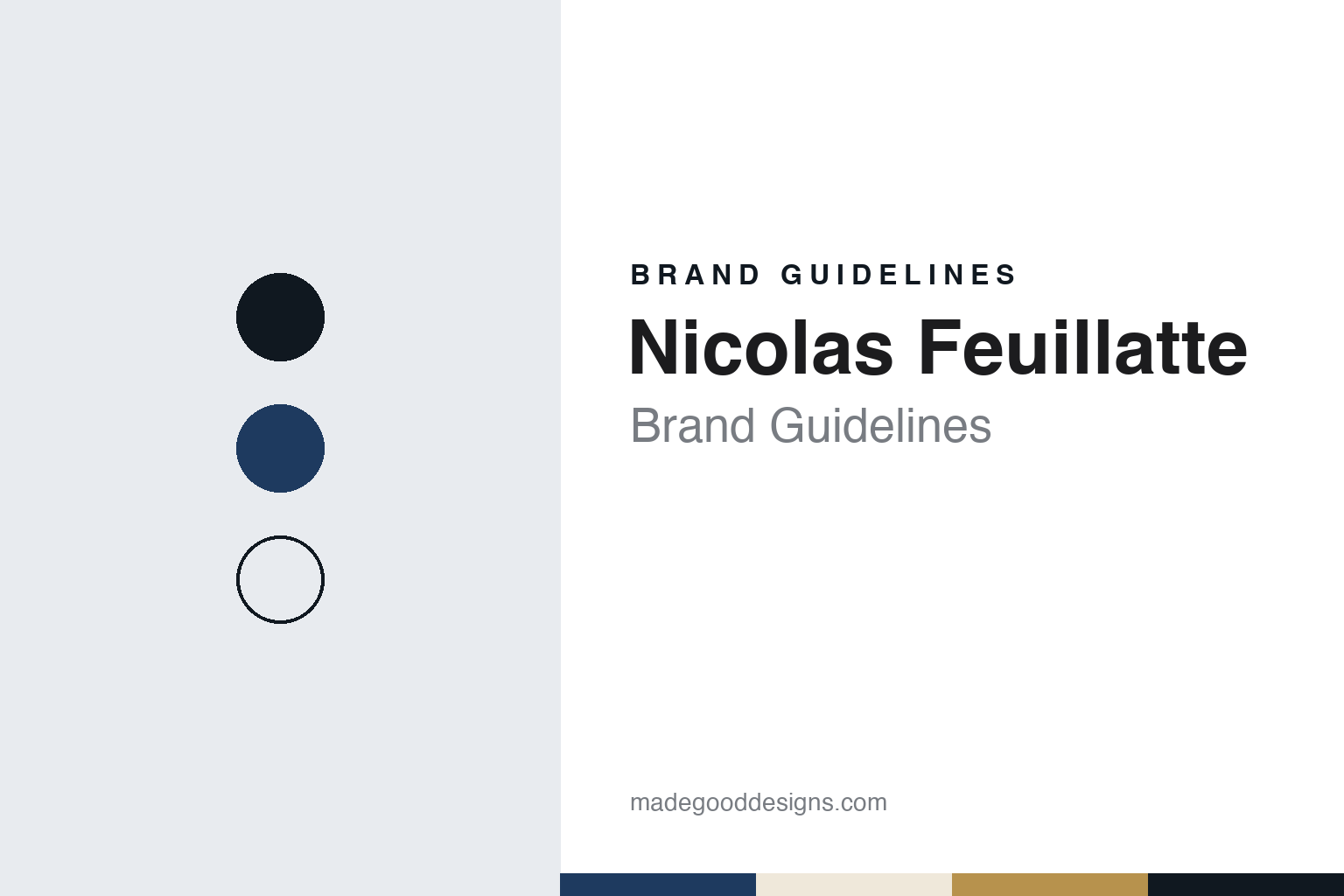
Two constants: a Nicolas Feuillatte blue, cream and gold palette and a Classic serif register. Abstract homage — not a Nicolas Feuillatte product or mark; no bottle, label or logo is reproduced.
Two founders
A coffee importer and a cooperative.
Nicolas Feuillatte is a Champagne brand with two starting points. The first is a man. Nicolas Feuillatte, born in Paris, turned down the chance to take over his family’s business and moved to the United States, where he became the country’s largest importer of African coffee, European Supermarket Magazine reported in 2014; the company itself calls him “the first importer of African coffee in the United States.” Back in France, he took over a 12-hectare estate, the Domaine de Bouleuse near Reims. Sources differ on how he came by it — English Wikipedia says he inherited it, The Drinks Business that he bought it — and European Supermarket Magazine dates his return to France to 1972. In 1976 he launched a Champagne under his own name; the company says he made it “for his American friends.”
The second starting point is a cooperative. In 1972, according to the company and English Wikipedia, Henri Macquart founded the Centre Vinicole de la Champagne, a pressing, storage and winemaking centre built for grape growers; the company says its “primary objective was for winegrowers to unite to guarantee the sale of their grapes.” English Wikipedia describes it as “federated around cooperative or individual wine presses.”
The two came together in 1986. The company says Feuillatte “sold his brand in 1986 to the Centre Vinicole de la Champagne,” and the combined business took the name Centre Vinicole – Champagne Nicolas Feuillatte. Feuillatte stayed on as the brand’s ambassador, European Supermarket Magazine reported. His death was reported in 2014 by that magazine and by The Drinks Business.
Colour
The house among the vines.
The brand is made at Chouilly, on the road to Pierry above Épernay, English Wikipedia says — a village at the northern end of the Côte des Blancs. The company runs cellar tours there and lists the inauguration of new premises in 2017, after two years of work, among its milestones. It describes its headquarters as set among the vineyards, and says its vintage wines are “vinified by vintage or by vintage zone and by grape variety.”
What makes Nicolas Feuillatte unusual among the big Champagne names is where the grapes come from. It does not depend on one family’s vineyards but on growers. In 2014 European Supermarket Magazine counted 80 cooperatives, about 5,000 growers and more than 2,200 hectares behind the brand; English Wikipedia gives 82 cooperatives. The company calls itself “the youngest of the great Champagne Houses” and “the most important brand of Champagne from winegrowers.” In 2014 European Supermarket Magazine described it as the best-selling Champagne brand in France and the third in the world, after Moët & Chandon and Veuve Clicquot, the magazine reported in 2014.
The company marks its growth in bottles: one million bottles of Nicolas Feuillatte sold by 1995, and a milestone of ten million reached in 2014, by its own account. Its range today is built around the Réserve Exclusive line — the Brut, the Rosé and a Demi-Sec among them — with vintage Blanc de Blancs and Grand Cru wines above it.
At the top sits Palmes d’Or, in Brut and Rosé versions. Its black bottle, covered in small rounded indentations, is the brand’s most recognisable object; importers repeat the house’s story that it was created as a tribute to an opera singer who loved black pearls, according to the house.
Typography
Design and documentation.
The seven brands in this group are all Champagne houses: Pol Roger, Billecart-Salmon, Perrier-Jouët, Pommery, Nicolas Feuillatte, Charles Heidsieck and Gosset. Champagne houses in general sit at many different points in the trade, from family houses that still carry a founder’s name to labels that now belong to much larger drinks groups, and a single name can be sold everywhere from a corner shop to a restaurant list.
A Champagne house’s identity is usually carried less by a single bottle than by a label, a name and the place it promises, because the company behind the name may have changed hands, moved its cellars or grown far beyond the town where it started. That makes the questions behind each name worth asking plainly: who started it, who owns it now, and where its wine is actually made and aged.
Each guide separates what independent sources record from what the company says about itself — its founding story, its owners over time, where its wine is made and how its labels have changed — and marks plainly what rests only on the company’s own word.
Aa
A classic serif — “the youngest of the great Champagne Houses.” (Specimen set in Cormorant Garamond, a serif STAND-IN; NOT the Nicolas Feuillatte logo.)
Nicolas Feuillatte
A cooperative that became a group.
The cooperative did not stay the same size. In 2019 it bought the Reims house Abelé 1757. In December 2021 the general assemblies of Centre Vinicole – Champagne Nicolas Feuillatte and the Coopérative Régionale des Vins de Champagne (CRVC), owner of the Castelnau brand, approved a merger, Decanter and Shanken News Daily reported on 16 December 2021. The new group, Terroirs et Vignerons de Champagne, was “born on January 1, 2022,” the company says. The trade press described it as bringing together about 6,000 growers and nearly 9% of the Champagne vineyard, with Nicolas Feuillatte, Castelnau and Abelé 1757 run as separate brands; Véronique Blin became its president and Christophe Juarez its chief executive.
The group then reached beyond cooperatives. In 2023 it agreed to buy Champagne Henriot, the Reims family house, from Artémis Domaines, The Drinks Business reported, with the deal finalised later that year. In February 2026 the Spanish wine-trade site Vinetur reported that Philippe Dessertenne had been named chief executive of the group, taking over from Juarez, who had led the business since 2017, with a start in March at the Chouilly headquarters.
The brand also has a design history of its own on this site: our separate page on the Nicolas Feuillatte font looks at its lettering. The black, dimpled Palmes d’Or bottle and the Réserve Exclusive labels give the house two very different faces — one dramatic, one everyday.
For a design guide, Nicolas Feuillatte shows how a grower cooperative can present itself with the polish of a Champagne house while keeping a founder’s name at the centre. Compare Moët & Chandon, the Épernay house it was once ranked behind, and Charles Heidsieck, a Reims house once owned by the Henriot family. For this guide we use a deep blue, a chalk cream and a foil gold with a serif, an unofficial interpretation; no product or logo is reproduced.
Explore & save
Keep Nicolas Feuillatte’s identity on hand — save it to a board in the Made Good inspiration library.
Nicolas Feuillatte identity set
Pin the Nicolas Feuillatte blue, cream and gold palette and the Classic serif register to your own board.