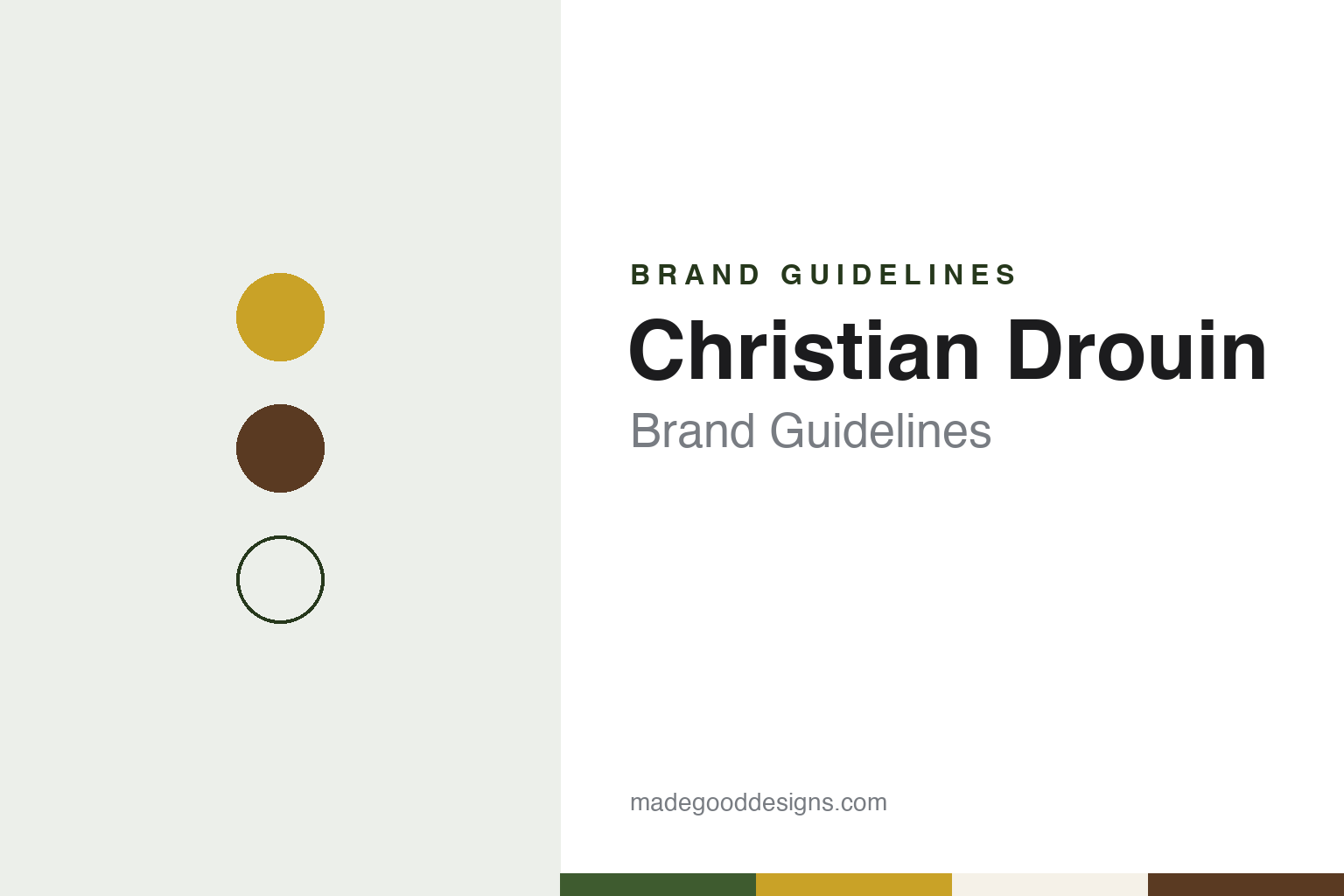
Christian Drouin Brand Guidelines
Three generations of Pays d’Auge calvados since 1960.
Aa
Two constants: an orchard green, apple gold and half-timber brown palette and a classical serif register. Abstract homage — not a Christian Drouin product or mark; no label, logo or bottle is reproduced.
A farm above Honfleur
Twenty years of distilling before a single bottle was sold.
The house of Christian Drouin is a family calvados maker in the Pays d’Auge, the part of Normandy whose apple brandy carries its own, stricter appellation. Its story, as the company tells it, begins in 1960, when Christian Drouin senior became the owner of the Fiefs Sainte-Anne, a farm on the hills of Gonneville, near Honfleur. The farm was already planted with cider-apple trees, and he soon set out to make his own calvados.
He did not do it alone. The company says he was helped by Pierre Pivet, a licensed distiller well known in the northern Pays d’Auge, and that for the first twenty years he simply distilled his cider and laid the spirit down. The calvados aged in casks that had held sherry, port or calvados, stored in the farm’s half-timbered outbuildings, and he added to his stocks by buying batches of very old calvados when the estates of well-known producers were sold. He won his first medals, the company says, in regional competitions and in Paris.
The second generation arrived in 1969, when Christian Drouin junior went into partnership with his father. Even then the house waited: according to the company, it was only in 1979 that stocks were judged large enough for sales to begin. The son had spent almost ten years abroad, and he gave the business an international outlook. In a market that, as the company puts it, was still regional and dominated by young calvados drunk with coffee, he specialised in rare and old calvados and sold it to leading hotels and restaurants around the world.
Growth forced a move. In 1991–92, the company says, production was transferred to another seventeenth-century farm at Coudray-Rabut, close to Pont-l’Évêque, where the house is based today.
Colour
Organic orchards, slow cider and casks from elsewhere.
The third generation joined in January 2004. The company says Guillaume Drouin, trained as an agricultural engineer and winemaker, spent his first five years developing exports and then took over production management and, in 2013, the general management of the firm. In an interview published by the calvados interprofession’s site, Drink Calvados, he said he had worked in wine in France and in rum in Haiti before joining. The company says the blends are still made jointly by Guillaume and his father, who also share the export markets.
The house describes its method in detail. Its apples come from two family orchards between Gonneville-sur-Honfleur and Coudray-Rabut, planted with some thirty apple varieties on tall, traditional standard trees, and from four partner farms in Gonneville. The company says the orchards are managed under organic farming rules and that cows graze beneath the trees. The ciders are fermented naturally and then double-distilled: a first distillation gives the light “petites eaux,” and a second, the “bonne chauffe,” gives the new spirit.
Casks are the house’s signature. Beyond sherry and port, the company says it uses casks that once held Rivesaltes and Banyuls, the sweet wines of Roussillon, and the calvados interprofession’s directory lists a historic farm at Gonneville-sur-Honfleur and a cellar in Domfront alongside the main site. Retail and auction listings show older bottlings sold under the range name Coeur de Lion and under single vintages.
The range has widened beyond calvados. The company’s website now lists ciders and perry, Pommeau de Normandie, an unaged apple spirit and gins next to its calvados.
Typography
Design and documentation.
The seven brands in this group are all brandy and grappa houses: Camus, Hine, Delamain, Otard, Père Magloire, Christian Drouin and Nonino. Brandy and grappa houses in general sit at many different points in the trade, from family firms that still carry a founder’s name to labels that now belong to much larger drinks groups, and a single brand can be sold everywhere from a village shop to a hotel bar.
A brandy or grappa house’s identity is usually carried less by a single bottle than by a label, a name and the place it promises, because the company behind the name may have changed hands, moved its production or grown far beyond the place where it started. That makes the questions behind each name worth asking plainly: who started it, who owns it now, and where its spirit is actually distilled, aged and bottled.
Each guide separates what independent sources record from what the company says about itself — its founding story, its owners over time, where its spirit is made and how its labels have changed — and marks plainly what rests only on the company’s own word.
Aa
A classical serif for a family name on an aged spirit. (Specimen set in Cormorant Garamond, a serif STAND-IN; NOT the Christian Drouin logo.)
Christian Drouin
A family name, three generations and a farm open to visitors.
The name on the bottle is a person’s, and the house has kept it in the family. Three generations have now run it, and the company’s site presents the business as the work of the Drouin family rather than of an investor group.
Recognition has come from the spirits-competition circuit. The calvados interprofession’s producer directory lists the house as Best European Spirits Producer at the International Wine & Spirits Competition in London in 2013, World’s Best Calvados at the World Drinks Awards in 2017, and Spirit of the Year from La Revue du vin de France in 2019.
The house is also a place to visit. The same directory gives its address on the Route de Trouville at Coudray-Rabut, in the Touques valley about two kilometres from Pont-l’Évêque, in a seventeenth-century Pays d’Auge property, and says it is open to visitors year-round, with a shop on site. The brand’s own website is calvados-drouin.com.
The name needs a little care. Christian Drouin is the name of two men, father and son, and the house uses it for both generations; the company calls them Christian Drouin senior and Christian Drouin junior.
For a design guide, Christian Drouin shows how a family name, a farm and patient stocks of old spirit can carry a small house into export markets without a mascot or a slogan. Compare Père Magloire, the much older calvados brand now owned by Spirit France, and Bénédictine, the Normandy liqueur from Fécamp. For this guide we use orchard green, apple gold and half-timber brown with a serif, an unofficial interpretation; no product or logo is reproduced.
Explore & save
Keep Christian Drouin’s identity on hand — save it to a board in the Made Good inspiration library.
Christian Drouin identity set
Pin the Christian Drouin orchard green, apple gold and half-timber brown palette and the classical serif register to your own board.