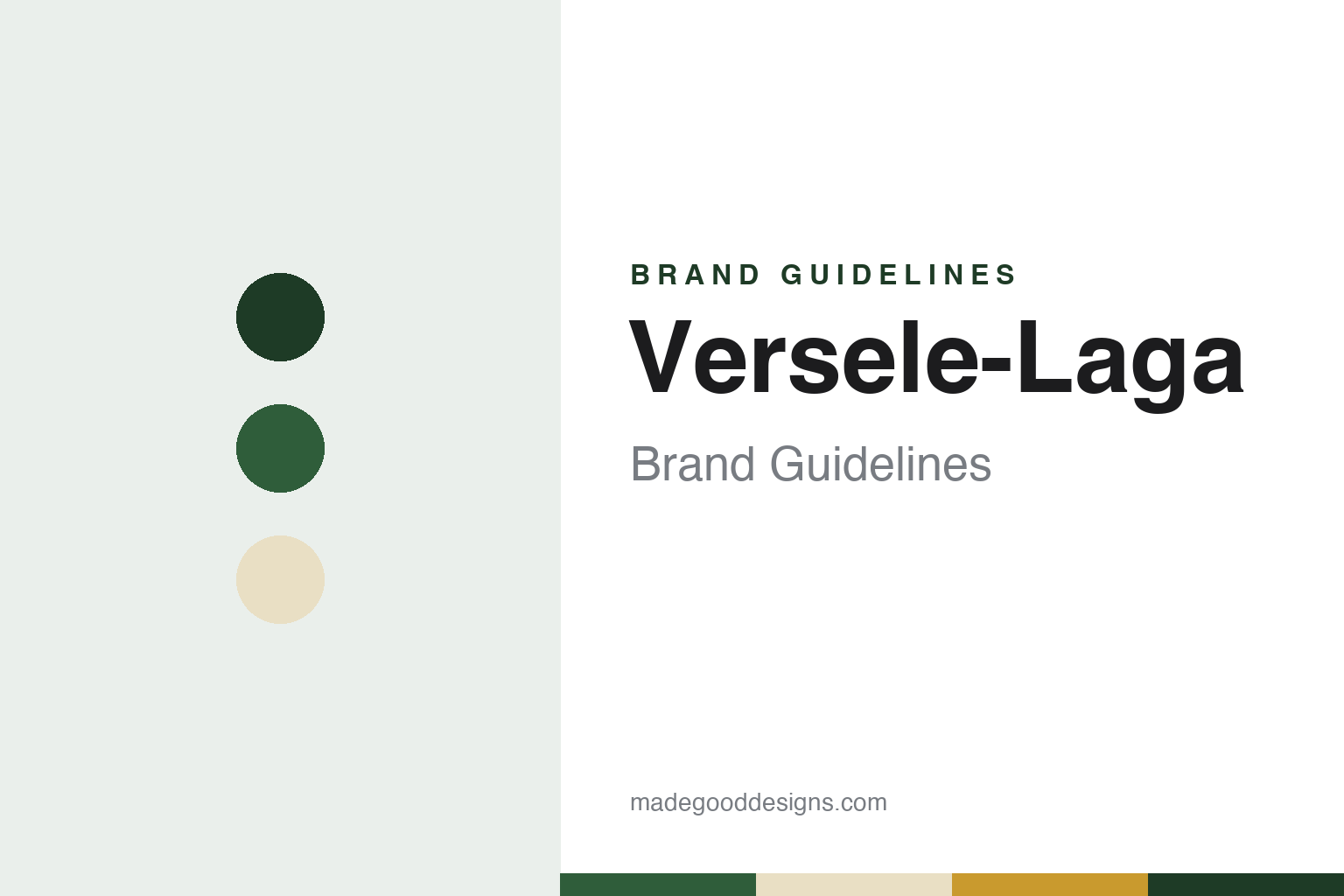
Versele-Laga Brand Guidelines
The Deinze family feed maker that became Versele.
Aa
Two constants: a green, straw and gold palette and a warm serif register. Abstract homage — not a Versele-Laga or Versele product or mark; no pack, logo or label is reproduced.
Astene
A grocery, a feed trade and a mill on the Leie.
Versele-Laga’s story begins in 1932 in Astene, a village on the river Leie that is now part of the town of Deinze in East Flanders. Dutch Wikipedia says Prudent Versele ran a garden restaurant and a grocery there and also sold compound feed for livestock, and that in 1937 he built a feed mill to make it. The company’s own website dates the business “ever since 1932,” and press coverage of its 2026 relaunch, in PET worldwide and Feed & Additive, describes it as founded that year by Prudent Versele and grown, over four generations, from a grocery shop in Deinze.
After the Second World War the second generation took charge, Dutch Wikipedia says; a first expansion followed in 1957, and in the mid-1960s the business merged with a feed mill in Hasselt. The name the company carried for six decades came in 1966, when, according to the same article, the Deinze firm merged with the factory of Joseph Laga-Houtekier and became Versele-Laga.
From the late 1960s the company followed the growth in pet keeping and began making food for birds, horses, rabbits and other animals as well as farm livestock. In 1981 a new pet-food factory was built on the other side of the Leie, Dutch Wikipedia says. The Belgian business magazine site De Rijkste Belgen described it in September 2016 as a fourth-generation family business owned by the Versele family that had moved from classic livestock feed towards pets; Dutch Wikipedia says it sits under the family holding company Heluca.
Colour
From livestock feed to pet aisles abroad.
The fourth generation took Versele-Laga abroad. Its route into North America was horses: Dutch Wikipedia says the company entered the market with its Cavalor horse feed, made at a site in Dalton, Georgia, giving the year as 2013, while De Rijkste Belgen reported in 2016 that it had run a horse-feed unit there since 2011.
Birds came next. Versele-Laga bought Goldenfeast, a Pennsylvania maker of mixes mainly for tropical birds, which also made feed for small furry pets; De Rijkste Belgen, writing in September 2016, dated the purchase to the previous year, while Dutch Wikipedia gives 2016 and places Goldenfeast in Phoenixville. The same 2016 report said Goldenfeast had recently added two blends for garden birds and that dog and cat food was planned under Versele-Laga’s supervision. Dutch Wikipedia adds a distribution centre in Montréal and, in 2018, the purchase of The Higgins Premium Pet Foods of Florida, citing the Belgian business daily De Tijd.
The company also narrowed its focus. In 2019, Dutch Wikipedia says, citing De Tijd, it sold Quartes, its feed business for livestock and small animals, with mills in Deinze, Hasselt and Roeselare, to the Dutch cooperative Agrifirm.
Its website lists Complete, Nature and Crispy for rabbits and rodents, beside bird ranges such as NutriBird, Prestige and Oropharma and the Cavalor horse line. On where its products are made, chief executive Francis D’Hoore told Feed & Additive in May 2026 that the company makes most of them “in our own factories in Belgium and beyond.”
Typography
Seed, hay and the specialist pet shop.
The seven brands in this group all make food, hay, treats or bedding for small pets and birds: Kaytee, Oxbow, Supreme Petfoods, Vitakraft, Burgess, carefresh and Versele-Laga. Brands like these sit at many different points in the pet trade, from family businesses that still carry a founder’s name to labels that now belong to much larger pet-products groups, and a single name can be sold everywhere from a supermarket shelf to a specialist pet shop.
A small-pet brand’s identity is usually carried less by a single product than by a pack, a name and a label, because the company behind the name may have changed hands, moved its production or grown far beyond the place where it started. That makes the questions behind each name worth asking plainly: who started it, who owns it now, and where its food and bedding are actually made.
Each guide separates what independent sources record from what the company says about itself — its founding story, its owners over time, where its products are made and how its packs and names have changed — and marks plainly what rests only on the company’s own word.
Aa
A warm serif for a family feed name. (Specimen set in Fraunces, a serif STAND-IN; NOT the Versele-Laga or Versele logo.)
Versele
One master brand over many category names.
In May 2026 the company announced that it would drop the double name. A press release dated 6 May, reported by PET worldwide, said the Belgian family business was adopting a single umbrella brand, Versele, while keeping and strengthening its category brands; Feed & Additive reported on 11 May that the new strategy would be presented at Interzoo in Nuremberg, the pet-trade fair held that month, where senior marketing manager Thomas Dewinter presented it to the press, according to PET worldwide. The old versele-laga.com address now forwards to versele.com.
The company has explained the change in its own words. Corporate brand manager Sarah Lanckman told GlobalPETS, in an article published in October 2026, that the aim was a “stronger, more recognizable consumer master brand that can support our growth across categories, markets and channels,” adding that “consumer recognition played an important role, but increasing awareness was the key driver.” She said the packaging approach “will also make sure the category brands remain clearly recognizable.” The same report says the company kept the core of its former name for continuity. Feed & Additive wrote that the family name stays central because of the company’s family roots, and Francis D’Hoore was quoted by PET worldwide as saying, “We turn scientific findings into practical, high-quality solutions for pets and their owners.”
The company’s headquarters remain in Deinze, the town where the business began, and its website still lists the Versele-Laga name among the brands it sells, beside the newer Versele mark.
For a design guide, Versele-Laga shows a family company moving its own surname to the front of the shelf while its category names do the everyday work. Compare Vitakraft, another family-founded European small-pet and bird brand, and Supreme Petfoods. For this guide we use a field green, straw and millet gold with a serif, an unofficial interpretation; no product or logo is reproduced.
Explore & save
Keep Versele-Laga’s identity on hand — save it to a board in the Made Good inspiration library.
Versele-Laga identity set
Pin the Versele-Laga green, straw and gold palette and the warm serif register to your own board.