smartwater Brand Guidelines
Glacéau’s vapour-distilled water, owned by Coca-Cola since 2007.
Aa
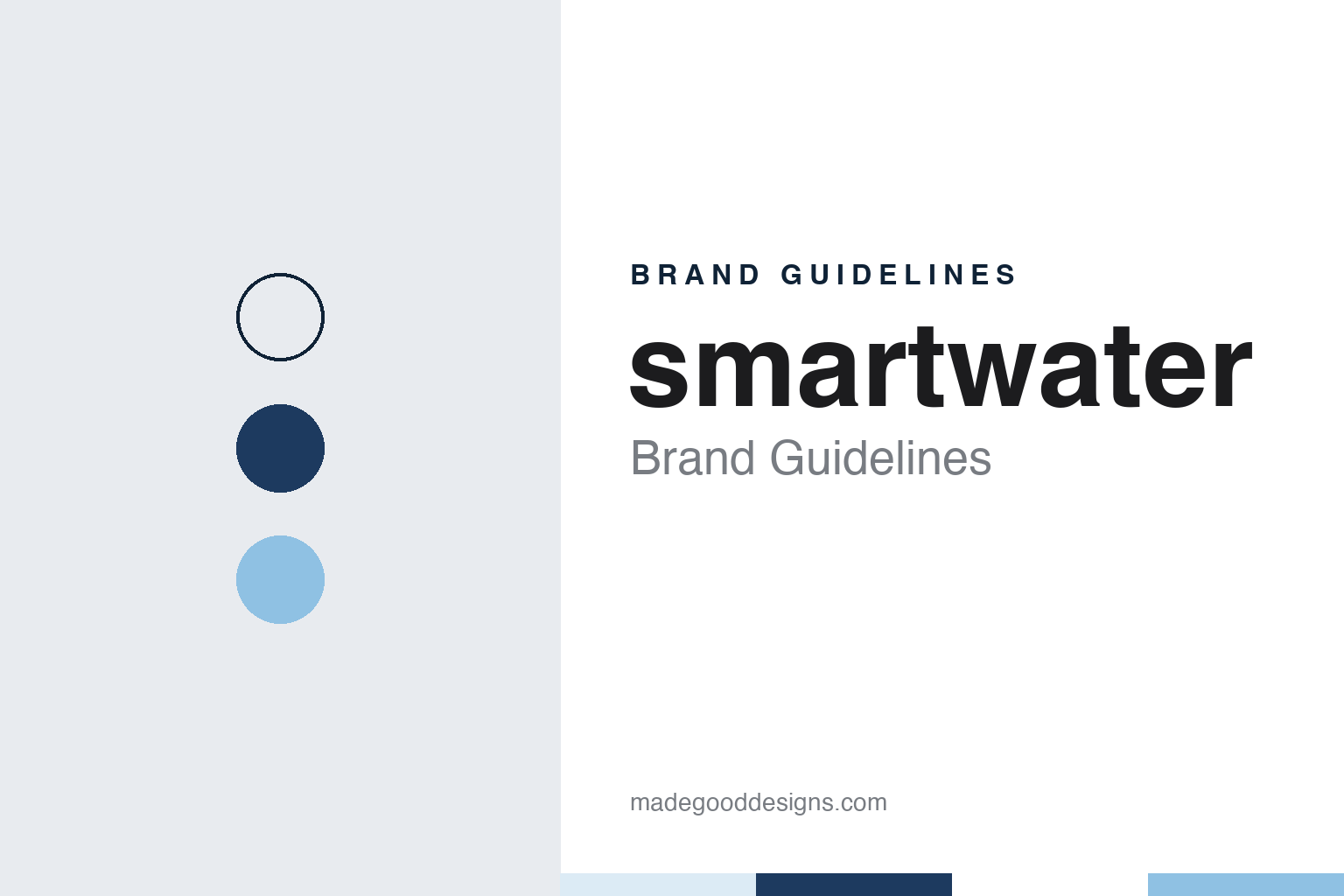
Two constants: a cloud white, sky blue and droplet navy palette and a clean grotesque sans register. Abstract homage — not a smartwater product or mark; no bottle, label or logo is reproduced.
A Queens start-up
One founder, a few natural-food shops and a water that came first.
smartwater — the brand writes its name in lower case, as one word — began as the first product of Energy Brands Inc., the company that trades as Glacéau. English Wikipedia’s article on Energy Brands says J. Darius Bikoff founded the Glacéau Water Co. in January 1994 and Energy Brands in May 1996, and that the first product the new company distributed was Glacéau smartwater. A 2003 interview with Bikoff in The Wall Street Transcript also gives 1996 as the founding year and places the company in Whitestone, Queens, in New York City. English Wikipedia’s separate article on the brand gives an earlier origin, saying it was introduced in 1990 as Glacier Mineral Water and took the smartwater name in 1998, so the sources do not agree on the very first years.
The launch was local. According to English Wikipedia, Bikoff, who had no background in drinks manufacturing, took smartwater himself to independent natural-food shops around New York, moved to a statewide launch once it sold, and then used the same route — small shops first, distributors later — for Fruitwater in 1998 and Vitaminwater in 2000. By 2001, the article says, the company’s drinks were stocked in more than 4,000 shops in the New York area, and national distribution followed in the early 2000s.
The water is defined by its process rather than by a spring. The Coca-Cola Company describes smartwater as vapour-distilled: the water is distilled and then calcium, magnesium and potassium salts are added back, which the company says is done for taste. English Wikipedia describes the same process. The tall, slim, clear bottle with a sports cap is the most recognisable part of the product, and English Wikipedia notes that the empty bottle has a following of its own among ultralight hikers, who reuse it because it is light, strong and compact.
Colour
Clouds, a droplet and a lower-case word.
smartwater’s look has been built from a small set of devices: white space, sky imagery and a single droplet. In January 2014 Packaging Digest reported a packaging refresh by the New York design firm Moxie, which added a fluid navy raindrop shape that ran across the shelf when bottles stood side by side, alongside a “cloud” lock-up. The company’s own release for a spring 2017 campaign again spoke of the “signature smartwater clouds.”
The current identity comes from Stockholm. In November 2022 the design site The Brand Identity published a refresh by the agency BVD, carried out under its “Simplify to Clarify” approach. BVD trimmed the supporting graphics, made what its design director Rikard Ahlberg called “tiny updates on the droplet shape that are not obvious,” and redrew the wordmark so that it locks up with the droplet instead of sitting behind it. The article names the typeface as Graphik, from the foundry Commercial Type, and says the arrangement gives more weight to “smart” than to “water.” The droplet now works as a variable device, carrying flavour colours or a material texture across the range, which by then included sparkling and flavoured variants.
Celebrity faces have carried the advertising. Jennifer Aniston became the brand’s ambassador in the late 2000s — English Wikipedia gives 2008, while the trade site MediaPost has said she signed in 2007 — and Coca-Cola’s release of April 2017 still called her a “longstanding” ambassador in a campaign made with the agency Chandelier Creative. English Wikipedia says Gal Gadot succeeded her in 2020, and in June 2022 the brand named Zendaya as its global ambassador, launching a campaign tied to improving water access, starting in her home city of Oakland, California.
Typography
Design and documentation.
The seven brands in this group are all bottled water names: Acqua Panna, Highland Spring, smartwater, San Benedetto, Poland Spring, Essentia and Buxton. Bottled water brands in general sit at many different points in the trade, from family companies that still run their own springs to labels that now belong to much larger drinks groups, and a single brand can be sold everywhere from a corner shop to a restaurant table.
A bottled water brand’s identity is usually carried less by the water itself than by a label, a name and the place it promises, because the company behind the name may have changed hands, added new sources or grown far beyond the place where it started. That makes the questions behind each name worth asking plainly: who started it, who owns it now, and where its water is actually sourced and bottled.
Each guide separates what independent sources record from what the company says about itself — its founding story, its owners over time, where its water is sourced and bottled and how its labels have changed — and marks plainly what rests only on the company’s own word.
Aa
A clean grotesque sans for a lower-case wordmark. (Specimen set in Inter Tight, a sans-serif STAND-IN; NOT the smartwater logo, which BVD set in Graphik.)
smartwater
A New York start-up inside a global drinks company.
Ownership changed in stages. English Wikipedia says Bikoff sold a 30 per cent stake to the luxury group LVMH, which later sold it on; the holding reached India’s Tata Group in August 2006. On 25 May 2007 The Coca-Cola Company announced an agreement to acquire Energy Brands — glacéau, with its vitaminwater, smartwater, fruitwater and vitaminenergy brands — in a release filed with the US Securities and Exchange Commission. Coca-Cola said the business would be run on a stand-alone basis, with Bikoff and senior managers Mike Repole and Mike Venuti staying on. Energy Brands remains a Coca-Cola subsidiary, and smartwater is sold under the Glacéau name in many markets.
Expansion abroad followed the sale. English Wikipedia says Glacéau launched its drinks in the United Kingdom and Australia in 2008, in France in 2009 and in Argentina in 2011, and lists smartwater in markets including Canada, Brazil, India, Singapore and the United Arab Emirates. The range later grew to sparkling and flavoured versions, and English Wikipedia records aluminium cans from 2024.
The brand’s marketing has also drawn criticism. In December 2018 the German consumer group foodwatch gave smartwater its “Goldener Windbeutel” award, decided by a public vote, for what it called misleading advertising of the vapour-distilled process; a Coca-Cola manager said in a statement outside its Berlin offices that the criticism was unjustified.
For a design guide, smartwater shows how a bottled water with no spring to picture can build an identity from a bottle shape, a droplet and a single typeface. Compare Aquarius, another Coca-Cola drink with its own look, and Essentia, another American bottled water sold on its process. For this guide we use cloud white, sky blue and a deep navy with a sans, an unofficial interpretation; no product or logo is reproduced.
Explore & save
Keep smartwater’s identity on hand — save it to a board in the Made Good inspiration library.
smartwater identity set
Pin the smartwater cloud white, sky blue and droplet navy palette and the clean grotesque sans register to your own board.