Cazadores Brand Guidelines
An Arandas tequila sold under a stag since the 1970s.
Aa
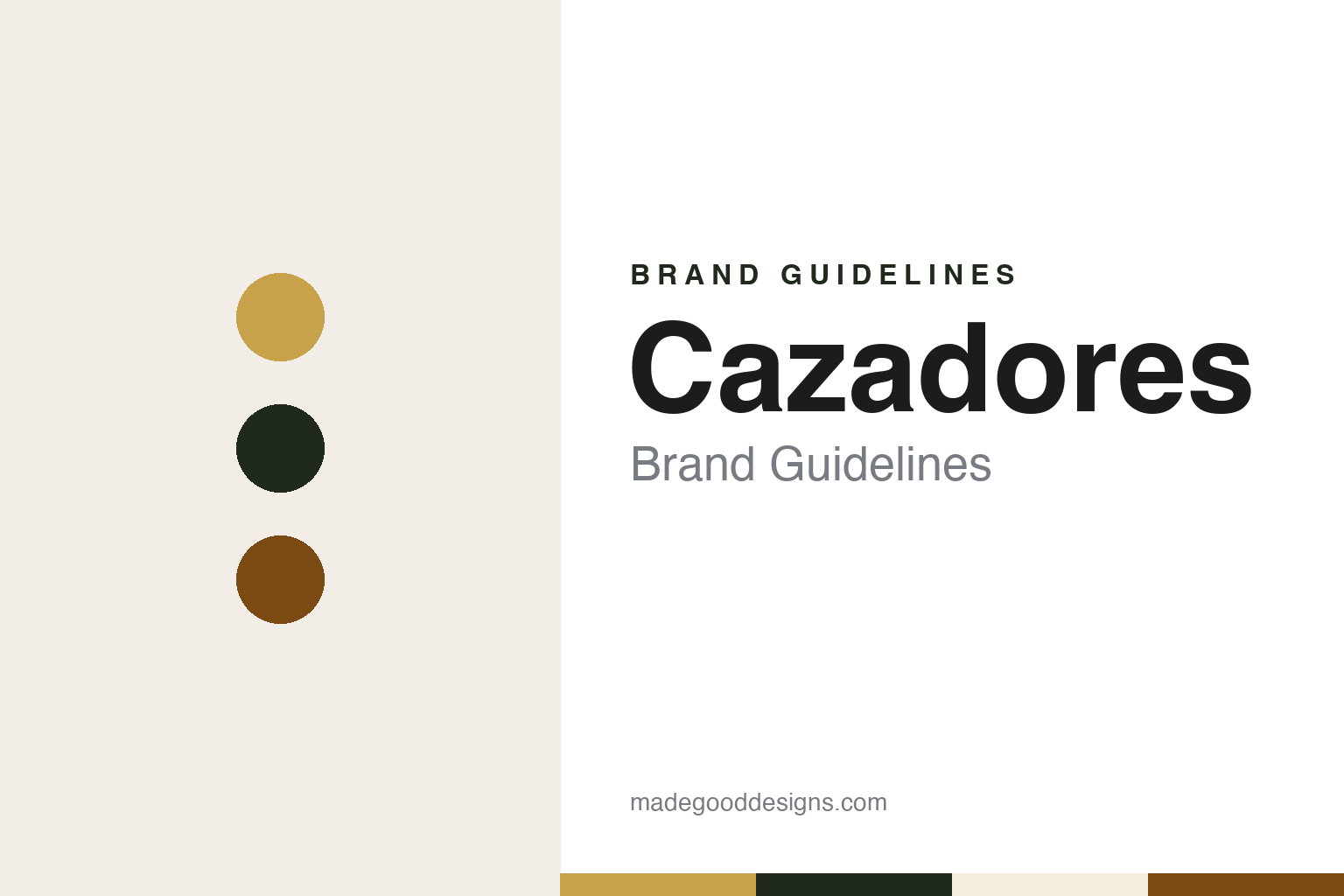
Two constants: a reposado amber, barrel brown and highland green palette and a high-contrast display serif register. Abstract homage — not a Cazadores product or mark; no label, logo or bottle is reproduced.
A family recipe from Los Altos
From a highland farm to a distillery of its own.
Cazadores is a tequila made from 100% blue Weber agave in Arandas, a highland town in the Los Altos region of Jalisco, Mexico. The brand’s current website tells its origin as a family story: it says it “all started with just one hard-working visionary in 1922 in the sun-kissed highlands of Jalisco,” that the recipe was passed down by word of mouth, and that the founder’s grandson opened a distillery in the early 1970s. An archived 2007 version of the company site names that founder only as a farmer called José María, who, the story goes, kept his recipe in a small wooden box hidden in the adobe walls of his farm.
The dates the company itself gives for the business are more modest than the legend. The English “About” page of the Cazadores website, as archived in November 2000, said production of Tequila Cazadores began in 1973, when the founding family made tequila only for private consumption and its business was milk candies and cattle raising. The same page said it was not until 1982 that the family took a business view of tequila and started a small industrial mill. By 2000, the company said, Cazadores was producing about 11 million litres a year and was aiming for 18 million. The 2007 site likewise dates the opening of a new distillery to 1973.
The family’s setting matters to the brand. The company’s 2000 history page described Arandas as enclosed by Los Altos, the highland region of eastern Jalisco, and English Wikipedia’s article on Arandas lists Cazadores among the tequilas the town is best known for exporting, alongside Centinela, Carrera and Tapatío. The brand now describes its values as born from “our 100-year history of agave care and craftsmanship,” and says it sources its blue Weber agave from local farmers in Jalisco.
Ownership moved outside the family in the 2000s. French Wikipedia describes the brand as held by Bacardi Limited, the family-owned spirits group headquartered in Hamilton, Bermuda, and English Wikipedia lists Cazadores in Bacardi’s tequila portfolio alongside Patrón, Corzo and Camino Real. Italian Wikipedia dates Bacardi’s acquisition of Cazadores to 2002. In the United States the brand’s site names its importer as Tequila Cazadores U.S.A., of Coral Gables, Florida.
Colour
A hunter’s name and a stag in the agave.
The name and the emblem tell the same story. Cazadores is Spanish for “the hunters,” and the company says the name refers to a journey and to the stags that ran through the agave fields. The archived 2007 site said José María loved watching deer move through his fields at night, and that a deer was placed on the label because to him the animals stood for boldness, perseverance and pride. Today the brand describes the stag as “a symbol of knowledge, wisdom, and confidence.” The deer is a registered element of the identity: the brand’s current site lists Cazadores, its trade dress and “the deer logo” as trademarks.
For years the company turned the emblem into a call to order. The 2007 website closed its history with the line “The One With The Deer On It.” The same site illustrated its timeline with agave fields, stacked barrels and the deer “standing proud.”
The production story is told in the company’s own words. Cazadores says it uses nothing but blue Weber agave, follows a seven-step process that runs from double distillation to maturation, and extracts most of the raw agave juice through a diffusion process rather than cooking the agave first. It also says that during fermentation it plays Mozart to the yeast, presenting the idea as its own theory, and describes a production process that it says creates zero waste. The 2000 site, by contrast, spoke of pressure autoclaves, stainless-steel equipment and white-oak barrels for ageing.
The company has long leaned on awards in its storytelling. Its 2000 site said that in 1990 Tequila Cazadores won a “Golden Star” for international quality in Madrid and a “Grand America” prize for quality and service in the same year.
Typography
Design and documentation.
The seven brands in this group are all tequila and liqueur names: Casa Noble, Clase Azul, 1800, Hornitos, Cazadores, Corralejo and RumChata. Tequila and liqueur brands in general sit at many different points in the trade, from family houses that still carry a founder’s name to labels that now belong to much larger drinks groups, and a single brand can be sold everywhere from a corner shop to a cocktail bar.
A tequila or liqueur brand’s identity is usually carried less by a single bottle than by a label, a name and the place it promises, because the company behind the name may have changed hands, moved its production or grown far beyond the place where it started. That makes the questions behind each name worth asking plainly: who started it, who owns it now, and where its spirit is actually made and bottled.
Each guide separates what independent sources record from what the company says about itself — its founding story, its owners over time, where its spirit is made and how its labels have changed — and marks plainly what rests only on the company’s own word.
Aa
A high-contrast display serif for a heritage tequila label. (Specimen set in Playfair Display, a serif STAND-IN; NOT the Cazadores logo.)
Cazadores
A highland brand inside a global spirits group.
Inside Bacardi, Cazadores sits beside a very different tequila. Patrón joined the group in 2018, Les Echos reported that year, while Cazadores has kept its stag and its highland family story. The group’s portfolio also includes the Corzo and Camino Real tequilas, English Wikipedia notes, so Cazadores is one of several agave brands under the same owner.
The Arandas setting places Cazadores in the highland side of tequila country, in the same town as several other exported brands, while the town of Tequila itself is home to houses such as José Cuervo. The brand’s own description of its agave as coming from local farmers in Jalisco keeps that geography in the foreground.
The name needs a little care online. Cazador and Cazadores are everyday Spanish words for hunters and appear in the names of a Chilean army brigade, songs, films and ships, so searches return far more than tequila; the brand’s own site is cazadores.com.
For a design guide, Cazadores shows how a single animal and a short line of family history can carry a tequila from a highland town to bars far beyond Jalisco. Compare Patrón, its Bacardi stablemate, and Hornitos, another tequila in this series. For this guide we use reposado amber, barrel brown and highland green with a serif, an unofficial interpretation; no product or logo is reproduced.
Explore & save
Keep Cazadores’s identity on hand — save it to a board in the Made Good inspiration library.
Cazadores identity set
Pin the Cazadores reposado amber, barrel brown and highland green palette and the high-contrast display serif register to your own board.