José Cuervo Brand Guidelines
The tequila house from the town of Tequila.
Aa
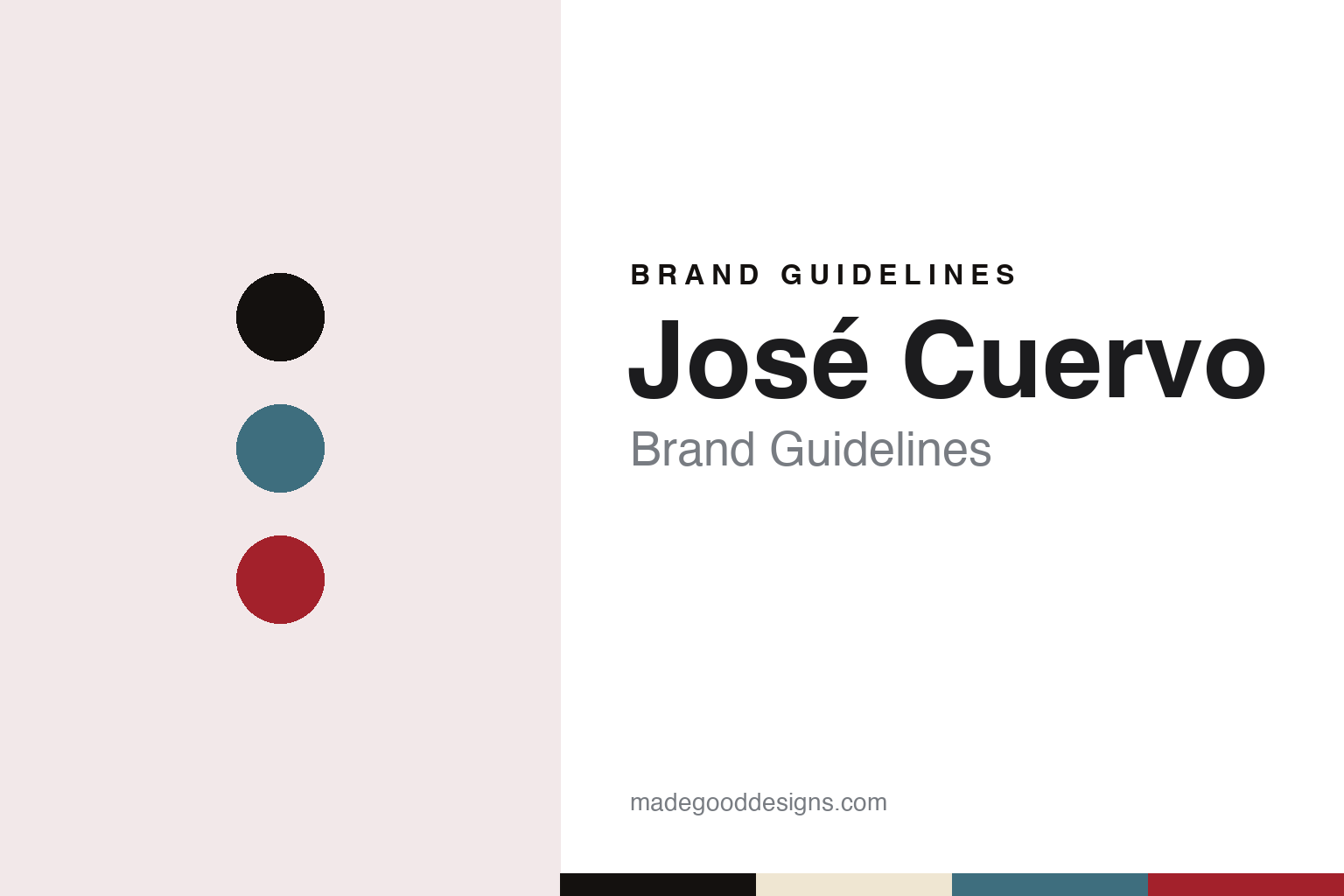
Two constants: a José Cuervo black, agave blue and red palette and a heritage serif register. Abstract homage — not a José Cuervo product or mark; no bottle, label or crest is reproduced.
Taberna de Cuervo
A land grant, a licence and a distillery in Tequila.
José Cuervo dates its story to 1758, when, the company says, José Antonio de Cuervo y Valdés received a writ of land ownership from King Ferdinand VI of Spain to plant agave near the town of Tequila, in what is now the Mexican state of Jalisco. Spanish Wikipedia describes him as the steward of a local religious brotherhood and the owner of a plot called the Solar de las Ánimas, where he began growing agave and making and selling “vino mezcal,” as the spirit was then called. His sons later acquired land known as the Hacienda de Abajo, where the Taberna de Cuervo was set up.
The date the brand treats as its founding is 1795. That year, the company says, King Charles IV issued a royal decree to José María Guadalupe de Cuervo y Montaño, which it calls the “first license to produce and distribute tequila.” Spanish Wikipedia gives a different account: it calls the 1795 permit the second licence to make vino de mezcal, after one granted by royal decree in 1764 to the third Marqués de Jaral. Spanish Wikipedia gives the founding date as 27 May 1795.
In 1812, the company says, it founded La Rojeña in the centre of Tequila, and it describes the site as “the oldest active distillery in Latin America”; the trade magazine Industry Today made the same claim in 2003. Accounts of the distillery’s nineteenth-century names differ between the English and Spanish Wikipedia articles, but both say that a later manager, Jesús Flores, was early in putting the spirit into bottles rather than only barrels. The company says José Cuervo barrels reached California from the port of San Blas in 1852, and that in 1880 it became the first tequila brand to bottle tequila individually, which made it easier to ship within Mexico and across the border.
Colour
From the Cuervo name to the Beckmann family.
The name on the bottle became fixed at the start of the twentieth century. In 1900, English Wikipedia says, Ana González Rubio, who had inherited the distillery, married José Cuervo Labastida, who renamed it La Rojeña and was the first to call the tequila made there Jose Cuervo. The estate passed in 1934 to her niece, Guadalupe Gallardo, and in 1966 to Guadalupe’s sister, Virginia Gallardo, whose son Juan Beckmann Gallardo came to run the business, English Wikipedia says, citing a company history. Spanish Wikipedia says that from 1972, under Juan Beckmann, the company pushed exports to the United States and then on a large scale to Europe.
Outside investors arrived later. In 1989 the Beckmann family sold 45% of Jose Cuervo to International Distillers and Vintners, part of Grand Metropolitan, The New York Times reported in 1996. When Grand Metropolitan merged with Guinness in 1997 to form Diageo, the new group became Cuervo’s main distributor outside Mexico. Diageo held talks to buy the business outright from 2011, but in December 2012 it announced that the talks had ended, The Guardian and The Independent reported.
The family then built its own distribution. Proximo Spirits, which the company says it set up in 2007, took over Jose Cuervo’s distribution in the United States from Diageo on 1 July 2013, Adweek reported at the time, calling Cuervo the world’s largest-selling tequila brand. The company says its shareholders approved a merger with Sunrise Holdings, Proximo’s parent, in 2016, and that the group held an initial public offering on the Mexican Stock Exchange in 2017. Its legal name is Becle, S.A.B. de C.V., and its shares trade under the ticker CUERVO, Spanish Wikipedia says. According to the company, the group has also added Maestro Dobel in 2005, the Old Bushmills Distillery in Northern Ireland in 2015 and the Pendleton whisky brand in 2018. Juan Domingo Beckmann, described by the drinks writer William M. Dowd in 2008 as the sixth generation to lead the company, is its chief executive, Spanish Wikipedia says.
Typography
Design and documentation.
The seven brands in this group are all spirit names from Mexico, France, Greece and Spain: José Cuervo, Patrón, Ricard, Pernod, Metaxa, Ouzo 12 and Licor 43. Spirit brands in general sit at many different points in the trade, from family firms that still carry a founder’s name to names that now belong to much larger drinks groups, and a single brand can be sold everywhere from a neighbourhood bar to a duty-free shelf.
A spirit brand’s identity is usually carried less by a single bottle than by a label, a name and the drink or ritual it promises, because the company behind the name may have changed hands, moved its production or grown far beyond the place where it started. That makes the questions behind each name worth asking plainly: who started it, who owns it now, and where its spirits are actually made and bottled.
Each guide separates what independent sources record from what the company says about itself — its founding story, its owners over time, where its spirits are made and how its bottles and advertising have changed — and marks plainly what rests only on the company’s own word.
Aa
A heritage serif for a house that dates itself to 1795. (Specimen set in Playfair Display, a serif STAND-IN; NOT the José Cuervo logo.)
José Cuervo
A crow, an agave and a branding iron.
The brand’s emblem is a family crest. English Wikipedia, citing the company’s history page, describes it as combining a crow — “cuervo” means crow in Spanish — a blue agave plant and the branding iron of the Hacienda Solar de las Ánimas. The range is built in tiers: Especial, sold in silver and gold versions; Tradicional, which the company presents as 100% agave; and Reserva de la Familia, introduced in 1995 for the bicentenary of the 1795 licence, The New York Times reported in 1996. The tequila is made in the town of Tequila, the Wall Street Journal and Bloomberg reported in 2012 and 2011, and the Jose Cuervo Express, a tourist train from Guadalajara to Tequila that ends with a tour of La Rojeña, opened in February 2012, Nearshore Americas reported.
The brand has a long record in music and sport. Steely Dan named “the Cuervo Gold” in “Hey Nineteen” on the 1980 album Gaucho. Cindy Jordan, who had appeared as a poster girl for the brand, wrote the song “Jose Cuervo,” which Shelly West took to number one on Billboard’s country chart in 1983, the Seguin Gazette-Enterprise reported in 1988. In 1979, English Wikipedia says, Cuervo became beach volleyball’s first major sponsor; IMG and USA Volleyball ran a Jose Cuervo Pro Beach Volleyball Series in 2011 and 2012, ESPN and the Los Angeles Times reported. An Especial campaign starring Kiefer Sutherland ran in 2013, Adweek reported. The UFC named Cuervo its first official tequila partner in 2021, and in February 2026 NASCAR announced a multiyear partnership naming Cuervo its official tequila, according to the two organisations.
For a design guide, José Cuervo shows how a family crest, a town name and a founding date can carry a mass-market brand across more than two centuries. Compare Patrón, a tequila brand from the Jalisco Highlands launched in 1989, and Cholula, another Jalisco name; our note on the José Cuervo font looks at the lettering. For this guide we use black, agave blue and a deep red with a serif, an unofficial interpretation; no product or logo is reproduced.
Explore & save
Keep José Cuervo’s identity on hand — save it to a board in the Made Good inspiration library.
José Cuervo identity set
Pin the José Cuervo black, agave blue and red palette and the heritage serif register to your own board.