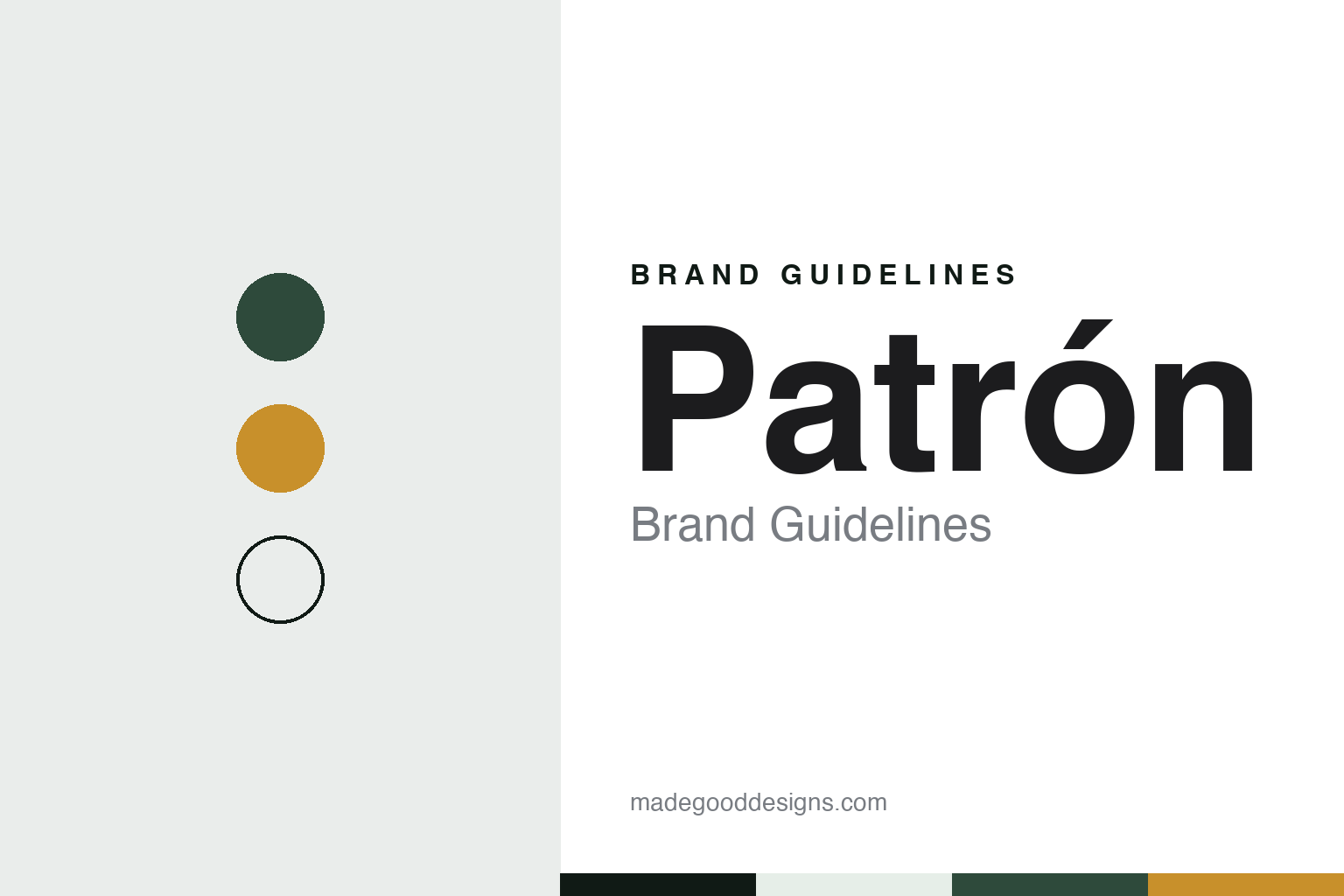
Patrón Brand Guidelines
The 1989 tequila brand from the Jalisco Highlands.
Aa
Two constants: a Patrón green, amber and glass palette and a classical capitals register. Abstract homage — not a Patrón product or mark; no bottle, bee or label is reproduced.
St. Maarten Spirits
Two Americans, a tequila and a launch by word of mouth.
Patrón is a young name in an old category. The company dates its beginnings to 1989, and its founders were two Americans: John Paul DeJoria, who had co-founded the hair-care company John Paul Mitchell Systems, and Martin Crowley. According to the drinks writer Mark Spivak’s book Iconic Spirits (Lyons Press, 2012), the pair bought the rights to the brand in 1989 through their company, St. Maarten Spirits. English Wikipedia says the original Patrón tequila was made by Casa 7 Leguas, one of Mexico’s older distilleries, and Spivak writes that production moved to a new distillery in 2002.
The launch was deliberately small. DeJoria told CNBC in 2023 that the tequila was first sold in the United States as an ultra-premium spirit, handed out to restaurants and friends so that it would spread by word of mouth. The business was run as the Patrón Spirits Company, which Spanish Wikipedia places in Las Vegas, Nevada; English Wikipedia says that Ed Brown, a former Seagram executive, became chief executive in 2000.
The tequila itself has always been Mexican. Bacardi, the brand’s owner today, says Patrón is “still exclusively produced in the Highlands of Jalisco” at Hacienda Patrón in Atotonilco el Alto, which it calls the brand’s “hometown.” The brand says its tequila is made with 100% Blue Weber agave, and its website footer reads “Handcrafted in Mexico.” Its homepage gives the brand’s formula as “Agave, Water, & Time,” and says that “crafting premium tequila takes time” and that Patrón uses “time-tested methods.”
Colour
A stone wheel, a numbered bottle and a bee.
The brand’s account of how it makes its tequila is a story of slowness. On its website, Patrón says the agave hearts, or piñas, are baked and then crushed by a two-ton volcanic stone tahona wheel and by a roller mill, and it claims to have “more working Tahonas than any other tequila producer in the world.” These are the company’s own claims. Bacardi’s brand page adds that the company’s “glass artisans measure and mold” the bottles, and Patrón says its stoppers are made of Portuguese cork.
The bottle has been central to the brand from the start. Spivak describes Patrón as following the playbook of Grey Goose vodka: it presented itself as a premium spirit and signalled taste through individually numbered glass bottles, aimed at drinkers in nightclubs and fashionable bars who might otherwise order vodka. Spanish Wikipedia describes the bottles as hand-blown and individually numbered. The brand’s mark is a bee, which the website lists as a trademark alongside the Patrón name.
The range grew from three core tequilas — Silver, Reposado and Añejo — into higher-priced and flavoured lines. English Wikipedia lists Gran Patrón Platinum, Gran Patrón Burdeos and Gran Patrón Piedra; Burdeos was reported by Duty Free News International in March 2007 as a new luxury tequila intended to drive exports. There is also a Roca Patrón line, the coffee-flavoured Patrón XO Cafe and an orange liqueur called Patrón Citrónge. Spivak credits much of the brand’s fame to repeated mentions in hip-hop and country songs, by the rapper Lil Jon in particular, which he says made Patrón a fixture of popular culture.
Typography
Design and documentation.
The seven brands in this group are all spirit names from Mexico, France, Greece and Spain: José Cuervo, Patrón, Ricard, Pernod, Metaxa, Ouzo 12 and Licor 43. Spirit brands in general sit at many different points in the trade, from family firms that still carry a founder’s name to names that now belong to much larger drinks groups, and a single brand can be sold everywhere from a neighbourhood bar to a duty-free shelf.
A spirit brand’s identity is usually carried less by a single bottle than by a label, a name and the drink or ritual it promises, because the company behind the name may have changed hands, moved its production or grown far beyond the place where it started. That makes the questions behind each name worth asking plainly: who started it, who owns it now, and where its spirits are actually made and bottled.
Each guide separates what independent sources record from what the company says about itself — its founding story, its owners over time, where its spirits are made and how its bottles and advertising have changed — and marks plainly what rests only on the company’s own word.
Aa
Classical capitals for a brand that sells itself on its bottle. (Specimen set in Cinzel, a serif STAND-IN; NOT the Patrón logo.)
Patrón
From St. Maarten Spirits to Bacardi.
The brand changed hands in 2018. On 22 and 23 January that year, CNBC and Reuters reported that Bacardi, the family-owned spirits group, had agreed to buy the Patrón Spirits Company, and the food-industry site FoodBev reported the purchase on 23 January. Patrón now sits in Bacardi’s portfolio beside rum, vodka, gin, whisky and other tequila brands, and the Patrón website points to Bacardi for careers and accessibility. Its website still names the Patrón Spirits Company as the importer. English Wikipedia’s article on Bacardi lists Patrón among its tequilas alongside Cazadores, Corzo and Camino Real, and Patrón Citrónge among its liqueurs.
Two other projects carry the Patrón name: a railroad car and a film. DeJoria owns the Patrón Tequila Express, a private railroad car built in 1927 and once used by the Gulf, Mobile and Ohio Railroad as Car No. 50, which the brand described in 2016; he bought it in 1996 and had it renovated, with three staterooms, a dining room and an observation lounge, the Wall Street Journal reported in 2018. English Wikipedia also says DeJoria narrated and appeared in television commercials for Patrón in November 2011. More recently the brand has made a short film, The Perfect Pour, with the Mexican director Guillermo del Toro, and promotes it on its website with the line that both director and tequila were “born in Jalisco.”
For a design guide, Patrón shows how a bottle and a single symbol can make a young brand look established. Compare José Cuervo, a Jalisco tequila house that dates itself to 1795, and Bacardi, Patrón’s owner since 2018; our note on the Patrón font looks at the lettering. For this guide we use deep green, amber and pale glass with a serif, an unofficial interpretation; no product or logo is reproduced.
Explore & save
Keep Patrón’s identity on hand — save it to a board in the Made Good inspiration library.
Patrón identity set
Pin the Patrón green, amber and glass palette and the classical capitals register to your own board.